

Managing local content across franchises and business locations wears people down. Every location page needs its own SEO-optimized content, something locally relevant that still sounds like your brand, and there might be a few hundred of them. The old fix never really scaled: headquarters coordinating with location managers, quality checks piling up, launch dates slipping past deadline by months on end. It rarely worked.
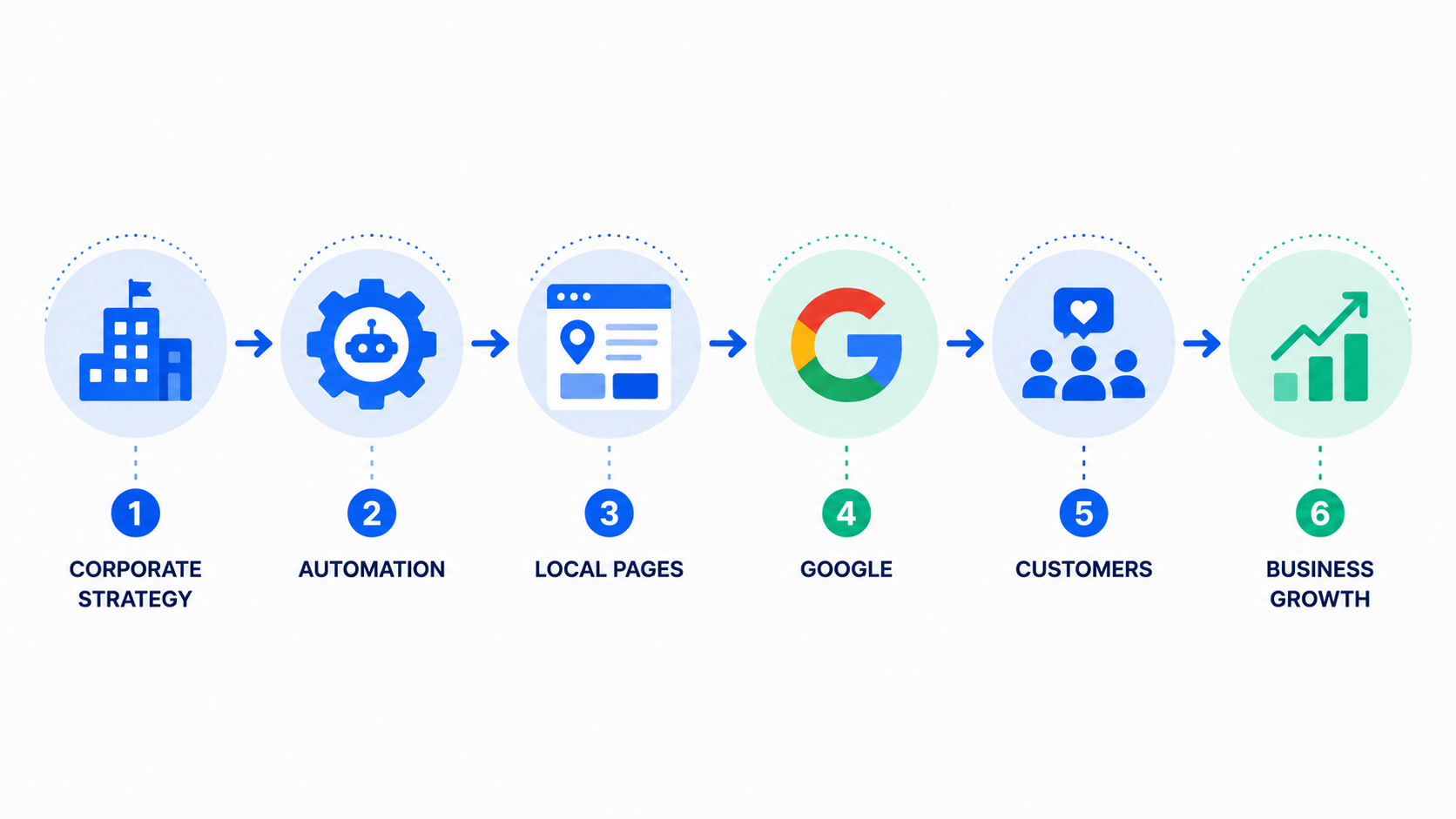
Automation changes the math. Pair AI with a proven content platform and you can cut manual work by up to 80%, holding brand consistency and local relevance steady across every market at once. Instead of asking each location manager to write their own content, you centralize the strategy, build smart templates, and let the system do the repetitive work. So a marketing team of a handful of people runs content operations for hundreds of locations, work that used to demand far more headcount.
This guide is a field-tested playbook. You’ll get the exact strategies, tools, and workflows enterprises use to grow their local digital presence without growing their teams at the same pace. Franchise with 50 locations, or a multi-unit chain running 500+? The framework holds either way: compete in local search while keeping the consistency and compliance your brand demands.

Understanding Local Content Automation for Multi-Location Businesses
Here’s what local content automation actually does. It uses AI, smart templates, and automation platforms to generate location-specific content, manage local listings, and optimize pages for many business locations from one central hub. Individual managers stop writing content in isolation. Headquarters sets the templates, brand guidelines, and content rules once, and the system applies them to each location’s own data automatically.
Don’t confuse this with global marketing automation. That world revolves around customer journeys, email campaigns, lead nurturing. Local content automation solves something else entirely: keeping dozens or hundreds of location pages alive, each one ranking in its own market while carrying the parent brand’s identity and values. A pizza franchise with 300 locations across multiple states can’t hand-write unique, SEO-optimized content for 300 separate websites. Nobody has that kind of time. The system generates content that fits each place, pulling from location-specific variables like address, phone number, service area, local testimonials, and community events.
How Local Content Automation Differs From Manual Management
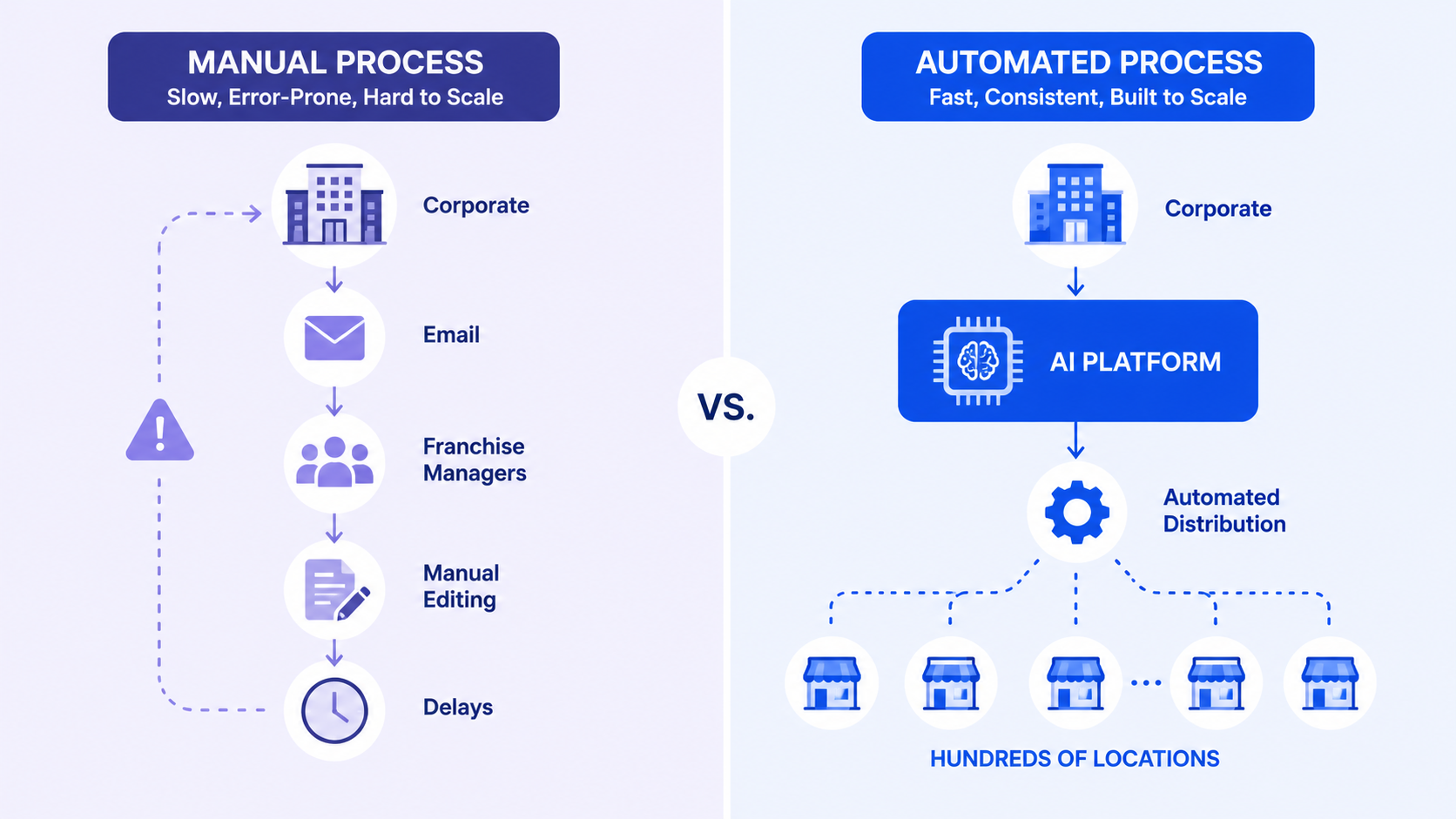
Manual and automated approaches barely resemble each other. Manual work is reactive, slow, and produces uneven results every single time. Watch the cycle: headquarters ships templates to location managers, waits on submissions, reviews the variations that come back, asks for revisions, finally publishes. Weeks per location. Then brand guidelines shift, and you’re coordinating a re-publish across every location, crossing your fingers that managers actually make the changes. At scale, it falls apart.
Automation flips the whole thing. The system generates content, checks it against compliance rules, and publishes everywhere in hours. Corporate guidelines change, whether that’s a new brand voice, updated service offerings, or a seasonal promotion, and every location updates at the same moment. Nobody has to coordinate. Nothing waits. Location-to-location drift disappears.
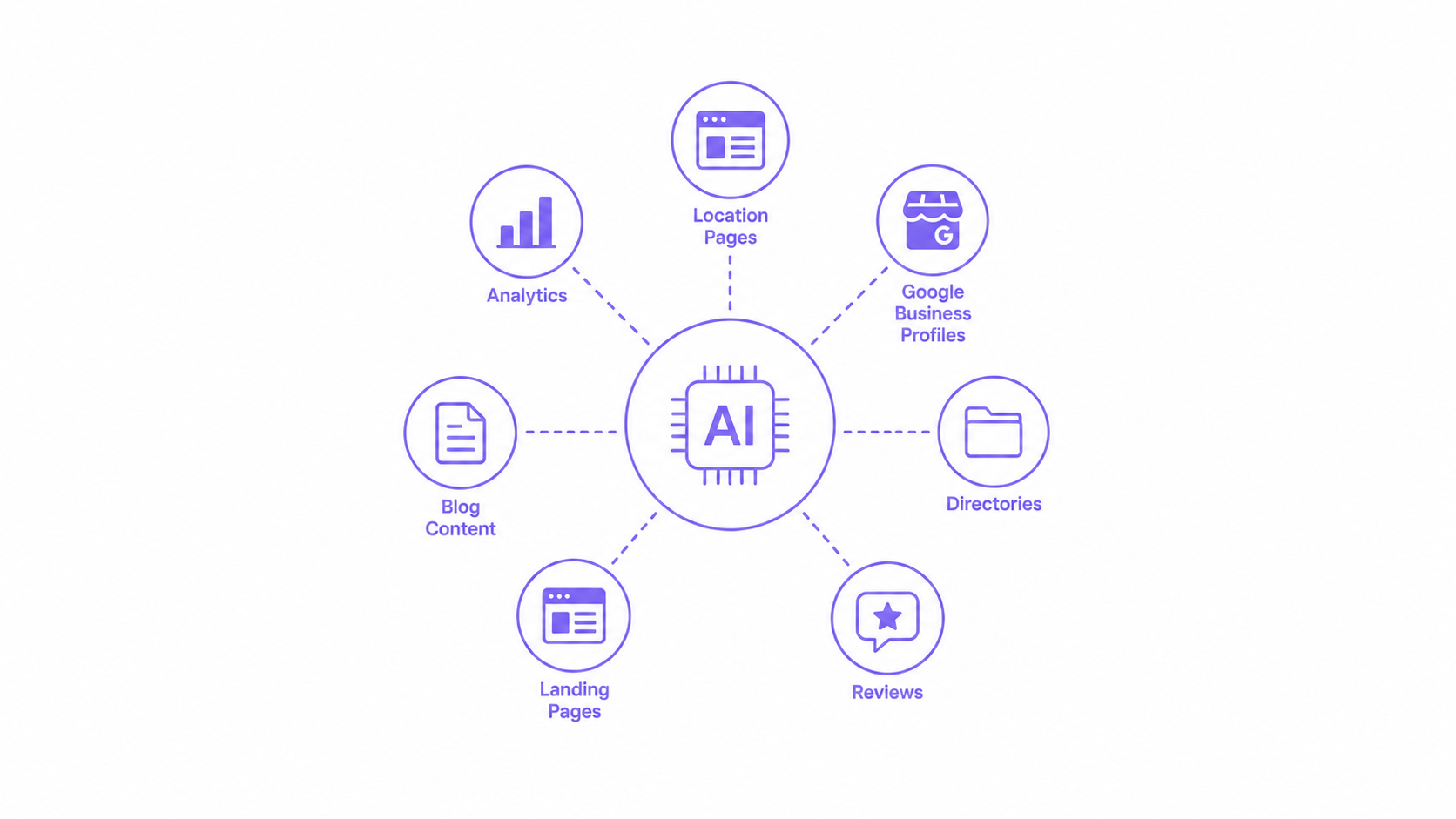
These platforms plug into the systems you already run: your CMS, your Google Business Profile tools, your listing distribution networks. That connection kills manual data entry and keeps everything in sync. Change an address once in your headquarters system and it propagates automatically. Location website, Google Business Profile, directories, review platforms. All current, no chasing anyone down.
Why Local Content Automation Is Critical for Franchises and Multi-Location Chains
Franchises carry a competitive burden most businesses never face. They have to rank locally across dozens or hundreds of separate markets at the same time, all while holding strict brand consistency and legal compliance at every single location. Local relevance pulling one way, global consistency pulling the other. That tension is exactly why automation stopped being optional.
Local search is where the customer’s journey begins. Someone needs a service and types “pizza near me,” “dentist in Boston,” “best coffee shop downtown.” Weak local SEO, and even a big well-funded brand bleeds customers to scrappy local competitors. Every location needs an optimized Google Business Profile, a unique location page with real content, and consistent listings across the review platforms and directories that matter.
Now scale it. Picture a 200-unit franchise. That’s unique, SEO-optimized content for 200 location pages, 200 Google Business Profiles to manage, listings pushed across 15+ platforms per location, and constant updates as promotions, staff, and services turn over. Lean on location managers whose SEO knowledge ranges all over the map and the results scatter. A few locations rank well and pull steady traffic. Others sit on page 3 and never convert. And some turn into outright liabilities, carrying outdated information, poor reviews, and broken listings that chip away at your brand reputation. This is where most networks quietly lose ground.
The Impact on Franchisees and Location Managers
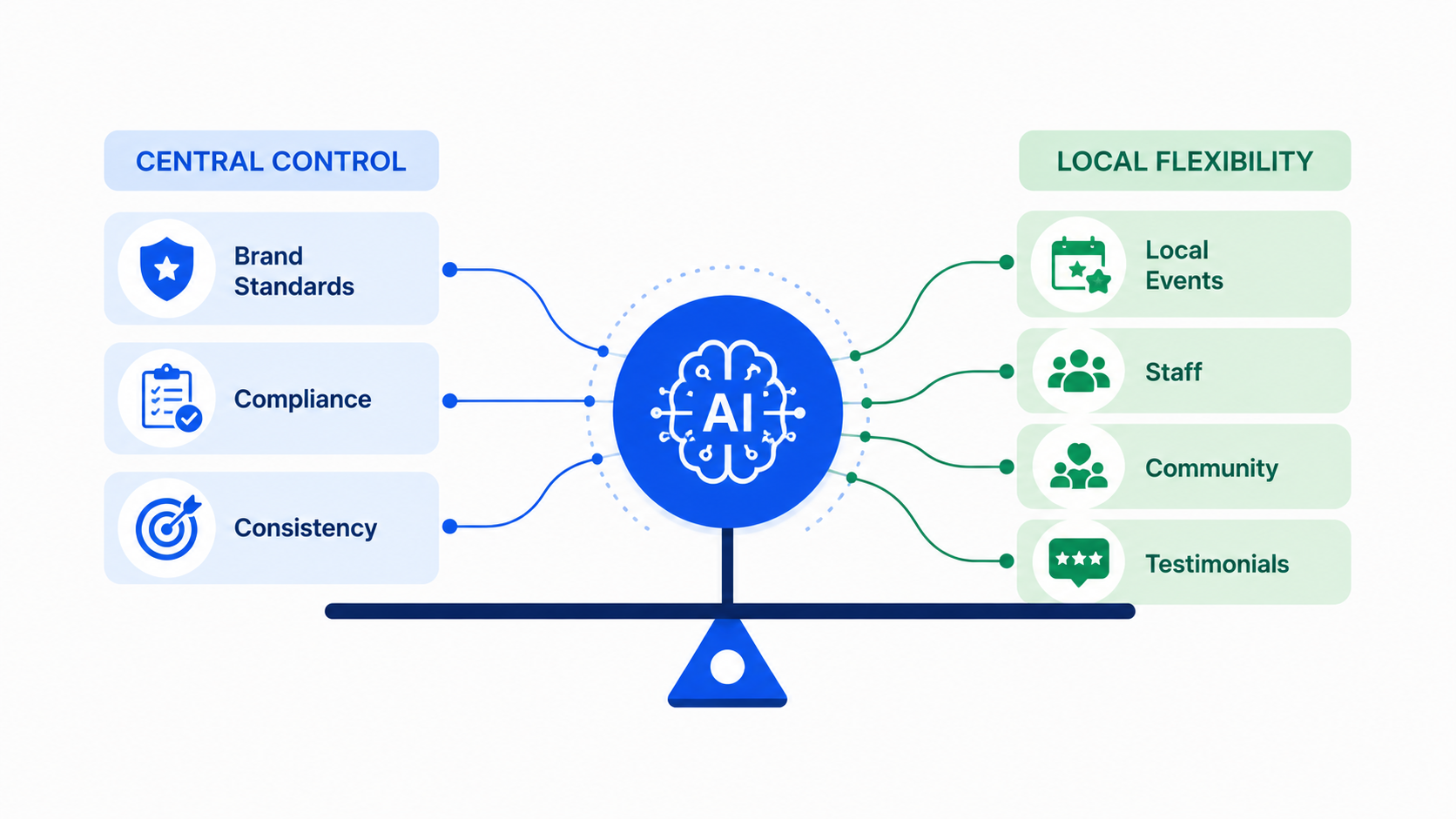
Franchises add another layer. Franchise agreements usually come with strict brand compliance requirements. Approved logos, approved language, approved brand elements, corporate wants uniformity. But franchisees run on limited resources and thin marketing expertise. They also want room to highlight a community award, add staff photos, tweak their service mix. Corporate control on one side, local autonomy on the other, and the two grind against each other constantly.
Automation clears the bottleneck. The marketing team sets the content strategy one time, defining what information is required, how far locations can customize, and which compliance guardrails don’t move, and the system generates and publishes across the whole network. Centralized control, local flexibility, both at once. Headquarters holds the brand voice and compliance line while individual locations layer in local events, testimonials, or service variations inside approved boundaries.
Franchisees come out ahead. The platform absorbs the heavy lifting of content creation and optimization and enforces brand standards while it does. A franchisee can pour their attention into operations and customer experience, and their digital presence still stays competitive and compliant. Both sides win: headquarters gets consistency and compliance, franchisees get a professional digital presence without needing an SEO background.
Measurable Business Impact
Automate local content well and the gains show up on a predictable curve. Local search visibility climbs 40-60% inside 3-6 months for most, which means more locations landing in the local pack and surfacing on relevant geographic searches. Local conversion rates tend to rise 25-35% as pages get more tailored and relevant to nearby searchers. And here’s the one that gets overlooked: listing inaccuracies and outdated information drop 15-25%, which lifts customer experience directly and quiets the flood of calls about wrong hours or dead phone numbers. Content that’s data-driven and consistently optimized earns each location more visibility while local staff do far less.
How Multi-Location Content Automation Works in Practice
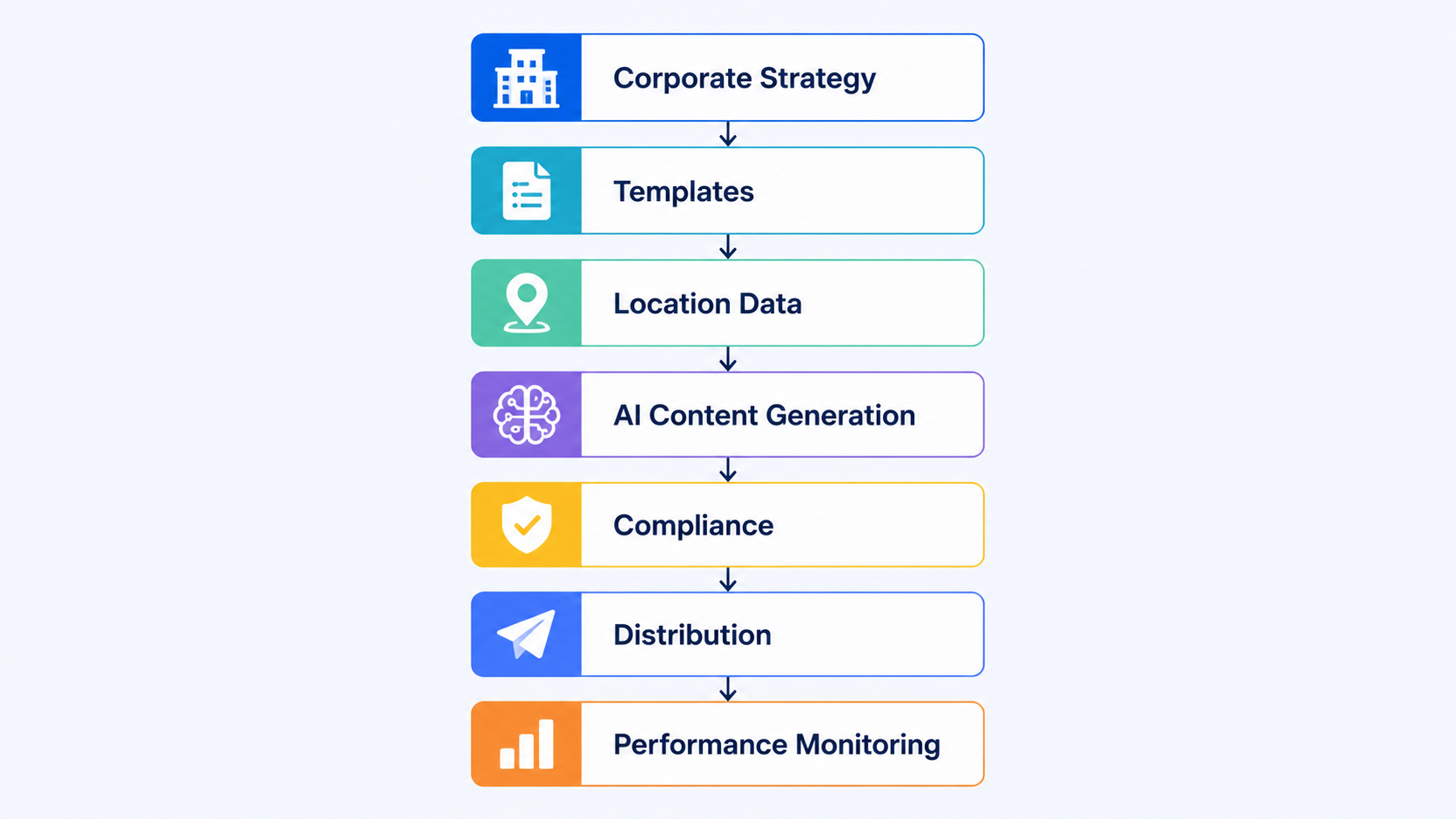
Knowing the actual mechanics, the technical workflow and where the integrations sit, makes planning your own rollout far easier. A working setup begins with centralized strategy and data, moves through template-based generation, applies compliance and brand rules on its own, and pushes finished content out to every channel. Here’s the sequence:
- Central data repository: Pull every scrap of location data into one authoritative database. Name, address, phone, hours, services, staff, photos, reviews, certifications. This is your single source of truth for every location, everywhere. Integrations with your POS, scheduling tools, or direct manager updates keep it fresh. No more rival versions of the truth scattered across a dozen spreadsheets.
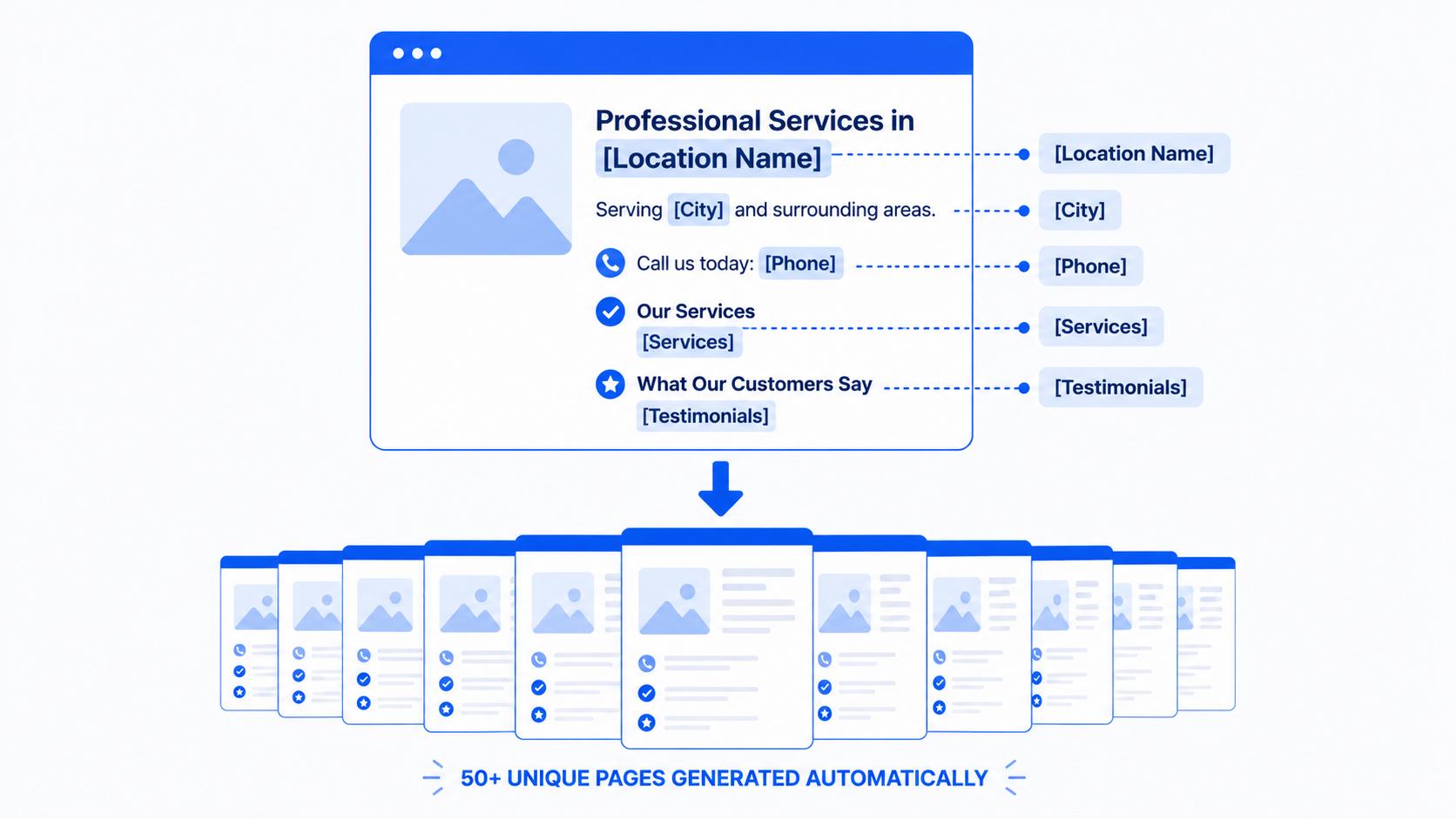
- Template creation: Your marketing team builds templates for the content types you actually need: homepage variations, service pages, location-specific landing pages, blog outlines, Google Business Profile descriptions, meta descriptions. Each template carries placeholders for the variables that change by location (“[Location Name]”, “[Service Area]”, “[Local Event]”) plus the brand-mandated sections that have to appear everywhere.
- AI content generation: The platform generates unique content per location, dropping location data into templates and spinning up variations. A spa location page template might read: “[Location Name] Spa in [City Name] offers [Services] to residents of [Service Area]. Book your appointment today.” It builds all 50 versions in one pass, each one relevant to and distinct for that location.
- Compliance review: Rules run automatically against every piece, checking required disclosures, brand language consistency, and restricted claims. Anything that trips a rule gets flagged for a human before it goes live. For franchises this layer earns its keep fast, because it stops legal and brand risk violations from ever reaching the public.
- Multi-channel distribution: Approved content flows to owned channels (your website, location pages) and managed channels (Google Business Profile, local directories, review platforms). Tie into listing distribution networks and the same information shows up everywhere at once. No more one directory contradicting another.
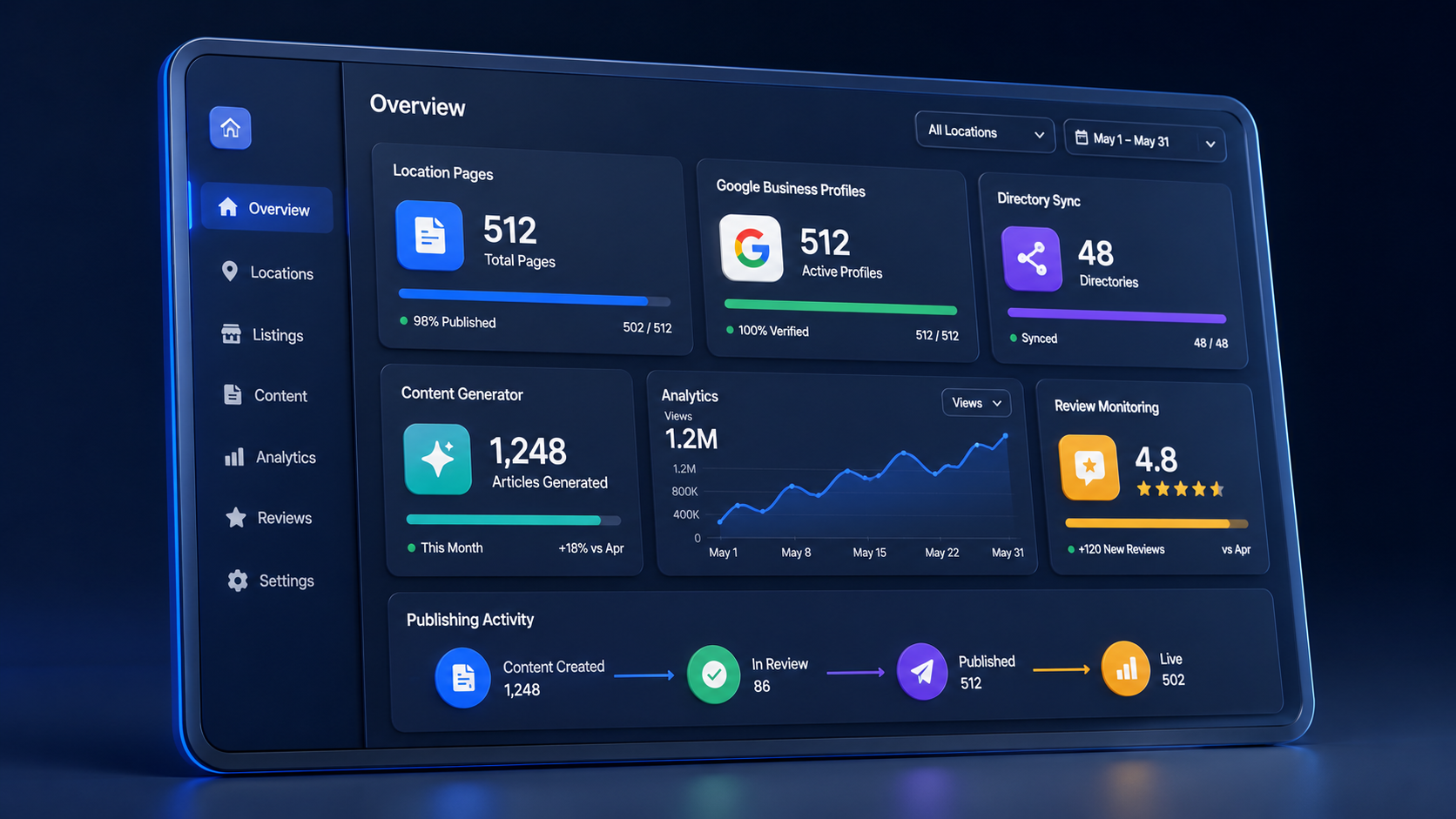
- Performance tracking: The system watches local search rankings, click-through rates, and review sentiment by location, continuously. Your team spots the underperformers and adjusts their content. You’ll see which locations deserve more investment and which are already thriving.
Building Your Local Content Automation Strategy From Scratch
A strategy that holds up needs planning across four dimensions: content, technology, organization, and governance. Most businesses skip the planning and pay for it down the line. Don’t. Get dead clear on what you’re automating and why before anything else.
Defining Your Scope
Most multi-location businesses automate a handful of core content types: location and landing pages that rank for local searches; Google Business Profile content (descriptions, posts, photos); local directory listings and citations across industry platforms; location-specific blog content and FAQs; review requests and response templates for reputation management; seasonal or promotional content that shifts by location. Pick the highest-priority types for your business and start with those. Trying to automate everything at once is how projects stall.
Then audit what you’ve already got. What content exists right now? What format is it in? Who creates and manages it today? How many locations are you really on the hook for? How much do services and offerings vary between them, or does every location run the same menu? That audit draws the line between what’s automatable and what has to stay human-made. Some content is standardized enough to hand off; some is so location-specific it still needs a person.
Designing Your Template Architecture
Strategy gets concrete here. Spell it out: Which content types need templates? Which variables absolutely have to be location-specific, like address, phone, and hours? What stays identical everywhere, like the brand story, company history, and corporate policies? Take a professional services firm. Its location pages might share one structure, About, Services, Team, Testimonials, Call-to-Action, while service descriptions and team bios swing wildly by office. You template the structure and design, then leave the substance open.
Template design makes or breaks this. Too rigid and you get generic, useless content. Too loose and inconsistency and compliance risk creep in. The sweet spot sits in the middle: structured templates, clear variable insertion points, optional sections locations can shape inside the guardrails.
Establishing Compliance and Brand Guardrails
Write it all down. What legal requirements must every location page hit? Which brand elements never bend? What are locations free to customize? Healthcare practices need specific disclaimers on every page and can’t make health claims. Legal services can trip bar association rules with the wrong client testimonial. Financial services carry investment-claim disclosure requirements. Document these rules plainly so the platform enforces them for you. In regulated industries this is non-negotiable, since it heads off the accidental violation that turns into a fine or a brand hit.
Build a three-tier framework. Tier 1, the locked content, covers brand messaging, legal disclaimers, and compliance language, identical everywhere and completely off-limits. Tier 2, templated with optional customization, covers service descriptions, team information, and location details, where locations add their own information inside the template. Tier 3, locally created, covers local events, community stories, and unique achievements written by location managers within brand guidelines. Tiering hands you central control where it counts and local voice where it makes the page ring true.
Selecting Your Technology Stack
You’ll need a few pieces working together: a local content automation platform (SEOBrain’s system, or alternatives like Yext, Semrush Local, or a custom MarTech build); a CMS to host location content; integrations into Google Business Profile management and your listing distribution networks; analytics to track how each location performs. Weigh platforms that generate content with AI, since that speeds creation and lifts quality over template-only tools. As you evaluate, press on the specifics. Does it do real AI content generation? Will it scale to your location count? Does it hook into your CMS and listing tools? Can you define and enforce compliance rules programmatically? What does it cost? Are analytics and performance tracking baked in?
Implementing Data Governance
People skip this one, and it’s critical. Name one data owner accountable for keeping the location database current and accurate. Set up workflows so location managers can push updates on hours, services, staff, and photos. Wire automated syncs to your source systems, POS, scheduling, HR, so the data stays fresh on its own. Weak governance makes automation actively harmful, since garbage in means garbage out. A database with wrong hours or half-finished addresses will smear those errors across every location and every channel. Fix this before you automate a single page.
Piloting Before Full Rollout
Automating all 200 locations on day one is a disaster waiting to happen. Start with 10-20 pilot locations instead. Generate content, review the quality closely, refine templates and rules against real results, and iterate. Only once you trust the quality, compliance, and performance do you scale to the full network. Think of the pilot as insurance against expensive mistakes.
Implementation Timeline and Resource Requirements
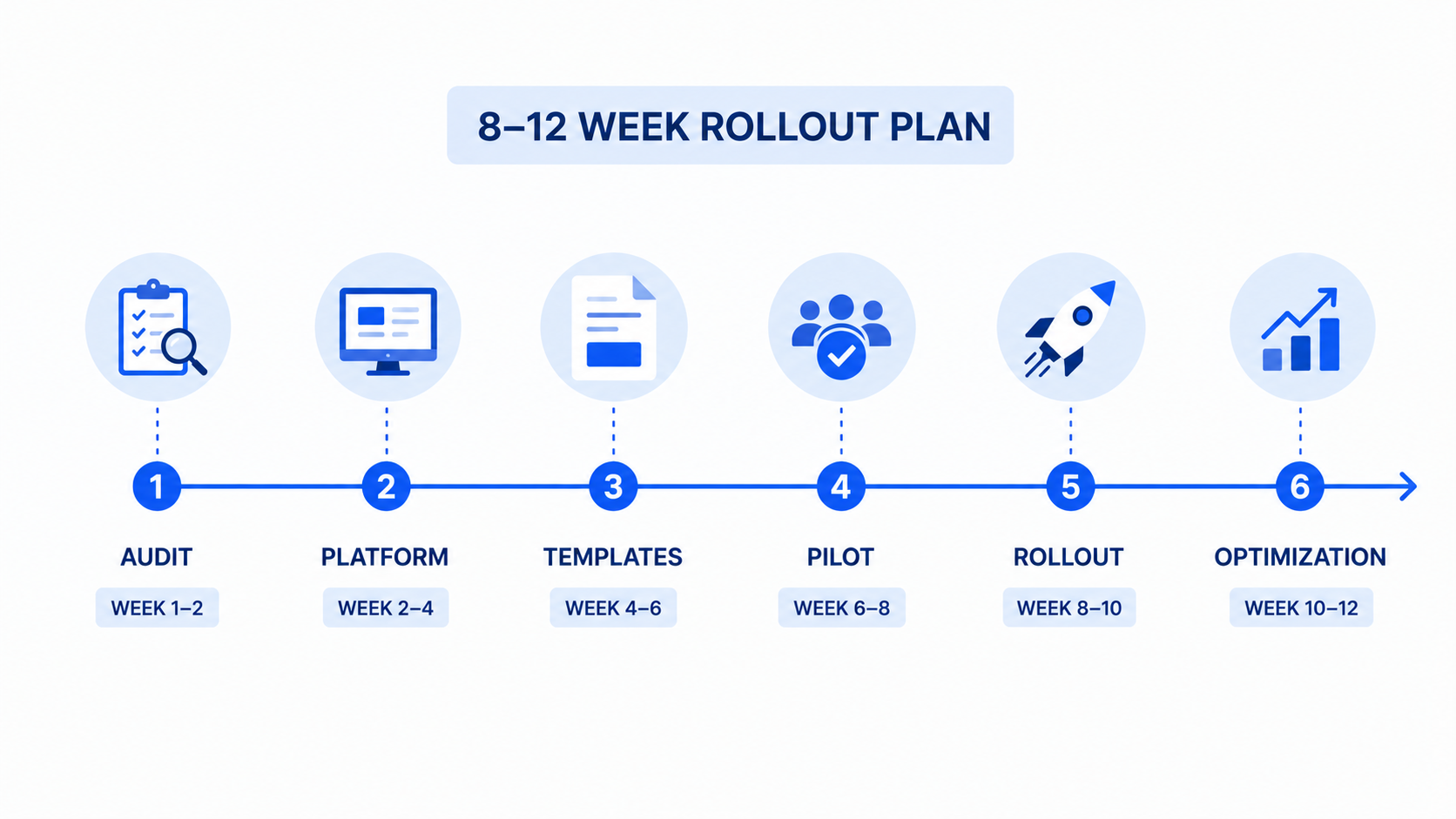
A realistic timeline runs 8-12 weeks. Weeks 1-2 go to audit and planning. Weeks 3-4 cover platform selection and setup. Weeks 5-7 handle template development and data integration. Weeks 8-9 are pilot execution and refinement. Weeks 10-12 finish the full rollout. A core team of 2-3 can carry the whole thing: a content strategist on templates, a data and analytics person on the database and reporting, and technical support for the integrations. Once it’s live, ongoing management for a 100-location network runs roughly 0.5-1 FTE. Sustainable, and easy on the budget.
Best Practices for Scaling Across Hundreds of Locations
Going from dozens to hundreds of locations brings fresh problems and demands sharper practices. These are the approaches successful enterprises lean on:
Centralize Governance, Decentralize Execution
Headquarters owns strategy, templates, compliance rules, and brand standards. Locations execute inside those guardrails, updating data, shaping local content, running community engagement. That split dodges two failure modes at once: the rigidity of total central control and the chaos of full decentralization. It’s the balance that lets you scale.
Build Modular, Reusable Templates
Stand up a library of templates for your common content types. Build them modularly so you can mix and match for location-specific variations. A professional services firm might keep modules for service introductions, team bios, case studies, and testimonials. Each location pulls the modules it needs into its own combination. Consistency and customization, same system.
Prioritize Locations Strategically
You don’t have to automate every piece for every location at once. Lead with the high-value ones: high-traffic markets, strong revenue potential, locations with a weak digital presence. Automate those first. That focuses your resources and lets you sharpen the process before it hits the lower-value locations. Smarter than a uniform rollout across the whole network.
Implement Location Tiers
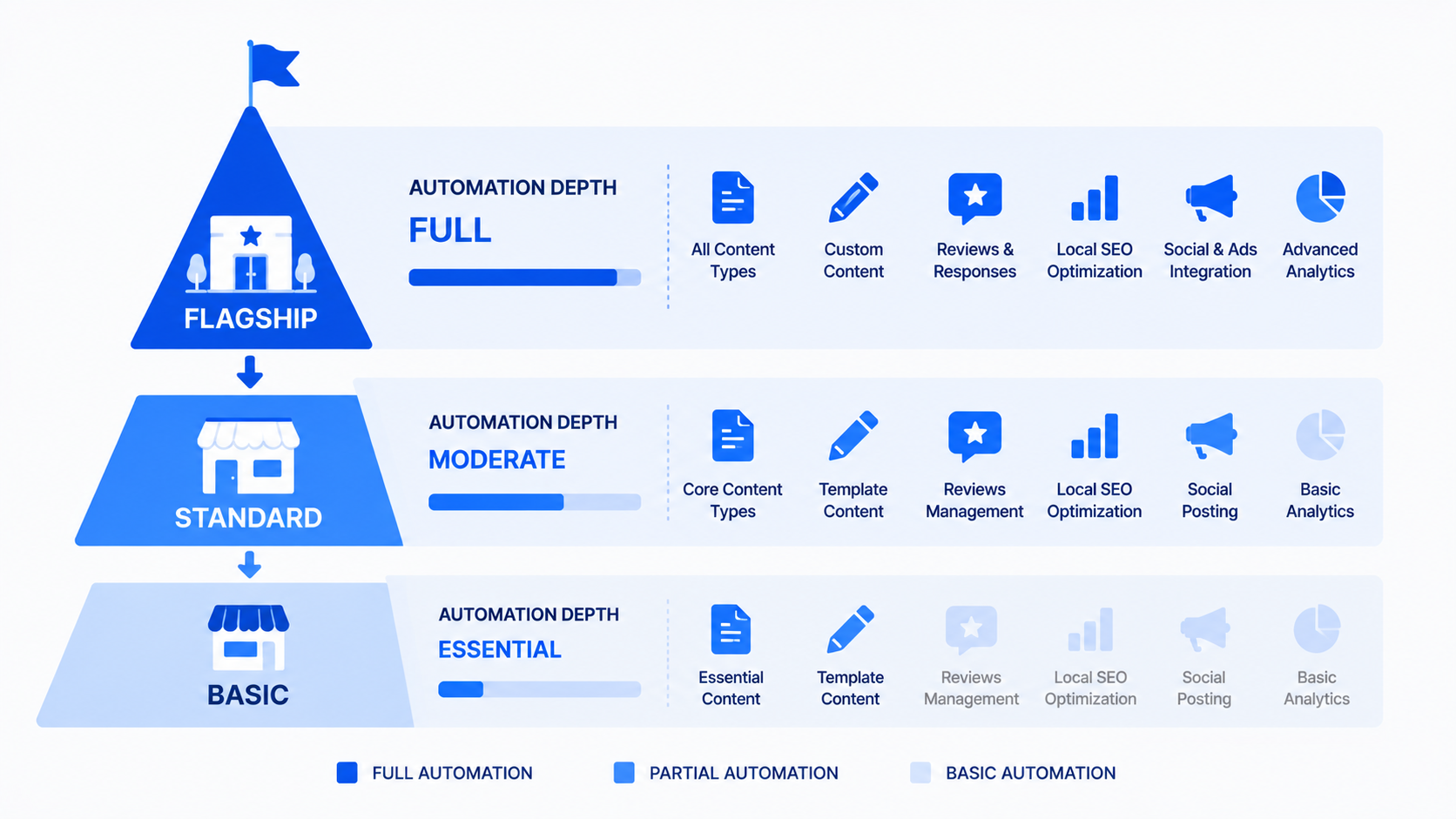
Locations aren’t equal in strategic weight. Flagship sites might earn custom, premium content. Standard locations get templated automation. Small ones get a minimal footprint. Design the system to handle that spread, with different locations drawing different levels of investment and customization. It’s how you get the most return for the effort you put in.
Create Location Manager Training Programs
Managers have to know what they can customize, what’s locked, how to submit updates, and why consistency matters at all. Put real effort into clear, accessible training. Simple and well-designed cuts friction and lifts adoption. Give them templates and guides for the routine stuff, updating hours, adding photos, requesting content changes. Do it right and managers feel empowered instead of policed. That step gets skipped more often than it should.
Build Feedback Loops From Locations
Open channels for locations to flag content issues, suggest improvements, and ask questions. A shared Slack channel, a monthly feedback form, quarterly surveys, any of these surface the problems worth catching, like an inaccurate address or a generic description that doesn’t fit their real services, and feed template fixes. Locations feel heard instead of dictated to from head office.
Monitor Location-Level Performance Variably
Locations won’t perform in lockstep. Market differences, competition, local marketing effort, and traffic patterns all move the numbers. Track performance by location and dig into the outliers. Your top performers might hand you a play you can run elsewhere. The laggards might need targeted investment or a template tweak. Let the data steer where the effort goes.
Schedule Regular Content Audits
Quarterly or semi-annual audits on a sample of locations catch drift and quality slippage before it spreads. Spot-check that content stays accurate, compliant, and lined up with current brand guidelines. Refresh whatever’s gone stale or is underperforming. Audits also surface the technical junk, broken links, outdated information, missing images. This keeps quality intact while the network grows.
Build Platform Expertise on Your Team
As you scale, someone has to know your automation platform cold, its features, its quirks, how to troubleshoot it and evolve your workflows. Not a full-time hire, necessarily, but a deliberate investment in depth. That expertise heads off problems and opens the door to better ways of working.
Plan for Evolution
Your strategy will shift as the business grows, platforms mature, and you learn what actually works. Bake in regular strategy reviews, annually or semi-annually, to size up what’s working, what isn’t, and which new capabilities are worth adopting. Automation isn’t set-it-and-forget-it. It wants active management and the occasional overhaul.
Maintaining Local Authenticity While Automating at Scale
Everyone asks the same fair question: can automated content actually feel authentic and locally relevant, or is it doomed to read corporate and impersonal? The honest answer has some texture. Automation done well balances scale against personalization, centralized enough to stay consistent, localized enough to feel real.
Layer in Human Content and Community Voice
The insight that matters: automation doesn’t have to do everything. Let it own the foundational, technical content, service descriptions, business hours, compliance information, base location data. Humans bring the voice, local team spotlights with real photos and bios, community involvement stories, testimonials tied to each specific location, coverage of local events. The hybrid scales the grunt work and protects authenticity where customers actually notice it.
Use Conditional Logic for Customization
Advanced platforms handle conditional content. Something like: “If location offers X service, include paragraph Y. If location is in an urban area, emphasize convenience and walkability. If suburban, emphasize parking and accessibility. If it’s been operating 10+ years, highlight experience and stability.” Content shaped to each location’s real situation, not one generic block copied across all of them.
Encourage Location Manager Input
Give managers a dead-simple way to feed in local color. A quarterly “local update” form where they share community events, local news, or achievements, and that material folds into the location’s content. Each location gets a voice while management stays central. Managers feel heard, not overruled.
Showcase Location-Specific Elements
Push past generic service copy and surface what makes each place its own: local staff bios and photos with actual personality, service specialties unique to certain locations, community partnerships, local awards and recognitions. Automation can frame it, “[Location Name] is proud to employ [number] local professionals with [average] years experience, including [specialty providers].” Personal, and still consistent.
Use Dynamic Content Based on Location Characteristics
Different locations want different messages. A flagship in a major city leans on reputation, expertise, premium services. A location in a price-sensitive market leans on value and accessibility. A young, growing site leans on potential and a fresh perspective. Your platform can run different content strategies by location characteristic, so each one reads as though it’s positioned on purpose.
Maintain Editorial Oversight for High-Touch Channels
Hand the transactional content fully to automation, listings, basic location information. Keep the editorial content, blog posts, case studies, social media, under human creation and curation, even when automation feeds the first draft. That’s how you protect the authentic voice where customers weigh it most.
Real-World Example: Balanced Automation in Practice
Take a dental practice franchise with 40 locations. Corporate automates the location pages: service overviews, hours, appointment buttons, compliance content. Each office adds its own layer, photos of their actual dentists and space, stories about community involvement, testimonials from their patients. The hybrid scales cleanly while every location reads as distinct and genuine. Customers get the sense they’re visiting a real local practice, not a cookie-cutter chain. Automation carries the mechanical work. Humans carry the relationships. Together they land.
Automating local content at scale stopped being a nice-to-have. For franchises and multi-location businesses fighting for local search, it’s an operational necessity. And the playbook is proven and within reach: centralize strategy and data, design flexible templates, choose technology that fits your needs, set up governance and compliance processes, pilot hard, then scale with care. Get it right and content creation time drops by up to 80%, brand consistency holds across hundreds of locations, local search visibility and rankings climb measurably, and more qualified customers come through local channels.
The real question was never whether to automate. It’s how to do it intelligently, weighing efficiency against authenticity, central control against local flexibility, compliance against creativity. Anchor the strategy to your business objectives from the start. Choose platforms for your specific needs, not for the hype or the longest feature list. Build carefully, with human eyes at the critical points. Measure hard and keep optimizing. Handled this way, local content automation reshapes how multi-location businesses compete online, and it genuinely lets a small team run digital presence across hundreds of locations. Your competitors are probably still doing this by hand, still coordinating between headquarters and location managers, still eating the inconsistency and delays. That gap is your advantage. When do you close it?
Ready to automate your multi-location content strategy and change how your franchise or multi-location business competes online? SEOBrain’s AI-powered local content automation platform generates location-specific, SEO-optimized content at scale while holding brand compliance and local relevance automatically. See for yourself how franchises and multi-unit operators automate hundreds of location pages in minutes, not weeks.
Start your free pilot today and find out how much time and budget your team can win back while rankings and customer acquisition improve.
