

Machine learning and natural language processing rewrote how businesses produce content. AI in content creation applies those technologies to automate writing, editing, and distributing marketing content at a scale no team could staff for, cutting manual production time by up to 80% while consistently improving SEO performance across your entire strategy.
Marketing teams are caught in a squeeze. Demand for quality content keeps climbing while resources stay flat, and tracking algorithm changes, competitor output, and shifting audience expectations by hand stops being realistic somewhere around the fourth competing priority. AI-powered solutions close that gap. They aren’t replacing human creativity. They expand how much strategic work your team can actually finish.
This guide covers how AI handles each stage of content creation, from ideation through ranking, and how to put these tools to work for measurable gains in efficiency, organic visibility, and marketing ROI. Lean team or enterprise content operation, the mechanics hold. Scale is the only variable.
What Is AI-Driven Content Creation and Why Does It Matter?
AI-driven content creation refers to using artificial intelligence algorithms to generate, optimize, and enhance written marketing content at scale. Template filling this is not. Modern systems read context, audience intent, and SEO fundamentals well enough to produce content that ranks and converts rather than content that merely reads well.
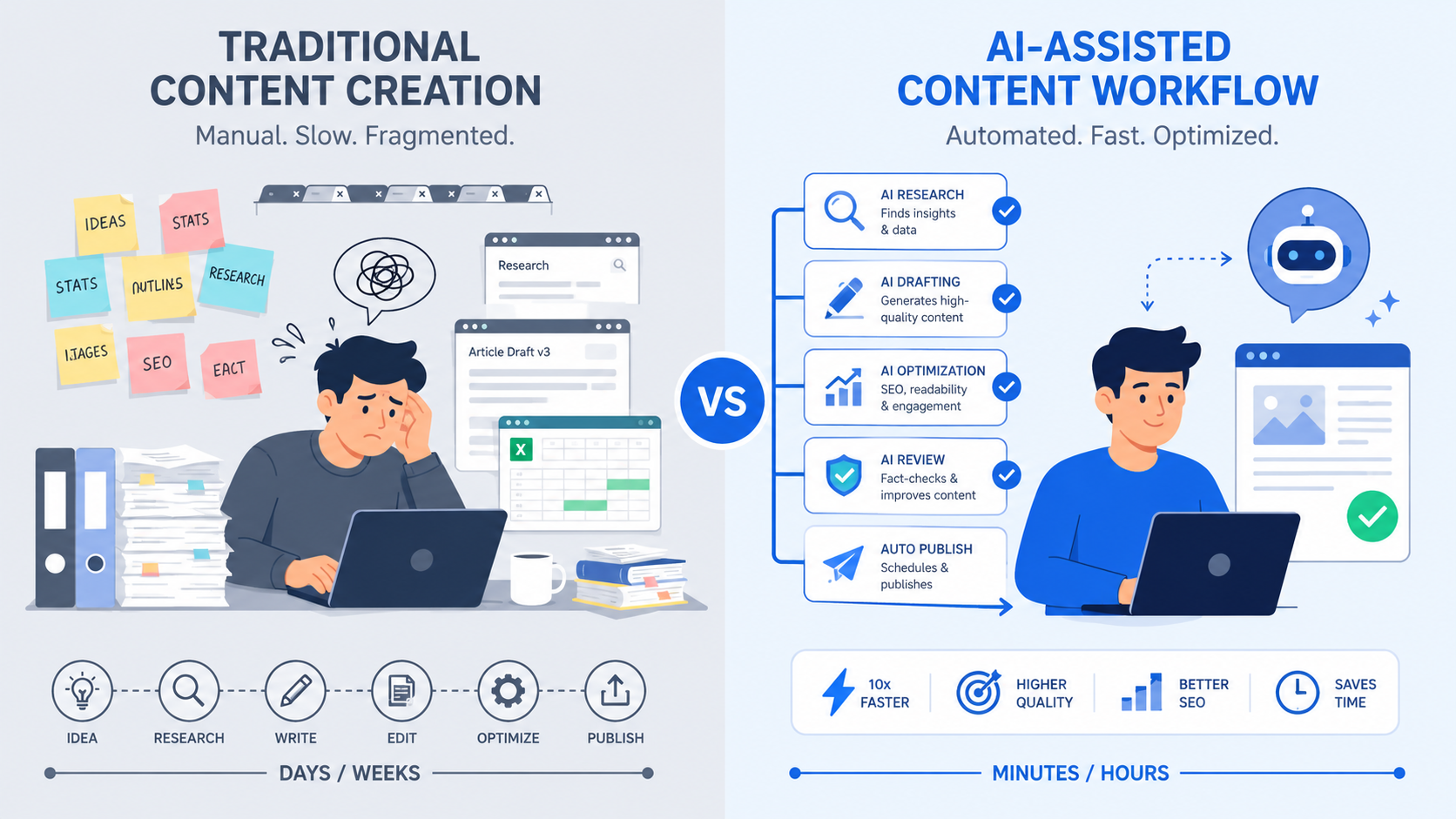
The math is the problem AI solves. A typical content marketing team spends 8–16 hours creating, editing, and optimizing a single long-form article, which works out to a 24-hour turnaround on a five-article-per-month schedule. Most organizations can’t hold that pace without burning out their teams or cutting quality. AI compresses the timeline while quality standards hold, and often improves them.
The Real Business Impact
Time savings are the smallest part of it. Recent industry data puts the real problem in focus: 72% of marketing professionals report that keeping up with search algorithm changes prevents them from executing consistent content strategies. AI flips that equation, because these systems adapt to algorithm updates as they land and recommend optimizations in real time. The guesswork disappears.
Reactive optimization is table stakes. AI also runs the analysis that used to require expensive consultants or months of manual research: competitor content analysis, keyword gap identification, topic discovery with commercial intent already factored in. For startups working against tight budgets and enterprises scaling production, AI democratizes access to enterprise-level content strategies. Hiring a full content team is slow and costly. Instead, companies keep publishing schedules consistent, optimize for multiple keyword variations, and climb search rankings with the team they already have pointed at strategy.
How AI Transforms Each Stage of Content Creation
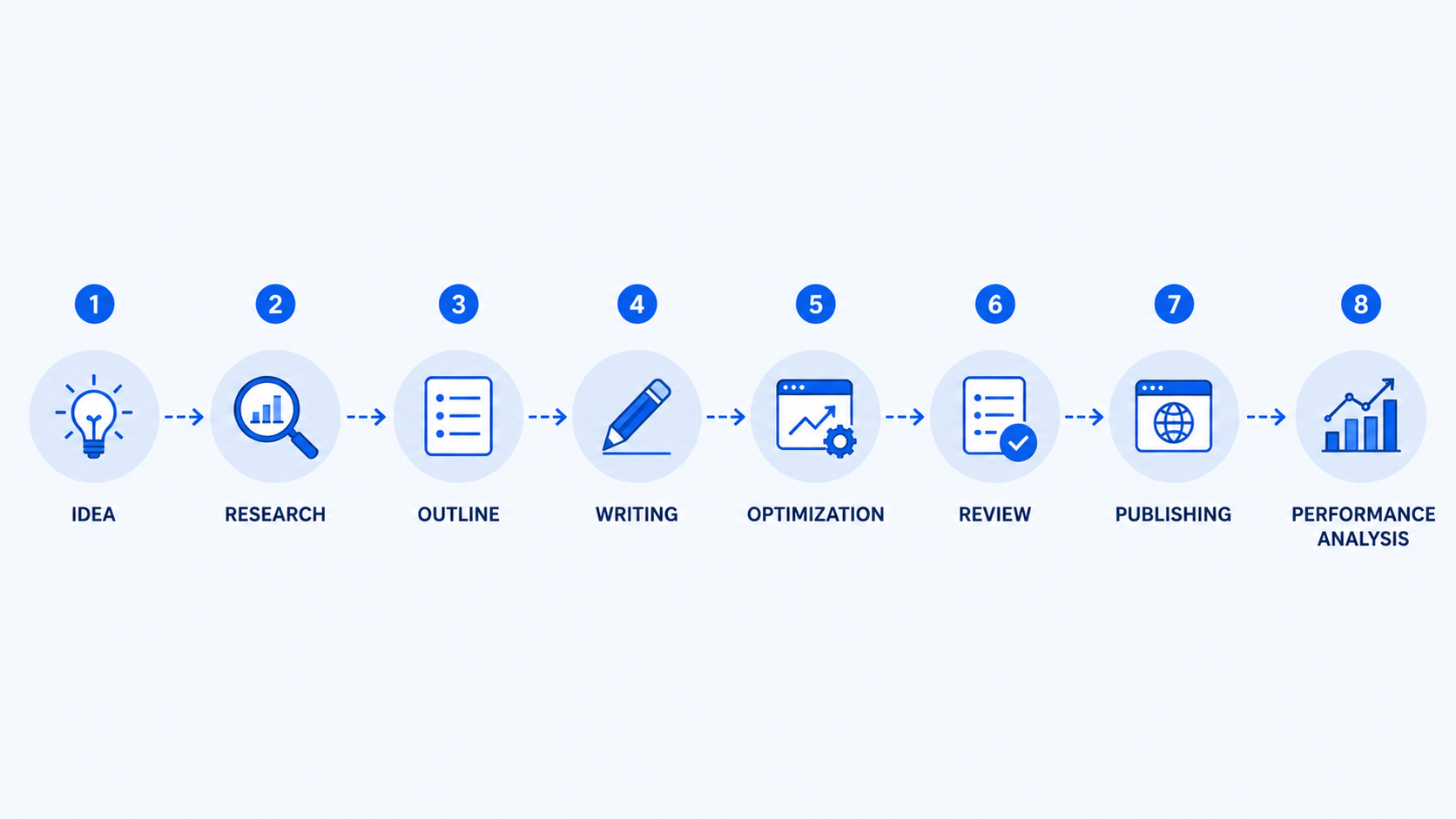
Every phase of the workflow changes, not just one. Research and ideation is where AI reads search trends, competitor strategies, and audience questions to surface high-opportunity topics nobody on the team had flagged. Writing produces complete drafts, detailed outlines, and full articles built around target keywords and buyer personas. Optimization brings title improvements, semantic keyword variations, and readability gains that lift engagement. Distribution handles publishing times, multiple content variations for A/B testing, and automatic generation of meta descriptions and social snippets. Days of manual work now happen without anyone touching it.
How AI Automation Improves SEO Content Workflows
Traditional SEO content workflows run sequentially, and every step waits on a person. A specialist does keyword research, someone else analyzes competitors, the writer drafts, an optimizer refines keyword placement and internal linking, then a final pass produces meta descriptions and promotional copy. That chain stretches across days or weeks.
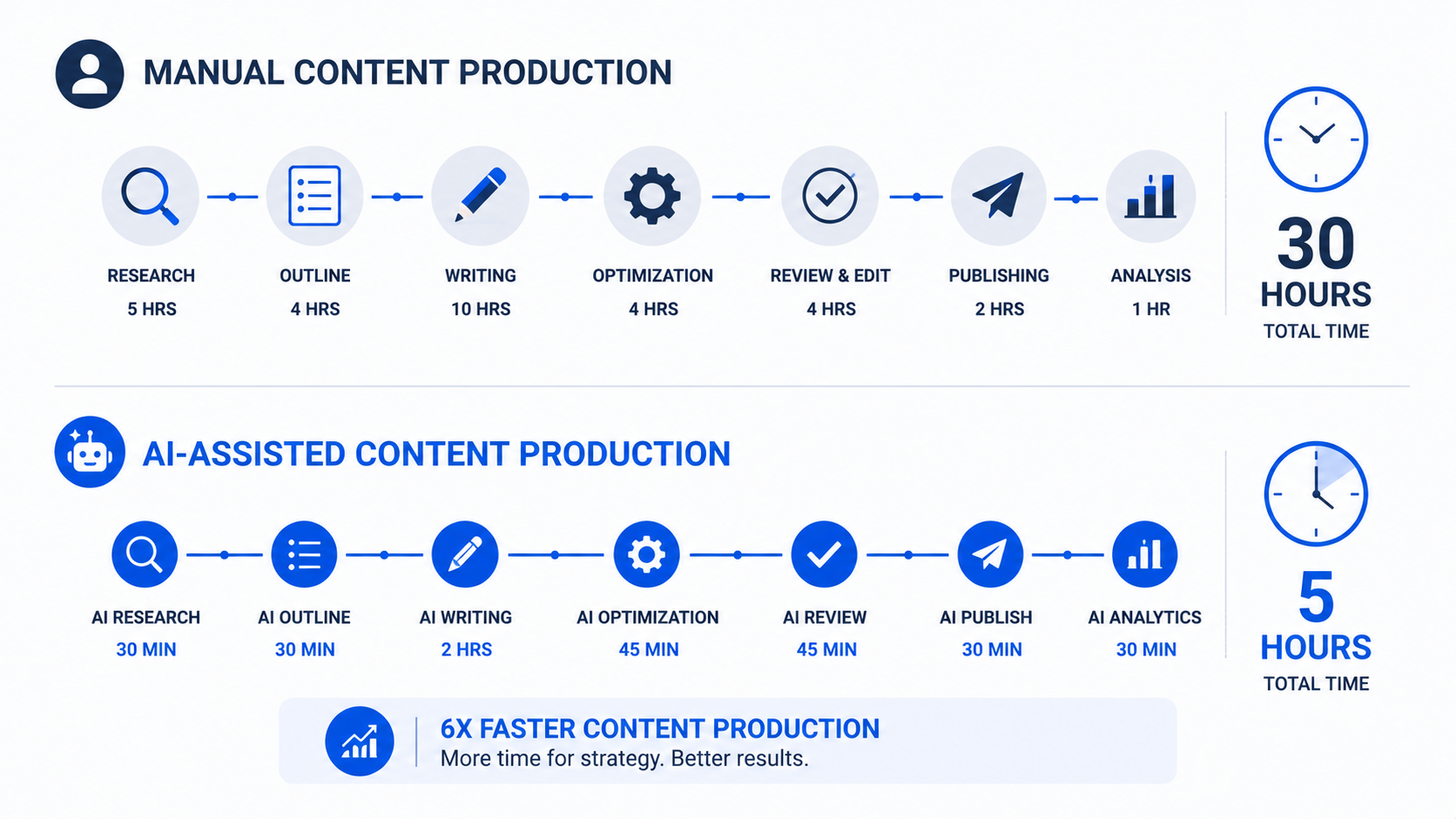
SEO automation compresses this entire timeline: AI runs those tasks in parallel instead of in sequence. Keyword research that once ate 4-6 hours takes minutes. Optimization that used to mean reviewing a finished article happens while the draft is being generated. Work that demanded a specialized team becomes achievable for a small group with the right tools.
Automated Keyword Research and Semantic SEO
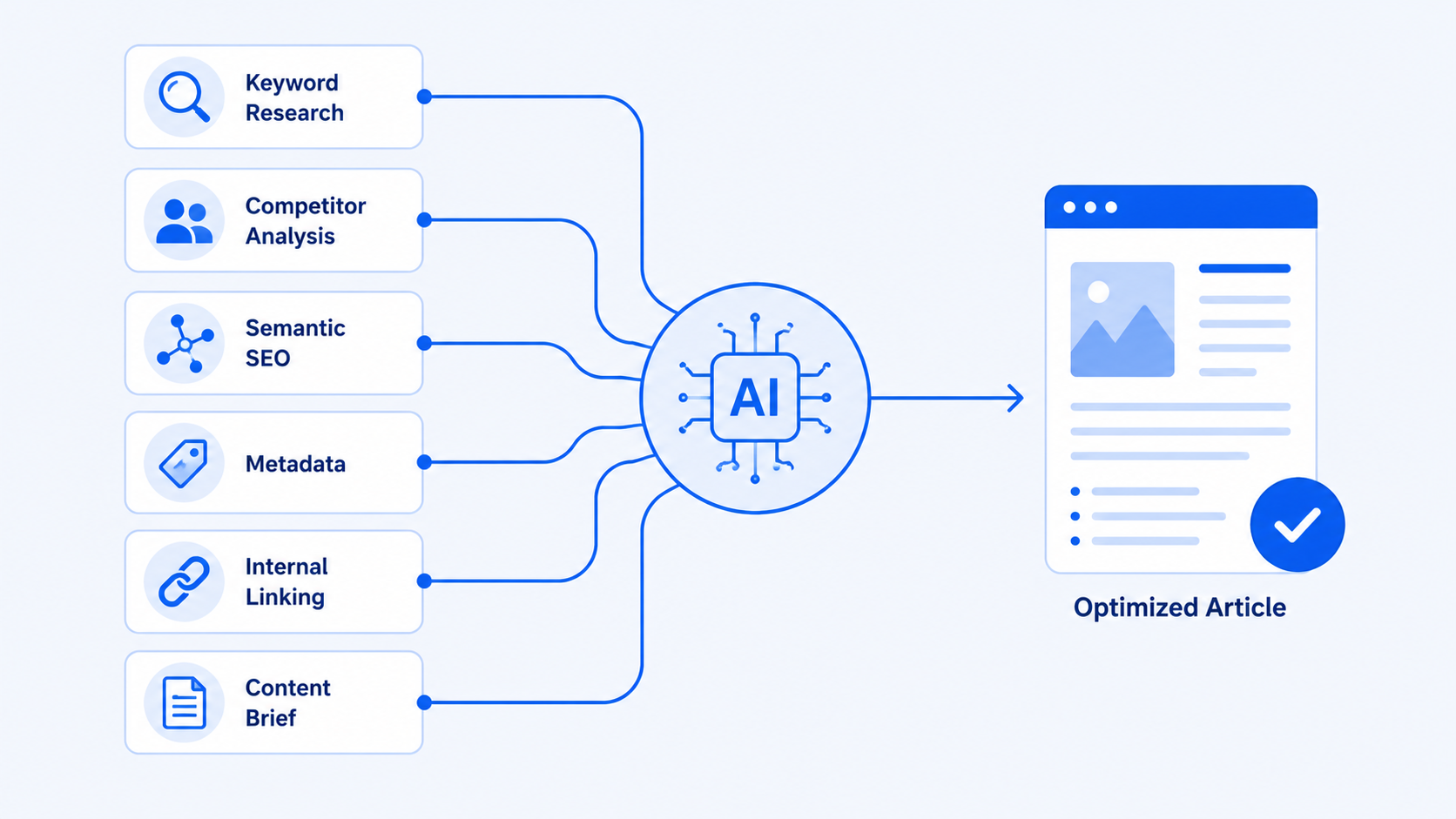
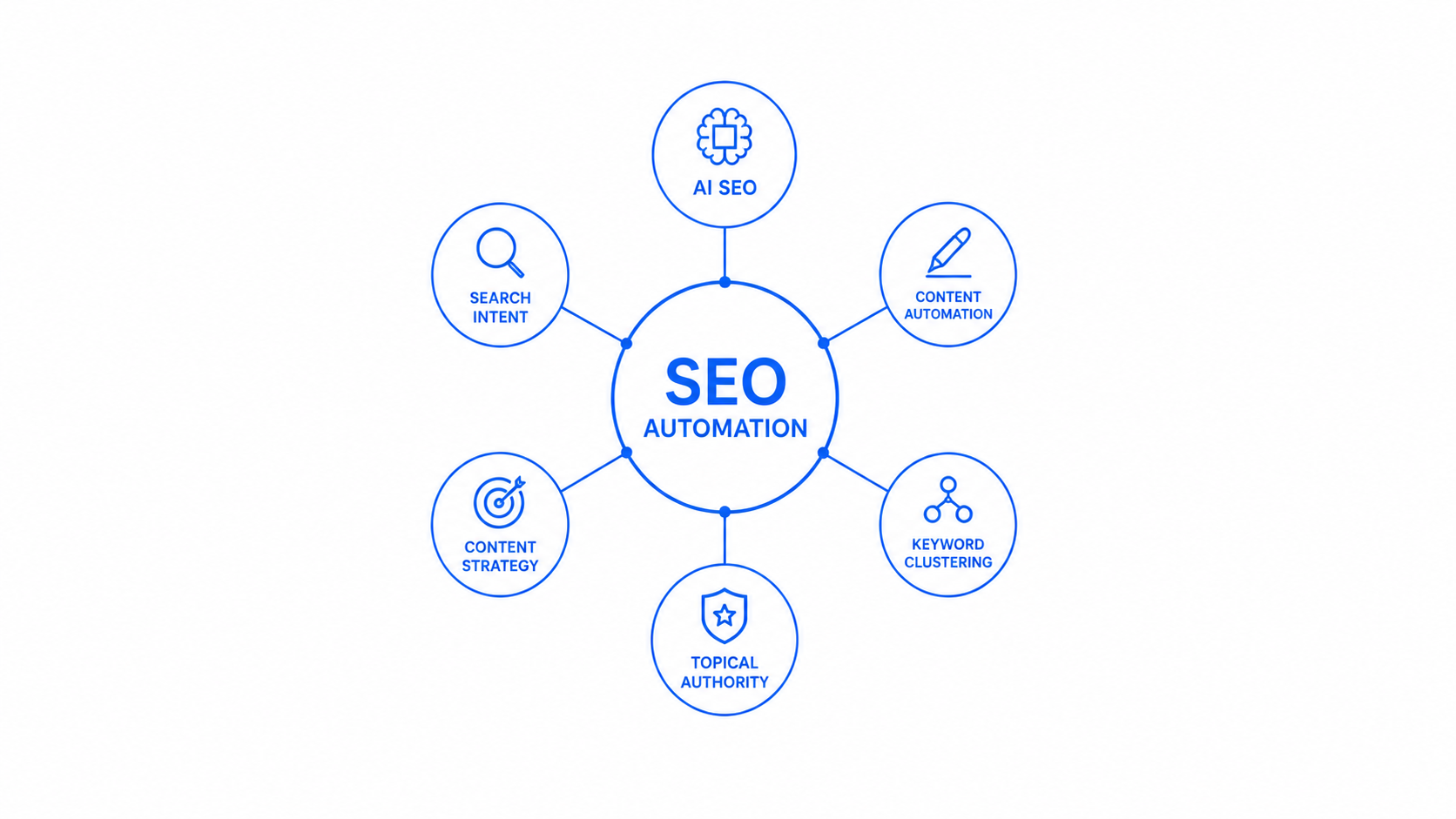
Semantic relationships are where modern AI is strongest, meaning the deeper connections between keywords that Google now weighs in ranking decisions. Isolated keywords aren’t the target anymore. AI identifies keyword clusters and topic groups that signal topical authority, so “SEO automation,” “automated SEO tools,” and “SEO automation software” get treated as one related cluster. One well-built piece addresses all three inside a cohesive structure instead of three articles competing with each other.
Content ROI multiplies under this approach. Teams stop spending budget on separate pieces that cannibalize closely related keywords, and a single article optimized for the full cluster picks up rankings across multiple high-value variations at once. AI also flags existing high performers worth refreshing with new keyword variations and emerging subtopics. Content lifespan extends without a rewrite.
Where Time Savings Are Greatest
Knowing which tasks return the biggest efficiency gains tells you where to start. These areas deliver the most:
- Initial article drafting: AI generates 1,000–5,000 word article drafts in minutes, reducing writing time from 4–8 hours to under an hour of editing and refinement.
- Keyword optimization across content: AI adjusts keyword density on its own, suggests semantic variations, and places terms correctly in headings and opening paragraphs, all of which used to sit in a manual review queue.
- Meta description and title generation: AI creates multiple title and meta description options, each optimized for click-through rates and character limits, saving 30–45 minutes per article.
- Internal linking recommendations: Instead of a manual crawl through your content library, AI surfaces the most relevant internal links based on topic relevance and anchor text optimization.
- Content gap analysis: AI scans your existing library against competitor sites and flags the topics you haven’t covered plus the high-value opportunities sitting open.
- Readability and structure optimization: AI reads sentence complexity, paragraph length, heading hierarchy, and overall flow, then suggests the changes that lift engagement.
Real-World Impact on Publishing Velocity
Stack those automations and the arithmetic gets hard to argue with. Traditional workflows burn 20–30 hours per article across research, writing, optimization, and review, while AI-assisted workflows cover all four phases in 4–6 hours. Teams publishing multiple articles weekly reclaim 40–80 hours monthly. That’s one full-time content specialist, minus the salary, benefits, and onboarding.
Picture a mid-sized B2B company shipping eight articles monthly with 2–3 full-time specialists. Add AI content creation and automated SEO tools, and that same team moves to 12–15 articles monthly with better average ranking positions. Velocity compounds. More content means more organic traffic opportunities, more keyword rankings, and faster domain authority growth.
Real Challenges in Implementing AI Content Automation
AI content creation and SEO automation deliver real efficiency gains, and they also come with real problems that need planning and mitigation. Knowing what those problems are, and having an answer ready for each one, is what separates a deployment that works from one that stalls out in month three.
Quality inconsistency during the learning phase hits first. New implementations usually need 15–30 articles before the system reliably produces publication-ready work, which means patience and upfront editing time while it absorbs your standards. Budget 2–3 hours of editing per article at the start. That drops to 30–60 minutes as the system learns your preferences.
Factual Accuracy and Hallucinations
Hallucinations are the harder problem. AI generates plausible-sounding information that happens to be completely false, and the risk peaks on emerging topics or niche subjects where training data thins out. A model will state a statistic with total confidence when the statistic doesn’t exist. Mitigation means mandatory fact-checking, citations required for every statistical claim, and expert review on anything technical or legally sensitive.
Research from industry leaders shows 64% of organizations implementing AI content tools report implementing stricter fact-checking workflows than before automation. Accuracy isn’t the issue. Volume is, because manual review of everything stops being practical once output triples, so systematic fact-checking becomes the only workable answer. Build it into the workflow and you avoid the embarrassing errors that cost brand credibility.
Workflow Integration and Organizational Friction
Integration is where some teams stall. Dropping AI into an existing content process feels disruptive at first, especially when the tools don’t connect to your CMS or can’t pull analytics. Anything requiring manual content transfer erases the efficiency gain it promised. Platforms with no ROI tracking make impact impossible to prove. Plan for real onboarding and a redesigned workflow rather than bolting AI onto what already exists.
Content saturation is a legitimate concern too. Faster, cheaper content production raises competition across the board, and pages that ranked comfortably two years ago now lose to competitors publishing consistently with AI assistance. That’s an argument for adopting sooner, not for holding back. Early adopters take the advantage, and organizations implementing now will be the ones competitors are chasing twelve months out.
Mitigating Risks Through Clear Governance
Governance is what makes the rest hold up. Define which content types can be fully AI-generated (long-form guides, resource lists, comparison articles) and which need heavy human input (opinion pieces, thought leadership, company announcements). Templates and content frameworks give AI a shape to follow, which does more for consistency than any prompt tweak. Subject matter expert review catches technical errors before publication, and citation requirements on statistical claims keep every number traceable. Governance feels like overhead in week one. It’s what prevents the expensive failures in month six.
Best Practices for Scaling AI Content Successfully
Organizations pulling the highest ROI from AI in content creation run a consistent set of practices that protect quality and brand consistency while the automation does its work. These are the practices that separate the success stories from the disappointments.
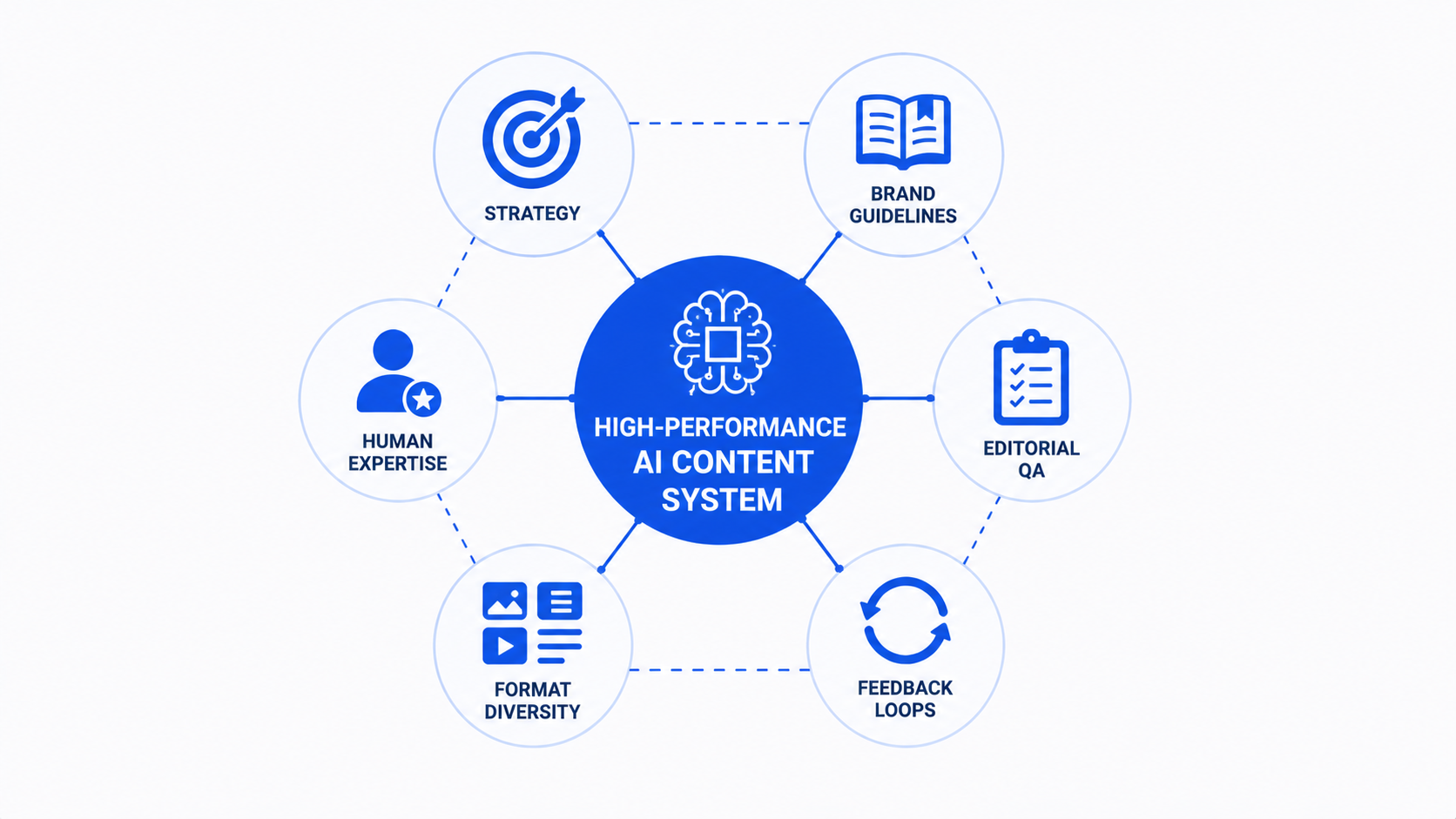
Strategy comes first. Define your target audience, priority keyword clusters, content formats (guides, comparisons, how-tos), and publishing frequency before you generate a single draft, because strategy decides what gets created and AI only handles the execution at scale. Skip that foundation and you get volume with no impact. Content still has to solve a specific business problem for a defined audience segment. AI scales whatever already works.
Developing Brand Guidelines for AI Systems
Second, build brand guidelines detailed enough for an AI system to learn from. That covers tone of voice (professional, conversational, authoritative), target complexity level, average article length, preferred examples and metaphors, and the brand messaging that can’t be paraphrased away. Feed the system 5–10 exemplary articles that demonstrate all of it. Concrete guidance produces first drafts that already sound like you, while vague guidance produces output that drifts a little further off-brand with every piece.
Third, standardize editorial review. Ad-hoc review slows editors down and lets quality vary article to article, so give them a checklist they use every single time. Efficiency improves because the standard is clear, and output quality improves because consistency lifts individual article performance. A working checklist covers factual accuracy verification, brand voice alignment, keyword optimization appropriateness, internal linking coverage, readability assessment, and compliance with brand guidelines.
Creating Feedback Loops and Format Diversity
Fourth, close the feedback loop. Track the edits your editors make most often, then change AI settings or retraining to eliminate those specific edits before they reach a human again. Editors trimming AI drafts by 20% every time? Generate shorter drafts. Editors constantly adding a certain kind of example? Give the system more example guidance. Every published piece should make the next one marginally better.
Fifth, diversify formats instead of defaulting to long-form articles for everything. Structured content is a strength here: lists, comparison tables, definitions, FAQs. Those formats often outrank prose for specific query types and hold up well in voice search. A balanced strategy runs articles, guides, resource lists, comparisons, and definition pages, each optimized differently.
Integrating Human Expertise With AI Capabilities
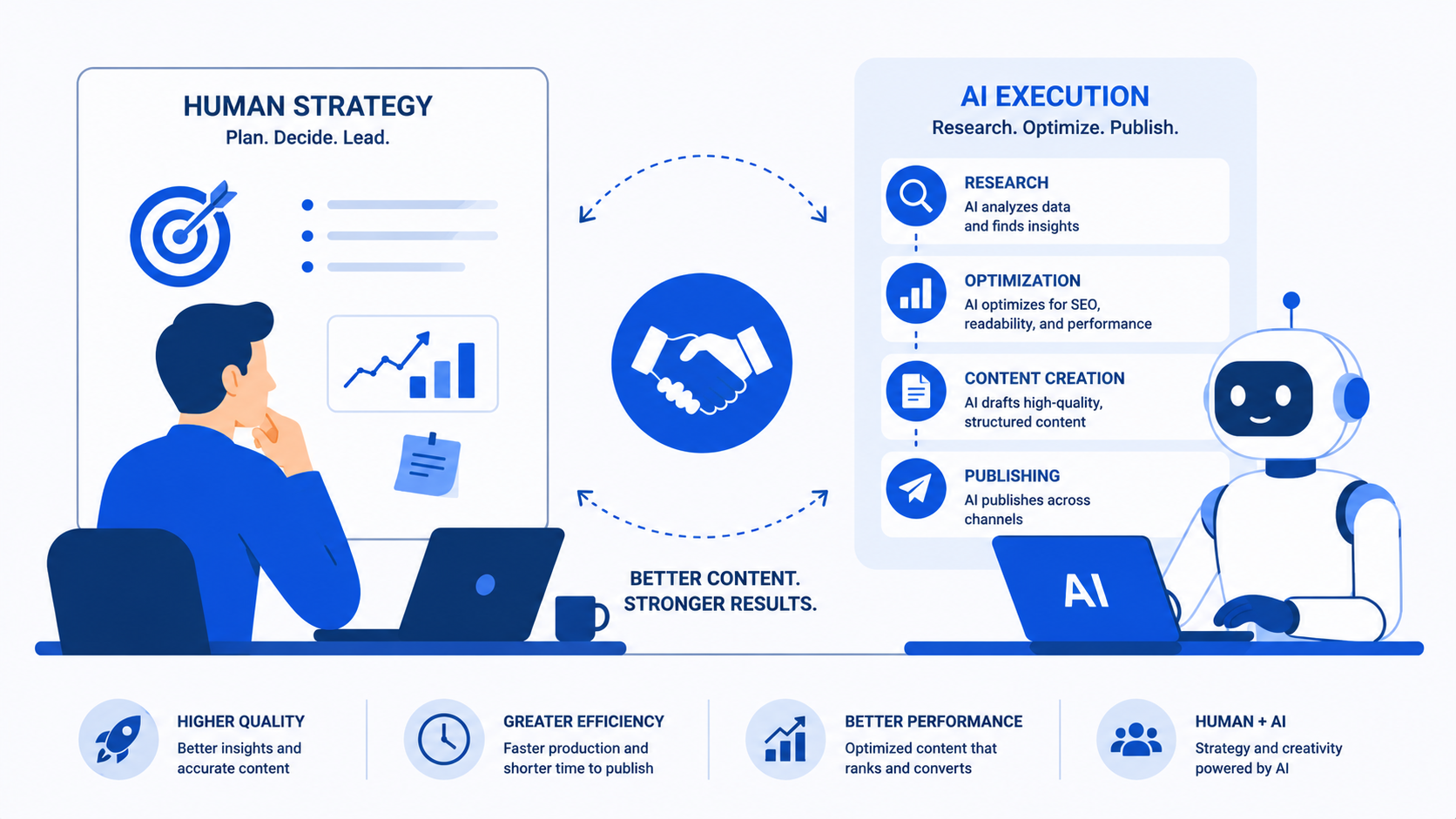
AI efficiency plus human strategic thinking beats either one running alone. Strategy, topic selection, and editorial decision-making stay with people, because those calls depend on judgment and experience that no model accumulates. Execution, optimization, and scaling go to AI. That split sidesteps both traps: full automation produces generic work that underperforms, and refusing to automate caps how far you can scale.
Rethink how you assign specialists. Senior strategists own topic calendars, content gap coverage, competitive threat evaluation, and emerging opportunity identification. Junior team members take editing and optimization, with AI handling the heavy lifting that used to demand senior expertise. Human capital moves to strategic, high-value work while automation absorbs high-volume execution. Nobody gets replaced. The work people do gets harder to outsource.
Why AI-Driven SEO Will Dominate Marketing Efficiency
AI-driven SEO is on track to become standard industry practice rather than an edge. Understanding the reasons behind that shift shapes how soon and how aggressively you invest.
The volume advantage compounds first. Organizations using AI publish at 2–3x their historical rates, and a content lead built at that pace is one manual competitors can’t close. After 12 months, an AI-enabled team publishing 15 articles monthly has 180 articles against 96 for a traditional team. Pair that gap with better optimization and the difference in organic visibility and traffic capture gets wide. Manual competitors then face two unappealing options: hire larger teams at significant cost and delay, or watch market share slide.
Continuous AI Improvement and Structural Advantages
Second, AI keeps improving while human capacity stays fixed. Language models get better monthly, producing more natural and more strategic content with each release, and optimization algorithms keep finding ranking opportunities that human reviewers miss. Hiring excellent content specialists, meanwhile, is still difficult, expensive, and slow. AI capability rises while its cost stays flat and human hiring costs climb, which builds a structural advantage into AI-enabled organizations that widens on its own.

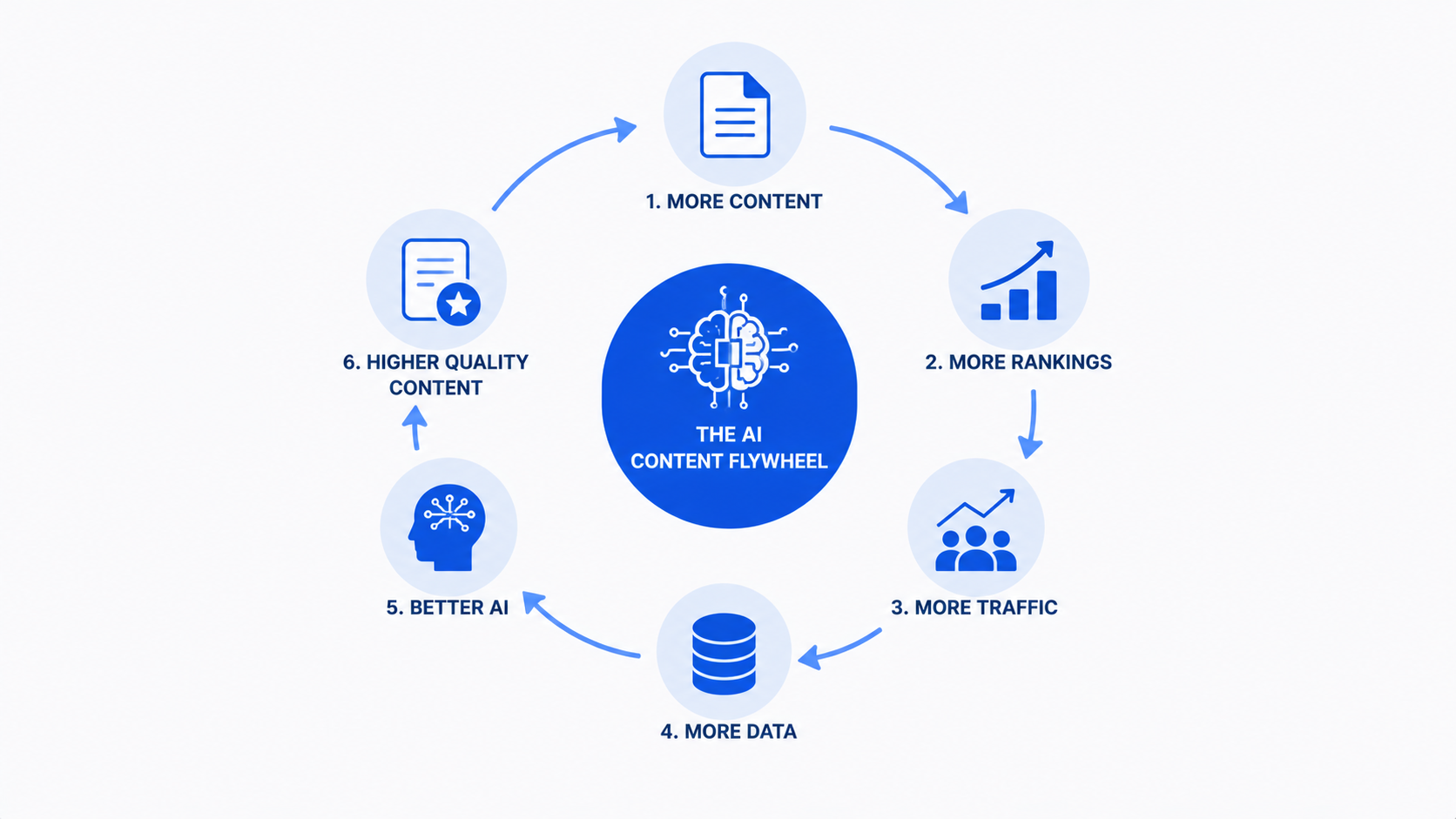
Third, data advantages compound in ways smaller competitors can’t replicate. Teams on AI-powered platforms accumulate performance data on which pieces rank, pull traffic, and convert, and that data feeds both strategy and AI training. Your fifth article learns from the performance of the first four. A competitor’s fifth article learns from nothing unless they’ve built a comparable system, so their content stays static while yours keeps getting sharper.
Search Engine Trends Favor AI-Powered Content Programs
Search engines reward consistency and topical authority, and both are AI strengths. Organizations that cover topics thoroughly, update frequently, and publish in multiple formats take the top of the results page. Consistency requires scale. Scale requires automation. Google’s own documentation keeps emphasizing expertise, authority, and trustworthiness demonstrated through thorough, current content, which describes exactly what an AI-enabled content program produces. The algorithm is rewarding scale, consistency, and depth of coverage.
Strategic Positioning for the AI-Driven Future
Marketing leaders aren’t deciding whether to adopt AI. They’re deciding when, and how fast. Early adopters take market share, build content moats that resist quick attack, and develop internal expertise while the field is still young, and those advantages hold for years. That leaves two positions available: lead the transition toward AI-driven marketing efficiency, or chase the teams that moved first. Organizations starting now will point back at 2026 as the year their competitive position in search rankings and organic growth changed shape.
The Future of Marketing: AI as Standard Practice
AI-driven SEO strategies are becoming standard competitive practice, not optional tooling. That shift changes how marketing teams operate, which skills carry weight, and what a competitive advantage in organic search even looks like.

Teams positioning themselves now, the ones implementing thoughtfully, measuring impact rigorously, and improving their processes continuously, hold advantages that persist for years. They rank higher, pull more organic traffic, convert that traffic better, and spend less per content asset than competitors still running manual workflows.
Humans don’t exit content marketing in this picture. The opposite happens. Routine production moves to AI and human roles shift upward into strategic thinking, audience insight, competitive analysis, and brand positioning, which is the work that actually differentiates your content from the flood of everything else. People define strategy. AI executes it at scale. Neither half is as strong alone.
The starting line isn’t “someday when we’re ready.” Start small, measure carefully, scale what proves out. Teams treating AI adoption as a core business capability will lead their markets, and the ones waiting will spend next year catching up.
AI in content creation is the biggest shift in marketing efficiency since content marketing became standard practice in the first place. Automating keyword research, content generation, optimization, and distribution lets teams scale output 2–3x while cutting cost per article by 60–75% and improving average ranking performance. The strongest implementations pair AI’s execution efficiency with human strategic thinking, building hybrid workflows where people set direction and AI runs the volume.
As markets fill with AI-generated content, advantage moves to the organizations that implemented first, built genuine expertise in using the tools, and kept refining their processes. Treating AI adoption as a strategic capability rather than a cost-cutting exercise is what separates the teams that dominate search rankings and organic growth from the ones that saved a little money.
The evidence is clear: AI works. The open question is whether you adopt it before your competitors do. Begin with a small-scale pilot, measure results rigorously, and scale on proven ROI. Your organic visibility and your marketing team’s capacity both hinge on how deliberately you make this transition.
Ready to transform your marketing efficiency with AI-powered content? Start with a structured pilot focused on your highest-priority content vertical. Test the tools, measure the impact, scale what works. Earlier starts produce bigger advantages. Let’s talk about how AI can amplify your content strategy.
