
AI-based SEO tactics change the actual mechanics of how marketers work a search strategy. The old way meant researching keywords by hand, drafting content from a blank page, and checking performance across scattered dashboards. Weeks of it. AI takes over the repetitive parts of that loop, which hands your team back the hours they’d otherwise spend on grunt work. Less manual effort, better accuracy, and a way to grow SEO output without hiring more people to produce it. This guide walks through where AI breaks from traditional SEO, which tactics reliably push visibility, and how to put them into practice for organic growth that holds. Startup, scaling org, or enterprise search presence, the efficiency argument lands the same way: you compete on scale you couldn’t reach by hand.
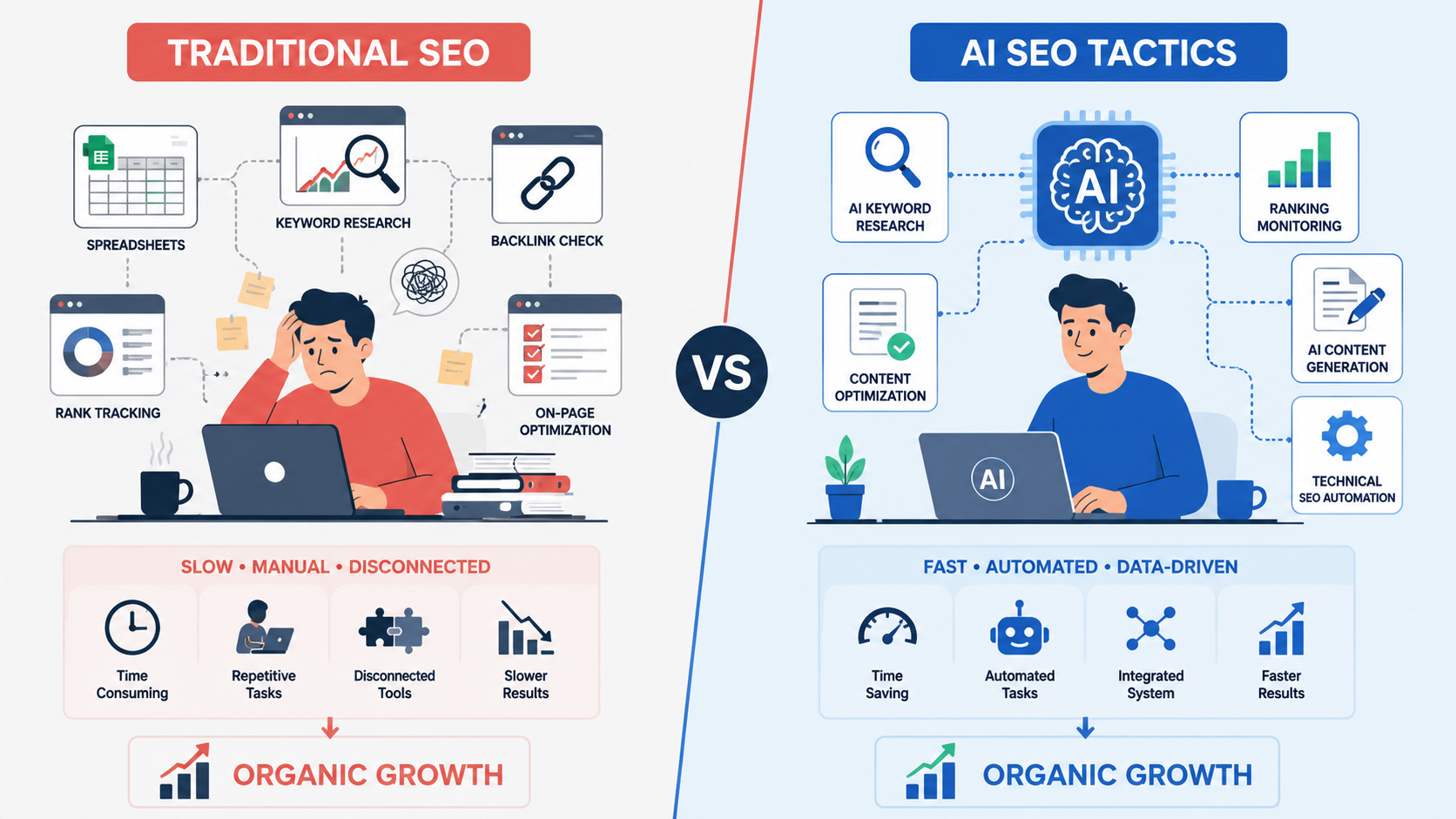
What Are AI SEO Tactics and How Do They Differ from Traditional SEO?
The gap is execution, not intent. Traditional SEO runs on manual labor: researching keywords by hand, writing content from scratch, pulling competitor data one tab at a time. All of it eats time and budget. AI SEO tactics hand those repetitive jobs to machine learning and natural language processing, and the results come back faster, more accurate, and at a volume a person can’t touch.
Scale and consistency are where the two split hardest. A traditional strategy might let one marketer optimize 10-15 pieces of content a month. AI-driven approaches push that same marketer past 100 pieces, and along the way the system catches patterns a human would miss. It reads across huge datasets of search queries, user behavior, and ranking factors that a human analyst would need weeks to work through. Consider the volume for a second. Millions of web pages, billions of search queries, hundreds of ranking factors. No person processes that efficiently.
How AI Changes the SEO Timeline
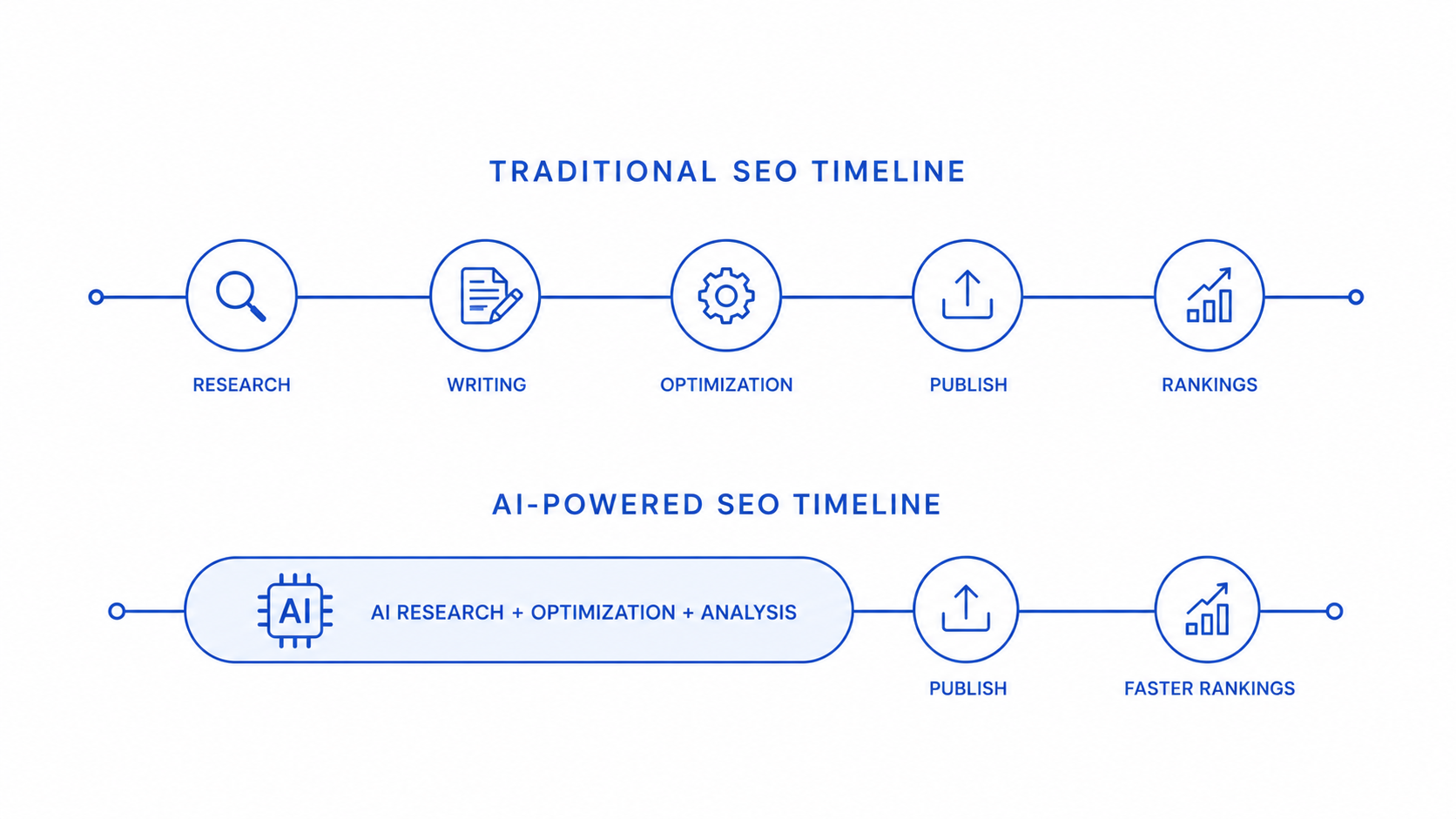
Traditional SEO usually needs 3-6 months to show measurable results, and the reason is sequencing. You research keywords, then you write, then you optimize, one after the other. AI collapses that timeline by running the steps at once. Keyword research, content gap analysis, and competitive benchmarking all fire in parallel, so high-opportunity keywords surface and optimized content ships in days. No three-month wait to learn whether the plan worked. You gather data and adjust as you go.
The Role of Machine Learning in SEO
Static SEO rules can’t capture semantic relationships between topics, intent patterns, and ranking correlations. Machine learning models trained on millions of web pages can. Feed a target keyword like “SEO strategy” into an AI SEO platform and the system does more than surface look-alike terms. It works out which content topics lift visibility, what length performs best for that exact keyword, and which internal linking structures move rankings hardest. That intelligence compounds. More data in, sharper output over time.

Here’s the part that actually matters: machine learning learns from real ranking data instead of following rules someone wrote years ago. Traditional advice says “make content 2,000 words long.” AI reads the pages that actually rank and finds that for competitive keywords, 4,000+ words often beats shorter pieces. Informational queries can reward tight, focused content. Commercial queries lean on comparison tables and pricing. The system picks up these distinctions on its own, because it’s seen thousands of real examples do the sorting.
How Does AI-Powered Keyword Research Work?
Conventional keyword tools hand you a static list ranked by search volume and competition. AI keyword research does something the older tools can’t: it maps how keywords relate, reads the questions users are actually asking, and identifies which content types win each query. That shift reshapes the whole strategy.
Drop a seed keyword into an AI tool, say “SEO strategy,” and natural language processing pulls semantic variations, related topics, and long-tail openings that never show up in conventional research. The AI surfaces “SEO strategy builder,” “competitive SEO content,” “enterprise SEO,” and “local SEO” because it grasps that people searching those terms share related needs. Simple keyword matching never sees those conceptual links.
Intent-Based Keyword Clustering
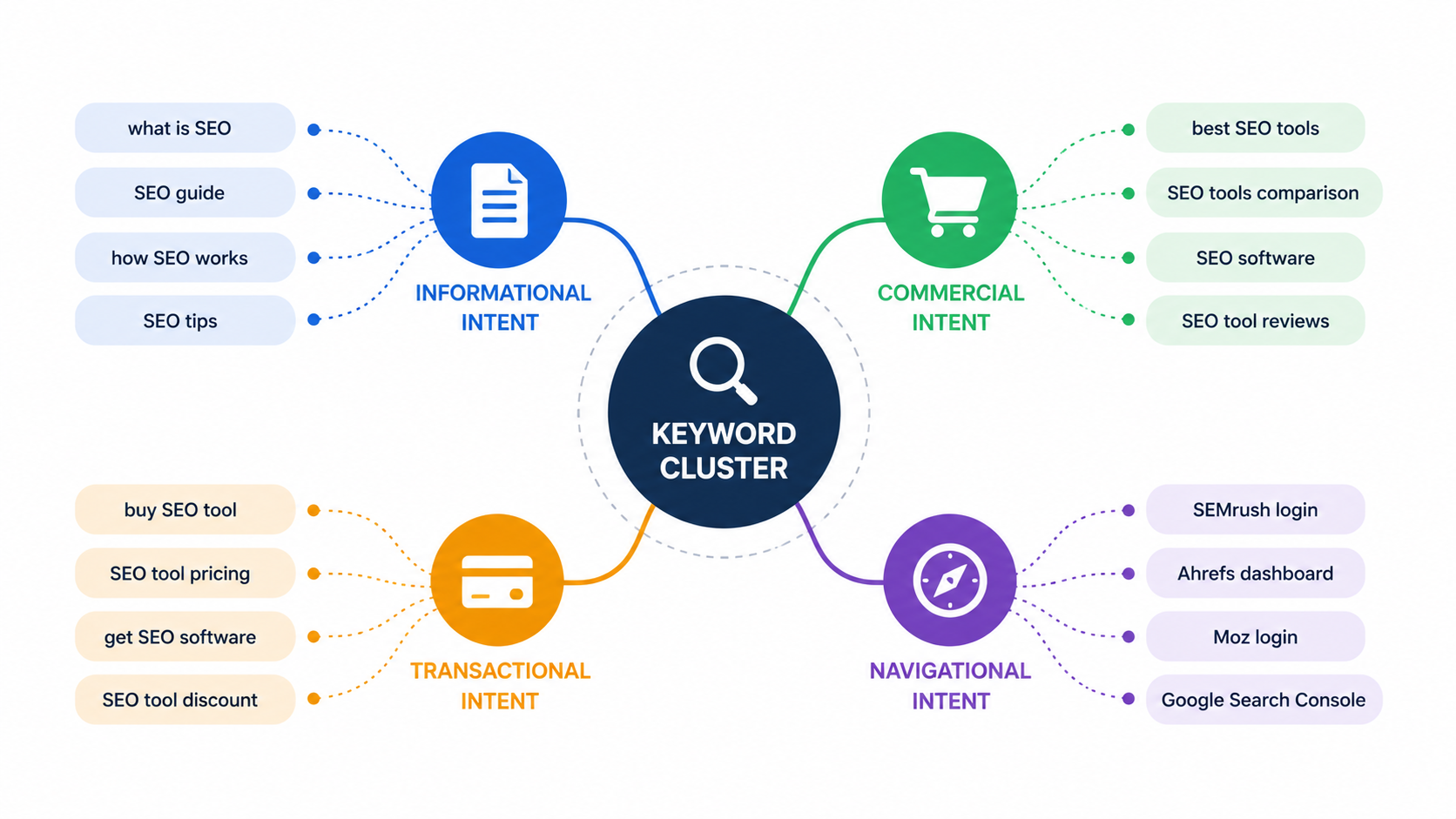
Traditional keyword research fumbles one thing badly: keywords with different search intents need completely different content. AI sorts keywords by intent on its own, whether the searcher wants information, is weighing a purchase, or is ready to act. That sorting keeps you from pouring effort into content aimed at people who aren’t close to converting.
Look at the split. “SEO strategy” is informational and calls for a full educational guide that builds understanding. “SEO strategy tools” is commercial and needs content that compares options and moves someone toward a decision. Those aren’t keyword variations. They’re different intents that demand different formats. Traditional tools throw them in the same bucket. AI reads the intent signals and separates them, which heads off the classic mistake of writing one piece for several intents and ranking for none of them.
The payoff is concrete. You stop burning content hours on keyword combinations you were never going to rank for, because the intent never matched your format. Every piece you write now targets keywords where you’ve got a real shot.
Competitive Gap Analysis
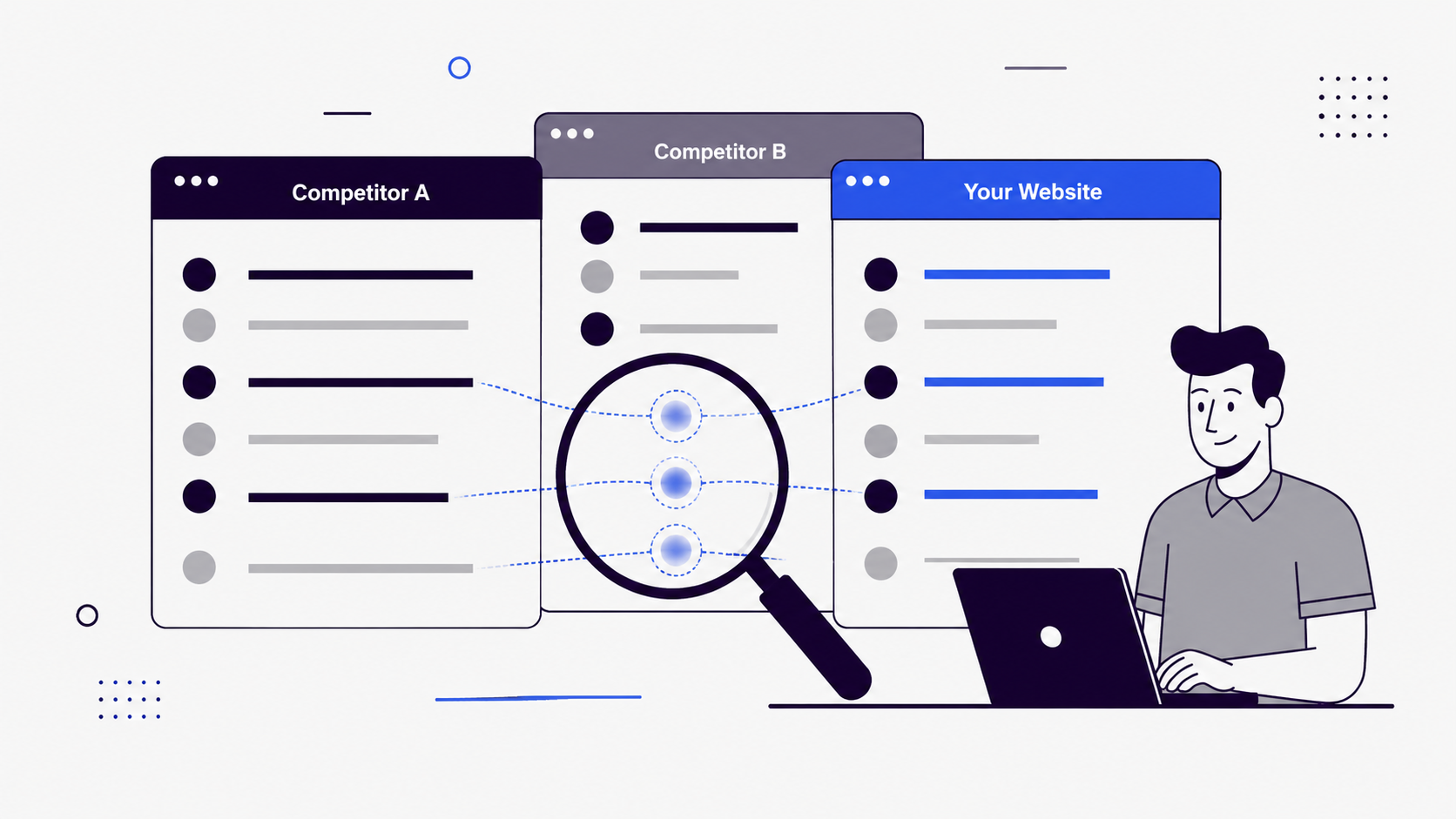
AI keyword research runs competitive analysis automatically and shows you where your content strategy trails the competition. It reads the top 20 ranking pages for your target keywords, pulls the keywords living inside those pages, and flags the spots where a small adjustment could lift you. What lands on your desk is a prioritized list sorted by difficulty and opportunity. Exactly the input a smart content call needs.
No more clicking through competitor sites and guessing at the gap. You get data-backed recommendations spelled out: “Your competitors rank for ‘seo strategy builder’ (8,400 monthly searches, medium difficulty). You don’t currently target this keyword. Content opportunity score: 8/10.” Speculation turns into a plan. You can see which keywords feed your competitors’ traffic and where you’ve got a realistic path in.
Trend Detection and Seasonality
AI tools track search volume over time, catch keywords on the rise before the field crowds in, and flag seasonal windows tied to your industry. For teams working digital marketing and AI-powered SEO automation, that means spotting “AI tools for SEO strategies” and “ai-driven search results” while volume is still workable, ahead of the competition rush. The system nudges you toward openings you can grab early.
Seasonality matters just as much. Some keywords spike at fixed points in the year. Traditional research shows you an average monthly figure. AI shows you the curve: “‘SEO strategy for holiday season’ peaks in September-October with 4,200 monthly searches, dropping to 200 monthly searches in summer.” That pattern lets you build content calendars around the months keywords actually pull. You stop publishing for demand that isn’t there and start timing releases to the cycle.
How Can You Optimize Your Website Using AI for Search Rankings?
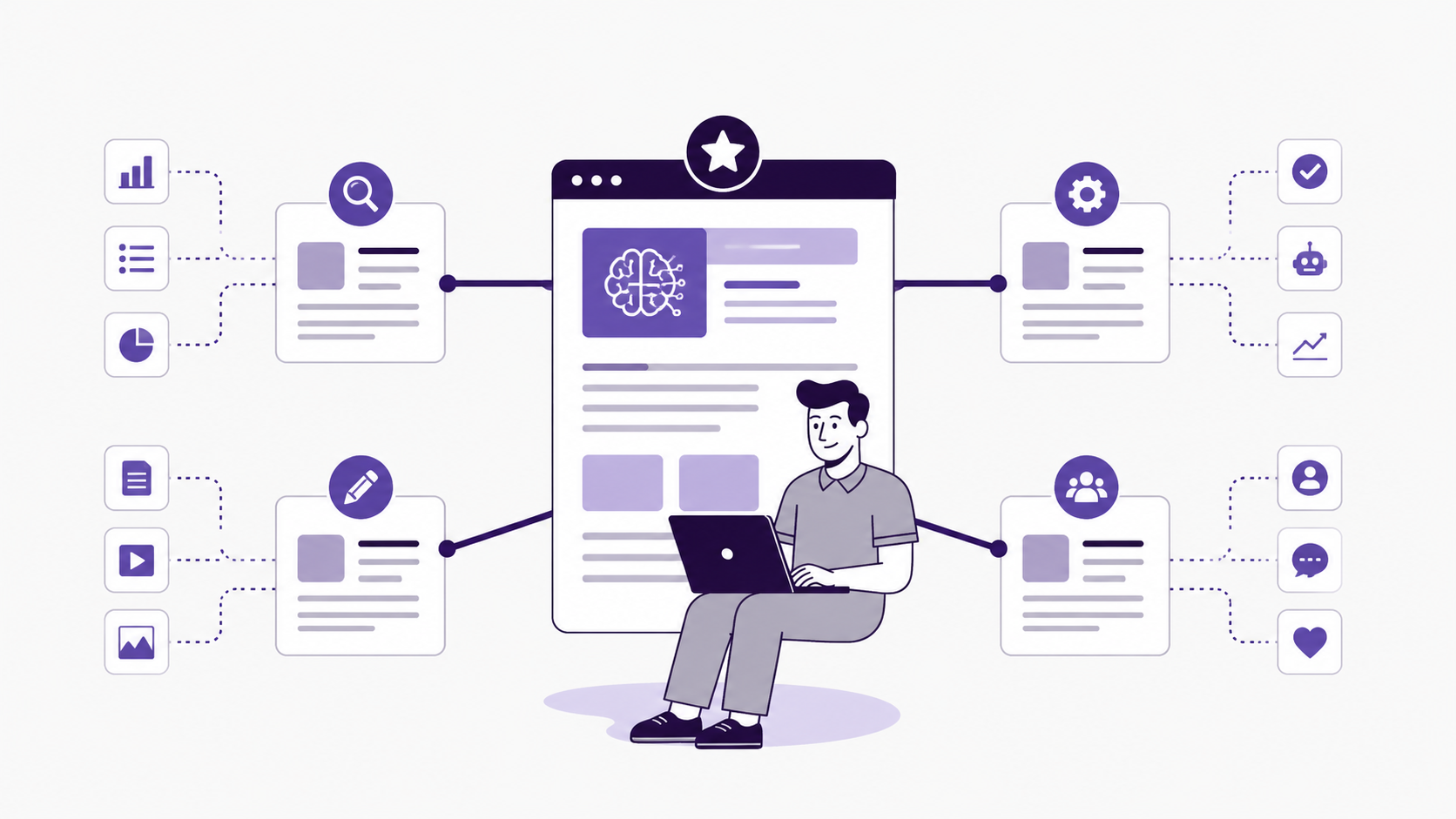
Optimizing a website with AI runs across three fronts: on-page optimization (how each page is built and written), technical SEO (how engines crawl and index the site), and content strategy (which topics you target and how they link up). AI speeds every front by automating the analysis and returning specific recommendations instead of generic best practices that may not fit your situation.
The sequence usually goes like this. Audit where you stand, find where you can gain the most, make the changes, watch performance, and keep iterating. AI handles the audit, the opportunity-finding, and the monitoring, which cuts the time hard while sharpening accuracy through data instead of guesswork.
On-Page Optimization with AI
On-page work starts with AI reading your current content against the pages beating you. It scans and flags the gaps: title tags that could carry your primary keyword more cleanly, meta descriptions that don’t sell the page to searchers, heading structures worth reorganizing for readability and keyword fit, or content missing topics your competitors cover.
For teams sitting on large libraries, 100+ pages or more, AI crawls the whole site and builds a prioritized optimization list that points your team at the highest-impact fixes first. No more scattering effort at random. You work the pages that move rankings most. The system even scores the upside: “Optimizing these 5 pages could recover approximately 800 monthly organic visits based on ranking potential analysis.” The target is right there.
Technical SEO Automation
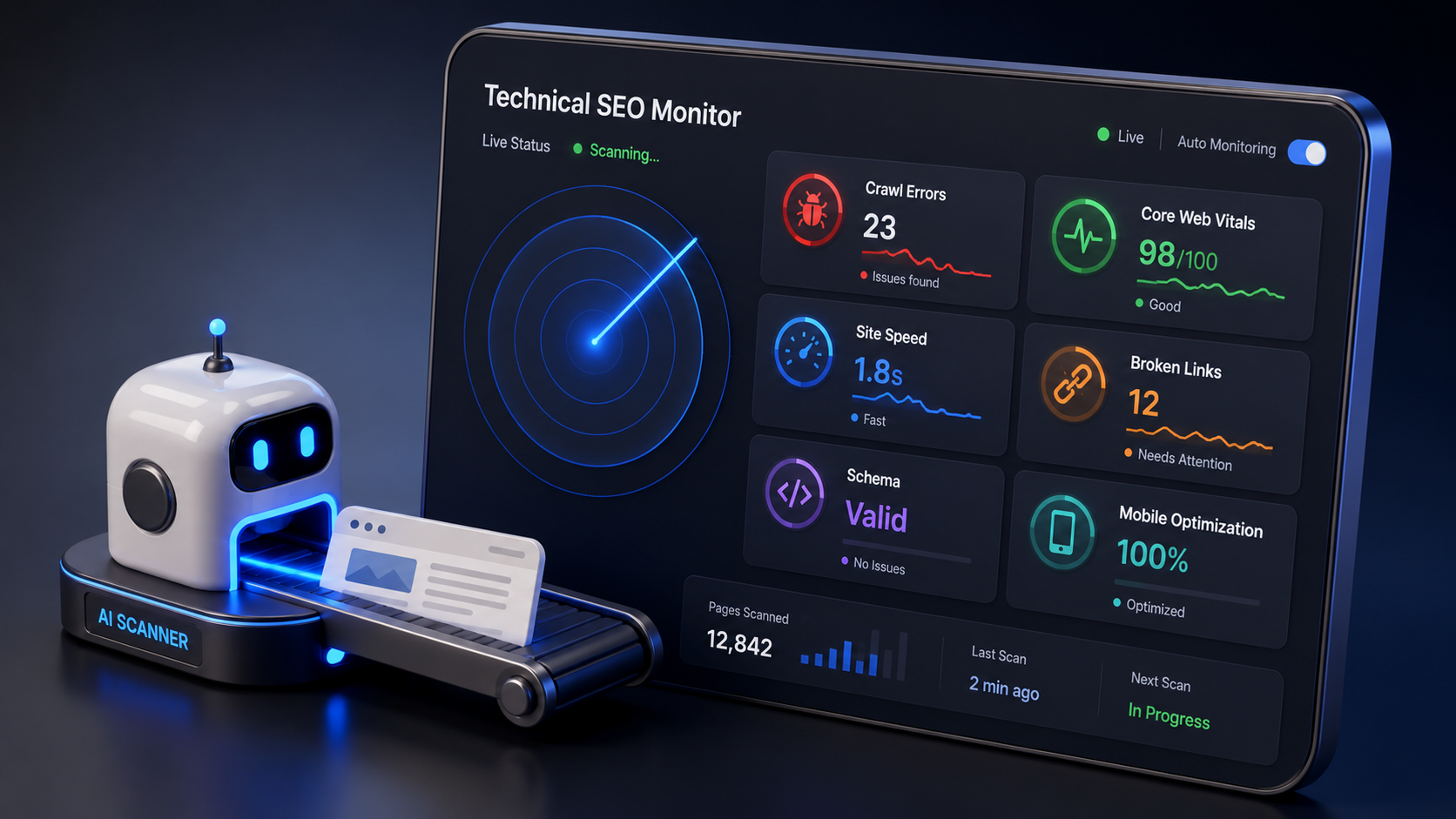
Technical SEO means crawling the whole site, finding what blocks proper indexing and ranking, and fixing it. That’s a job built for automation. The old approach put an SEO specialist on manual page-by-page inspection. Now AI-powered SEO tools sweep the entire site on their own and produce a full audit that surfaces duplicate content across pages, missing or conflicting hreflang tags that hurt international SEO, broken internal links that wreck the user experience, crawl errors that stop indexing, and site structure that fails to spread link authority.
Semantic Optimization and Entity Recognition
AI reads entities, the specific people, places, concepts, organizations, and products in your content, and it reads how they connect. Optimize a piece for “AI SEO tactics” and the system recognizes the entities that belong nearby: specific AI tools (ChatGPT, Claude, specific SEO platforms), industry figures, relevant platforms. Then it tells you to work them in, which raises semantic relevance and builds topical authority.
Pages that cover an entity cluster in full, the topic plus every related entity and concept, outrank pages that treat topics in isolation. AI pushes your content toward that complete coverage so search engines read the authority signal. You move past just talking about “AI SEO tactics” and into owning the whole cluster: the tools, the approaches, the connected ideas.
What Role Does AI Play in Local SEO and Search Optimization?
Local SEO covers location-based searches like “SEO agency near me,” “digital marketing services in [city],” or “best seo tools in [region],” and it drags along a load of complexity: multiple location pages, local listings, and content variants for each spot. That’s a scale problem, and scale is exactly where AI earns its keep. It automates the repetitive local work that normally swallows hours, so you hold a steady presence across dozens or hundreds of locations.
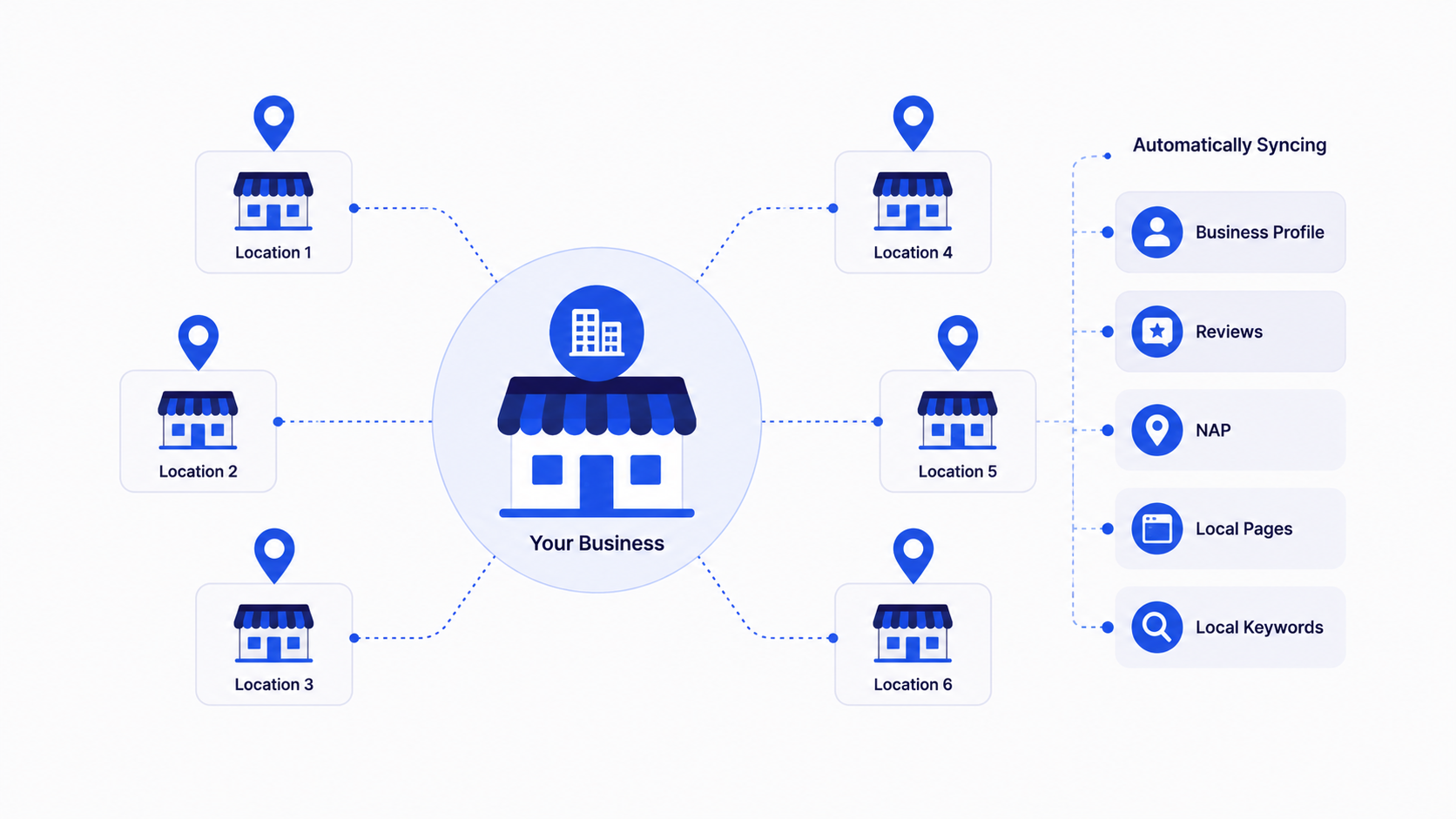
Multi-location businesses feel this most. AI generates location-specific pages, each tuned for local search and still on-brand. Instead of writing separate content by hand for every location, you run variations off a template that pull in local keywords, location names, business details, relevant case studies, and the services or products that fit that area. An agency with 50 locations spins up 50 optimized pages in hours, not weeks. Each one fits its local search behavior while your brand voice and value proposition stay intact.
Local Business Listing Optimization
Keeping local listings straight across Google Business Profile, Apple Maps, Bing Places, directories, review sites, and industry platforms is a genuine time sink. When those listings disagree, customers and search engines both get confused, and local visibility takes the hit. AI syncs your business information across every platform at once, so the name, address, phone number (NAP), hours, categories, descriptions, and images match everywhere you show up.
Business details change. You move, you shift hours, you add a service. AI pushes the update to every listing at the same moment instead of leaving you to edit dozens of platforms one at a time. This part isn’t optional: search engines treat listing consistency as a trust signal. Listings that contradict each other read as unreliable, and that drags your local visibility down. AI holds the consistency for you.
Review Monitoring and Response
AI watches customer reviews across platforms, flags new ones for your team, and drafts smart response suggestions. Rather than checking Google, Yelp, Facebook, niche review platforms, and aggregators by hand every day, you get an automatic alert. The system reads sentiment as reviews land: positive ones surfaced for a quick thanks, negative ones bumped to priority before they dent your reputation.
Those response drafts hold your brand voice while they address the actual concern. A one-star review reading “poor communication about timeline” produces a suggestion that owns the problem, explains what went sideways, and offers to fix it. The drafts keep tone consistent and make sure reviews get prompt, fitting replies that show you’re paying attention. Review responsiveness feeds local SEO rankings, so automated monitoring means you never miss the window to reply.
Local Search Ranking Optimization
Local rankings ride on three factor groups: relevance (how well your business matches the query), distance (how close you sit to the searcher), and prominence (how established you look). AI works all three at once. Relevance comes from location pages carrying the right local keywords and details. Distance depends on accurate location data, which AI keeps clean. Prominence builds through local citations (business mentions on relevant local sites), local backlinks from community pages, business photos, and posts.
The system pulls the high-priority local keywords for each location, the terms people in that area actually type, and recommends content that answers them. Take a plumbing business in Austin. Local keyword research turns up “emergency plumber Austin,” “24 hour plumber Austin,” “affordable plumber Austin,” and “plumbing repair Austin” as high-volume searches. AI then recommends content for each with location-specific detail. No guessing at what people search. You optimize on the data.
Multi-Language Local SEO
Serving communities that speak different languages usually means hiring translators and local SEO specialists for every language-and-location combination. AI runs local SEO across languages at scale instead. It generates location and language-specific content variations that account for cultural nuance and how people actually search in each market. A health provider covering English and Spanish-speaking communities produces location pages tuned for both languages automatically.
Translation alone doesn’t cut it, and the system knows that. Content has to be culturally adapted. Health terminology, search habits, and information preferences shift across cultures. AI builds culturally appropriate variations rather than word-for-word conversions. Global businesses rank across geographic and linguistic markets at the same time, and the content workload doesn’t balloon to match.
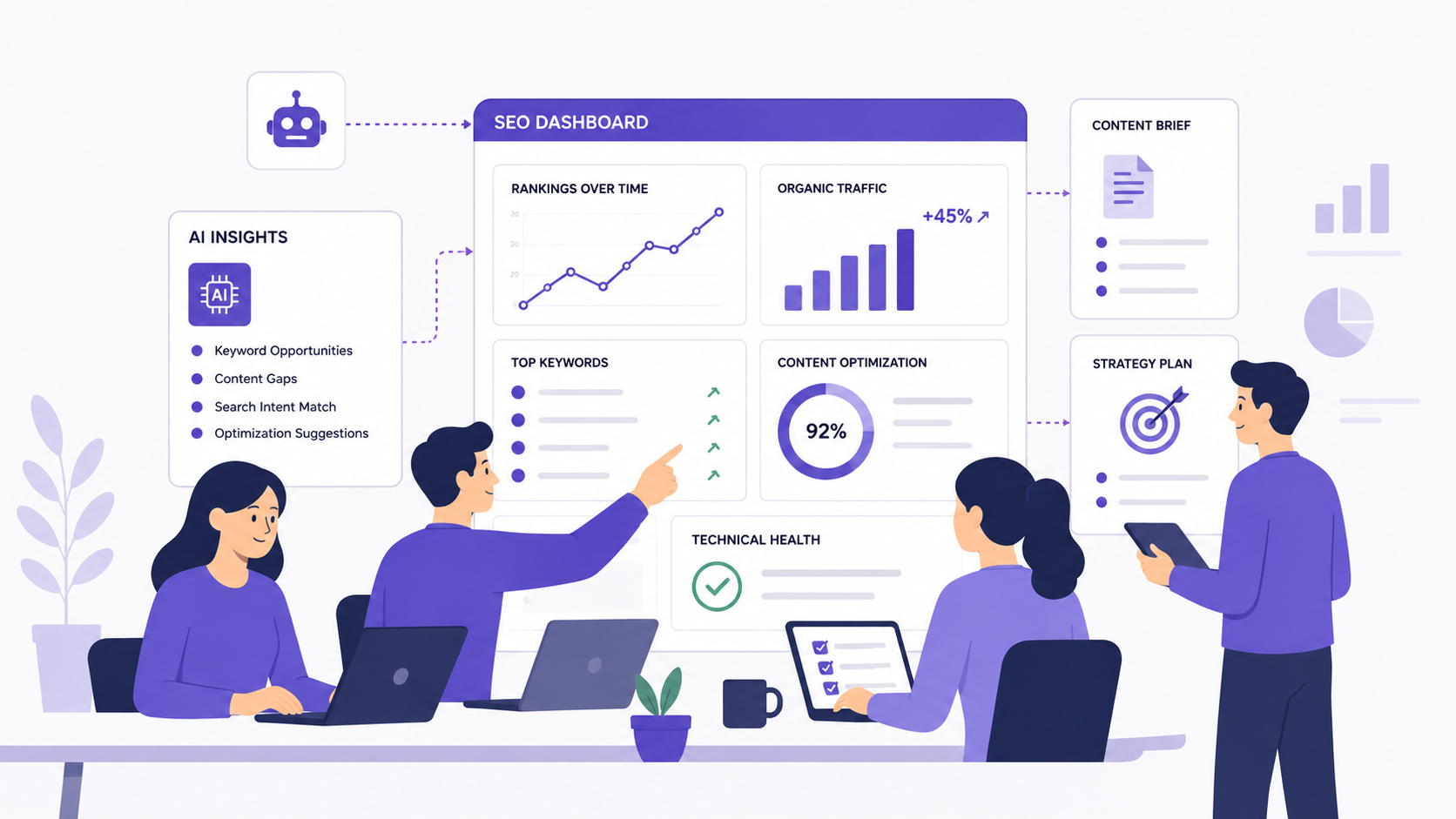
How Is AI Reshaping Traditional SEO Best Practices?
AI is rewriting what counts as SEO best practice. The move is away from manual, rules-based optimization and toward data-driven strategies that react to current ranking data instead of old rules. Follow these shifts and you stay ahead of the field, running tactics that hold up as SEO keeps moving. The landscape you learned five years ago isn’t the one in front of you now, and today’s won’t survive the next five either.
Old best practice leaned on exact-match keyword usage (drop your exact phrase in verbatim), density targets (1-2% was the sweet spot), and set length recommendations (1,500-2,000 words was the standard call). Those rules were rough approximations of what happened to rank at one moment in time. AI, reading millions of ranking pages without pause, found they were often wrong or half-right. Competitive keywords reward 3,000+ word articles over shorter ones, consistently. Exact-match keywords carry far less weight than semantic relevance and topic depth. Length swings wildly by intent and competition. No universal “ideal length” exists.
From Rules to Context
AI drags SEO off rigid rules (“Include your keyword in the first 100 words, use it 2-3 times total, create content exactly 2,000 words long”) and onto context: the specific keyword difficulty, the competitive field, the search intent, the audience’s expectations. “AI SEO tactics” runs high competition and informational intent, so the optimal piece is 4,000+ words, genuinely thorough, stacked with examples and implementation frameworks. “seo tools” carries mixed intent and brutal competition, so content needs a strong commercial angle, direct comparisons, and pricing. “seo for beginners” sits at low competition with educational intent, where a 1,500-word intro can actually beat longer pieces that drown a new reader.
From Keyword Targeting to Topic Mastery
Traditional SEO chased single keywords: one piece for “SEO strategy,” another for “seo strategy builder,” another for “competitive SEO content,” another for “seo strategies.” That splinters your content, and now your own pages fight each other for the same intent. Modern AI-driven SEO chases full topic understanding instead. Rather than a separate piece per variation, you build one comprehensive pillar on the broad topic (“SEO Strategy: Complete Guide”) and back it with related pieces on specific angles and use cases (“SEO Strategy for E-Commerce,” “SEO Strategy for Local Businesses,” “SEO Strategy Tools,” and so on).
Search engines keep rewarding thorough topic coverage over keyword farming. One site with a single comprehensive piece across a topic cluster outranks a site running 10 narrow pieces, each chasing one keyword. AI finds the right topic structure, then holds you to full coverage inside each piece and across the whole library.
User Experience as Core SEO Signal
AI has moved user experience from a nice-to-have into a primary ranking signal. Pages that load slowly (over 3 seconds), bury content under intrusive ads or pop-ups, lack clear navigation, or stumble on mobile get penalized in AI-driven rankings no matter how good the writing is. Traditional SEO could sometimes muscle past weak UX with strong content. Modern AI-driven SEO treats UX as non-negotiable, right alongside content quality.
So your optimization has to cover a wider board: page speed (how fast pages load), mobile responsiveness (how they behave on phones and tablets), readability (clean fonts, real white space, logical structure), visual design (professional, uncluttered), and clear calls-to-action (where does the user go next?). Content quality alone won’t carry a page anymore. You need the writing and the experience pulling together.
AI-based SEO tactics mark a real shift in search optimization, trading slow manual work for scalable automation that returns better results. Wire in AI-powered keyword research, content optimization, competitive analysis, and performance monitoring, and your odds of landing maximum visibility climb sharply. The implementations that win pair automated execution with human judgment, letting AI grind through the repetitive analysis and content generation that used to burn weeks, while your marketers hold the line on strategy, quality, and business fit. Stuck on the slog of manual content creation, short on SEO expertise, or scrambling to keep pace with algorithm shifts and competitors?
AI SEO tactics hit those pain points head-on by automating the routine and handing you data-backed direction. Search engines keep tilting toward AI in ranking decisions and rewarding thorough, well-optimized content, so the distance between AI-optimized and hand-optimized work only stretches wider. The businesses pulling ahead in organic search are the ones adopting AI SEO tactics now and banking advantages in automation, scale, and consistency that manual work can’t reach. The real question isn’t whether to adopt AI SEO tactics. It’s how fast you can get them running before a competitor takes the share you’re leaving on the table.
Ready to transform your SEO strategy with AI-powered automation? See how modern AI platforms automate keyword research, generate optimized content, and track performance, so your team scales SEO-driven growth without adding headcount. Start putting AI SEO tactics to work today and watch your organic visibility, rankings, and traffic climb month after month.
