guide

AI SEO Tool for SaaS: Complete Keyword & Content Strategy Guide

Date

Author

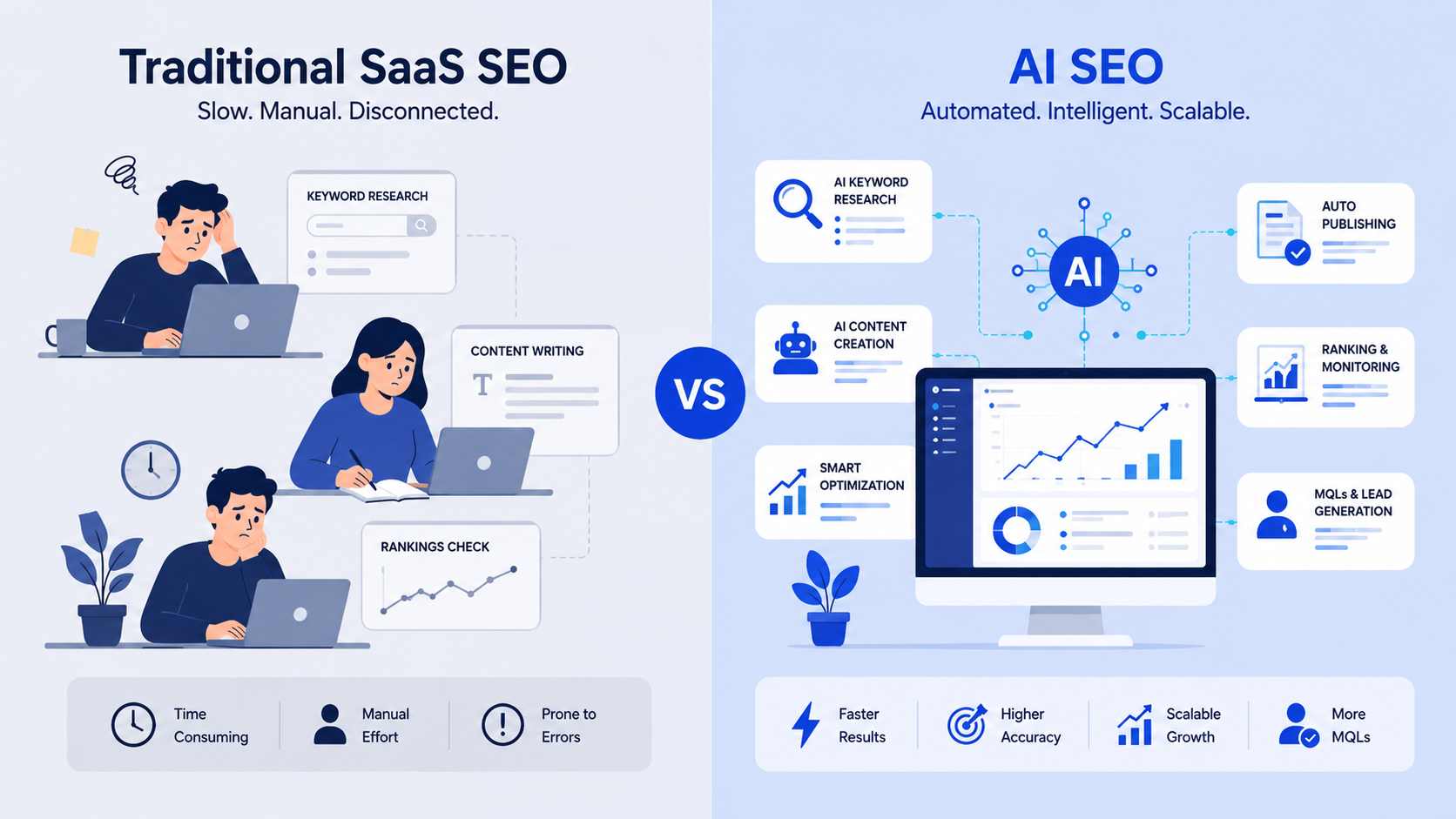
Competing for visibility in crowded SaaS markets is tough. Manual SEO takes months of work—from researching keywords to optimizing content to tracking results. An AI SEO tool for SaaS companies changes this equation by automating the heavy lifting while keeping strategic control in your hands. These tools accelerate keyword research, streamline content optimization, and monitor performance across hundreds of keywords simultaneously. For SaaS businesses, implementing an AI-powered SEO strategy combined with the right keyword approach and content publishing rhythm can reduce your time-to-MQL by 60-70% while dramatically improving search visibility. This guide walks you through a complete AI SEO for SaaS playbook—including which keywords to target, publishing frequency that drives results, content types that convert, realistic timelines to qualified leads, and the specific tools that deliver. Whether you’re a five-person startup or a growth-stage company with dedicated marketing resources, you’ll find actionable strategies to turn organic search into your most cost-effective acquisition channel.

Why AI SEO Matters for SaaS Companies

SaaS companies face a unique competitive landscape where traditional marketing approaches often fall short. Your buyers aren’t waiting for sales calls—they’re actively searching for solutions. When prospects search for terms like “project management software” or “customer support automation,” they’re signaling buying intent. They’re in self-education mode, comparing alternatives, evaluating pricing, and qualifying solutions long before they ever contact your sales team. This is where SEO becomes invaluable.

Here’s the reality: whoever appears first in those search results wins that moment. Your product might be the perfect fit, but if competitors show up on page one and you’re on page three, you never get the chance to prove it. The opportunity cost is staggering—every day without strong SEO visibility means qualified prospects finding your competitors instead.

The problem? Manual SEO for SaaS is genuinely resource-intensive. Traditional keyword research requires analyzing search intent, competition levels, and ranking difficulty. Creating content demands understanding buyer personas deeply, addressing objections at each funnel stage, and optimizing for both search engines and conversions. Deciding how often to publish and what topics matter means balancing quality with frequency—publish too infrequently and you lose momentum; publish without strategy and you waste resources on content that doesn’t rank or convert.

For growing SaaS teams without a dedicated SEO agency, this becomes overwhelming fast. You need to move quickly, but you can’t sacrifice quality. You need consistent publishing, but your team gets pulled toward product development. This is exactly where AI SEO tools provide real leverage.

How AI SEO Tools Level the Playing Field

Modern AI SEO solutions automate repetitive tasks while keeping strategic control where it matters. According to Semrush’s industry analysis, companies using AI-assisted SEO see 40-50% faster content production without sacrificing quality. For SaaS specifically, AI-powered keyword research identifies high-intent buyer keywords your team might miss through manual analysis alone. AI content optimization ensures every article targets the right keywords, answers user questions comprehensively, and follows search engine best practices automatically.

The compounding effect is powerful: more content published faster, better-optimized from day one, regularly updated based on performance data. Over 6-12 months, this acceleration creates a significant gap between your organic visibility and competitors still working manually. For SaaS companies with 5-50 person teams, AI SEO tools essentially level the playing field against larger competitors with dedicated SEO departments.

The tangible benefit: AI-assisted SaaS SEO programs typically achieve first meaningful page-one rankings 2-3 months faster than manual approaches, leading to earlier traffic, earlier leads, and earlier proof-of-concept that organic acquisition works for your business.
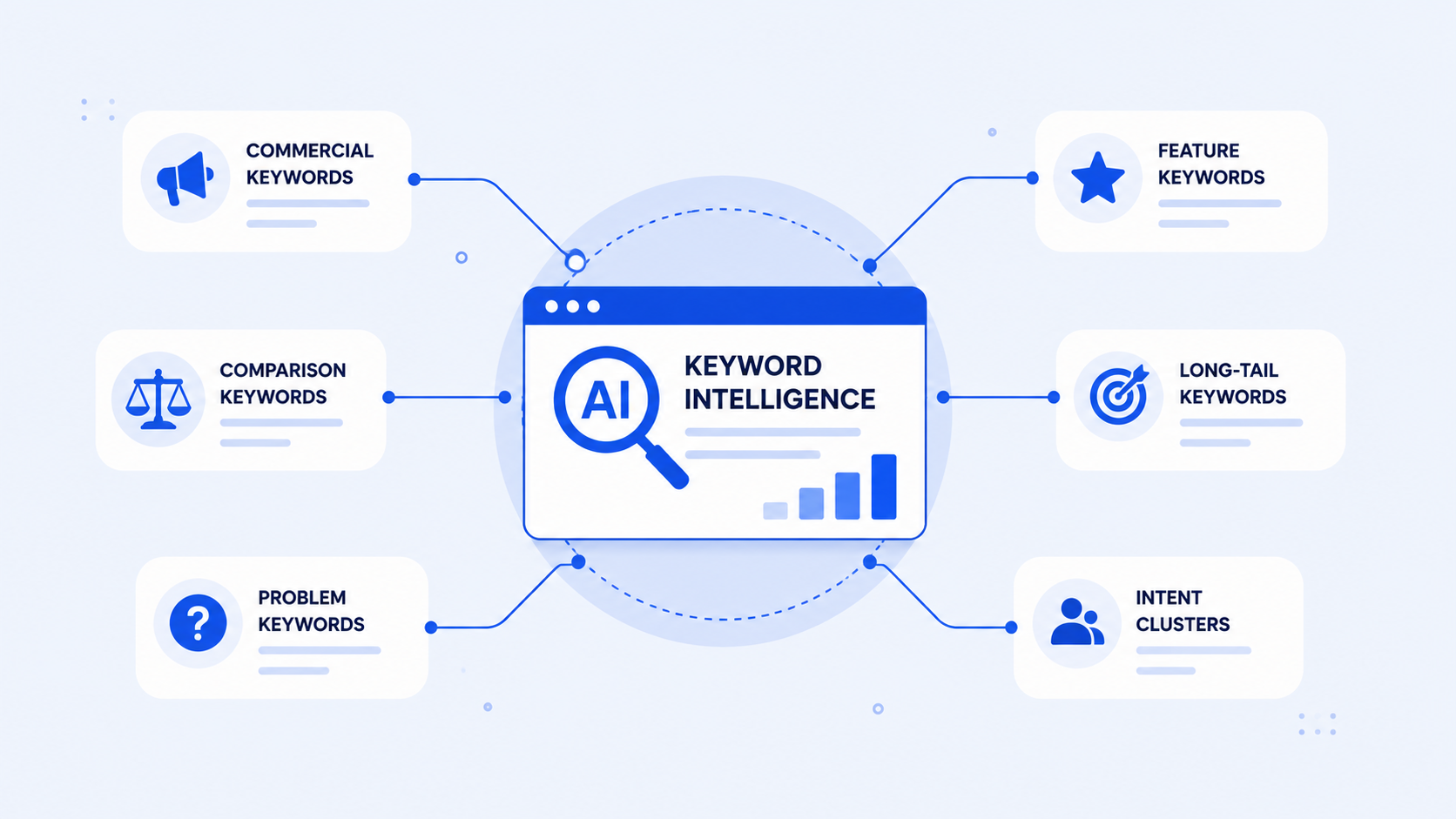
How AI Keyword Research Works for SaaS

Traditional keyword research for SaaS involves manually searching tools like Google Search and Moz Keyword Explorer to surface opportunities. You might spend hours identifying keywords, then more time analyzing each one for search volume, competition, and whether your site could realistically rank. An AI SEO tool for SaaS companies compresses this entire process. Instead of hours, you get comprehensive keyword recommendations in minutes—automatically analyzed for opportunity potential and strategic fit.

The AI Keyword Research Process Explained

Here’s how the AI-driven approach works in practice: First, the AI analyzes your SaaS website, product, and existing content to understand your market position and what you’re currently optimized for. Second, it scans competitor websites and content to identify keywords they’re ranking for and—crucially—gaps where you have opportunity. Third, the AI processes large-scale search volume and competition data from sources like Google Search Central, identifying keywords where your domain can realistically rank based on current authority and content depth.

Fourth, and this is where AI excels, it clusters keywords by user intent. This means distinguishing between someone searching “what is project management” (informational, early awareness) versus “buy project management software” (transactional, ready to purchase). This intent-based clustering is critical for SaaS strategy because it shapes your entire content plan.

The output isn’t just a massive list of keywords to overwhelm your team. Instead, AI organizes recommendations by strategic priority—automatically identifying which keywords represent the best opportunities for your specific situation.

Understanding the Keyword Categories AI Identifies

For SaaS, effective AI keyword research typically categorizes opportunities into three funnel stages:

Top-of-funnel (awareness) keywords are broad, high-volume terms where search intent is exploratory. Examples: “what is project management software,” “benefits of remote work tools,” “how to improve team productivity.” These attract larger audiences but typically have lower conversion rates to leads. Think of them as awareness-building content that positions you as knowledgeable in your space.

Mid-funnel (consideration) keywords show more specific, buyer-intent signals. Examples: “best project management tools for remote teams,” “Asana alternatives,” “project management software comparison.” These have moderate search volume but significantly higher commercial intent. Prospects reaching this content are actively evaluating solutions. Conversion rates are substantially higher here.

Bottom-funnel (decision) keywords indicate buying readiness and highest intent. Examples: “project management software pricing,” “implement project management tool,” “project management software ROI.” These drive fewer clicks but the highest conversion rates to MQLs. Every visitor here is genuinely considering purchase.

For a SaaS company selling project management software, an AI keyword research tool might identify 200+ relevant keywords across all three categories. Rather than manually analyzing each one (a process taking 10+ hours), AI prioritizes based on opportunity score—a calculation combining search volume, competition level, and estimated traffic potential. Most AI tools recommend starting with 20-30 primary keywords and building your comprehensive strategy around these high-impact targets.

The practical benefit: Your team moves from “which keywords should we target?” (a question taking days to answer well) to “here are our top 30 opportunities ranked by impact” (answered in minutes, with detailed analysis behind each recommendation).

What Content Types Convert Best for SaaS SEO

Ranking content and converting content are not the same thing. A piece might capture 500 monthly visitors but zero leads because it’s not structured for conversion. Conversely, a niche comparison guide might rank for a lower-volume keyword but convert at 10% because it serves exactly where prospects are in their buying journey. Understanding which content types work best for SaaS SEO—both for ranking and conversion—is essential for strategy.

High-Performing Content Types for SaaS Markets

Comparison content ranks exceptionally well for mid-funnel SaaS keywords and converts at above-average rates. When prospects search “Asana vs Monday” or “HubSpot vs Salesforce,” they’re actively comparing options. They want objective analysis of features, pricing differences, use-case fit, and which tool works for different scenarios. Detailed comparison guides dominate these search results for good reason—they deliver exactly what searchers want. AI tools help by identifying comparison opportunities in your keyword data and suggesting content angles that differentiate your approach while remaining objective. The best comparison content isn’t about why your product wins—it’s about helping prospects understand when each solution makes sense.

Buyer guides and feature guides also perform well. A guide titled “Beginner’s Guide to Project Management Software” attracts prospects in awareness stage while subtly positioning your product as an ideal solution. Feature-specific guides like “How to Use Task Dependencies in Project Management” capture users searching for how-to information and demonstrate how your product simplifies the process. AI tools accelerate this by analyzing search intent for these queries and recommending specific angles likely to rank and convert.

Case studies and customer success stories provide crucial social proof at the consideration stage. When prospects see how similar companies (ideally in their industry or facing similar challenges) achieved results using your product, objections decrease significantly. Use AI tools to identify which customer outcomes match your keyword opportunities. If you have customers in e-commerce who increased productivity by 40%, create a case study specifically targeting keywords around e-commerce project management tools. This targeted approach beats generic case studies.

Product documentation and help articles often rank for long-tail, high-intent keywords. Prospects searching “how to set up task dependencies in project management software” frequently land on product help articles. Individual help articles get modest traffic, but collectively they drive significant qualified volume because search intent is extremely high. Someone reading help documentation is already a customer or very close to becoming one.

Structuring Your Content Library for Maximum Impact

Rather than randomly creating individual pieces, strategic SaaS content libraries follow a specific architecture that compounds ranking power:

Start with 2-3 cornerstone pieces (3,000-5,000 words) covering broad topics directly aligned with your core value proposition. Examples: “The Complete Guide to Project Management Software” or “SaaS SEO Strategy Guide for B2B Companies.” These pieces are designed to establish topical authority—Google sees them as comprehensive resources covering everything a prospect needs to know about a topic. Cornerstone pieces take significant effort but repay that investment repeatedly as they rank for primary keywords and attract consistent traffic.

Support with cluster content (5-10 pieces, 1,500-2,500 words each) addressing related keywords. These supporting articles link to and reinforce the cornerstone piece, creating a topical cluster. For example, if your cornerstone is “Complete Guide to Project Management Software,” cluster pieces might cover “Project Management Software for Remote Teams,” “Project Management Tools for Agencies,” “Free Project Management Software,” and similar variations. This structure tells Google: “This site thoroughly covers project management software from multiple angles.”

Add quick-reference content (800-1,200 words) addressing specific questions and long-tail variations. These shorter guides capture traffic for narrowly-focused queries and link back to cluster content, distributing ranking power throughout your content library. They’re easier to produce quickly, making them perfect for maintaining publishing consistency.

Implement continuous monitoring and optimization using AI tools to track how each piece performs, identify which ones dropped in rankings and need updates, and score content for optimization based on ranking potential. Content that ranks position 8 can often move to position 5-6 with targeted optimization—a 30-50% traffic increase from the same piece.

The Optimal Content Mix for SaaS

Most successful SaaS SEO programs follow an 80/20 content rule: 80% educational, value-focused content that answers prospect questions without mentioning your product, and 20% product-focused content that positions your solution. This balance builds authority and trust while subtly moving prospects toward considering your product. Flip this ratio and you look like every other self-promotional SaaS company—your content feels like sales collateral rather than genuine help, which hurts both ranking and conversion.

What Publishing Cadence Drives Results for SaaS

One of the most underrated variables in SaaS SEO is publishing consistency. A startup publishes 8 articles in month one with enthusiasm, then product development demands pull resources away—by month four they’ve published just 2 more articles. Meanwhile, another company publishes one article every single week for two years. Which approach wins? Neither, because consistency matters more than initial volume.

Google’s algorithms reward consistent, authoritative content refresh over time. A website publishing 4 high-quality articles monthly for six months ranks better than one dumping 50 articles in a single month and then going silent. Consistency signals to Google that your site is actively maintained, regularly updated with fresh information, and genuinely focused on serving searchers in your topic area. It also distributes your effort in a way that teams can actually sustain.

Recommended Publishing Cadence by SaaS Stage

Early-stage SaaS (pre-product market fit or early customer acquisition): Target 2-3 substantial articles monthly. Focus entirely on content that your prospects will actively search for—not thought leadership pieces or industry commentary, but content addressing real search queries. Use AI tools to identify your 20-30 highest-opportunity keywords, then create content addressing these searches. Quality absolutely trumps quantity here—two deeply researched, comprehensively optimized 3,000-word guides outrank five shallow 600-word articles. At this stage, use AI for content research, structure suggestions, and optimization recommendations; your team handles unique insights and customer perspectives that make content credible and differentiated.

Growth-stage SaaS (customers exist, seeking market expansion): Increase to 4-6 articles monthly. Your content mix now includes awareness, consideration, and decision-stage content. AI tools identify content gaps in your existing corpus and recommend topics filling those gaps. Content generation tools can draft outlines and initial sections based on your strategic direction, reducing production time significantly. Your team focuses on high-value customization, unique research findings, and customer stories that AI genuinely can’t generate authentically. This stage typically requires one person dedicating half their time or more to content production.

Mature SaaS (established market position, significant customer base): Target 8-12+ articles monthly. Managing this volume typically requires dedicated content creators—the rule of thumb is one full-time person per 3 articles monthly. AI becomes essential for managing volume: from research through optimization to performance monitoring. A content marketer using modern AI content tools can produce 6-8 articles monthly versus 2-3 without automation. At this stage, you’re not just competing on ranking—you’re establishing comprehensive content libraries that dominate entire topic areas.

The Critical Consistency Factor

Here’s what matters most: consistency compounds better than volume. Publishing 4 articles monthly for 12 months beats publishing 20 articles for 2 months every time. Your AI SEO strategy should include a sustainable cadence your team can genuinely maintain long-term, even during busy product cycles. Most SaaS companies see meaningful MQL increases starting month 4-6 of consistent publishing, but only if that consistency never breaks.

Think of it like compound interest in finance—small contributions made consistently beat large sporadic contributions. Early months feel unrewarding because you won’t see ranking results. This is where many SaaS teams give up. If you push through months 1-4 with consistent publishing, months 5-12 show exponential returns on that early effort.

How Should You Structure Your Keyword Strategy Timeline

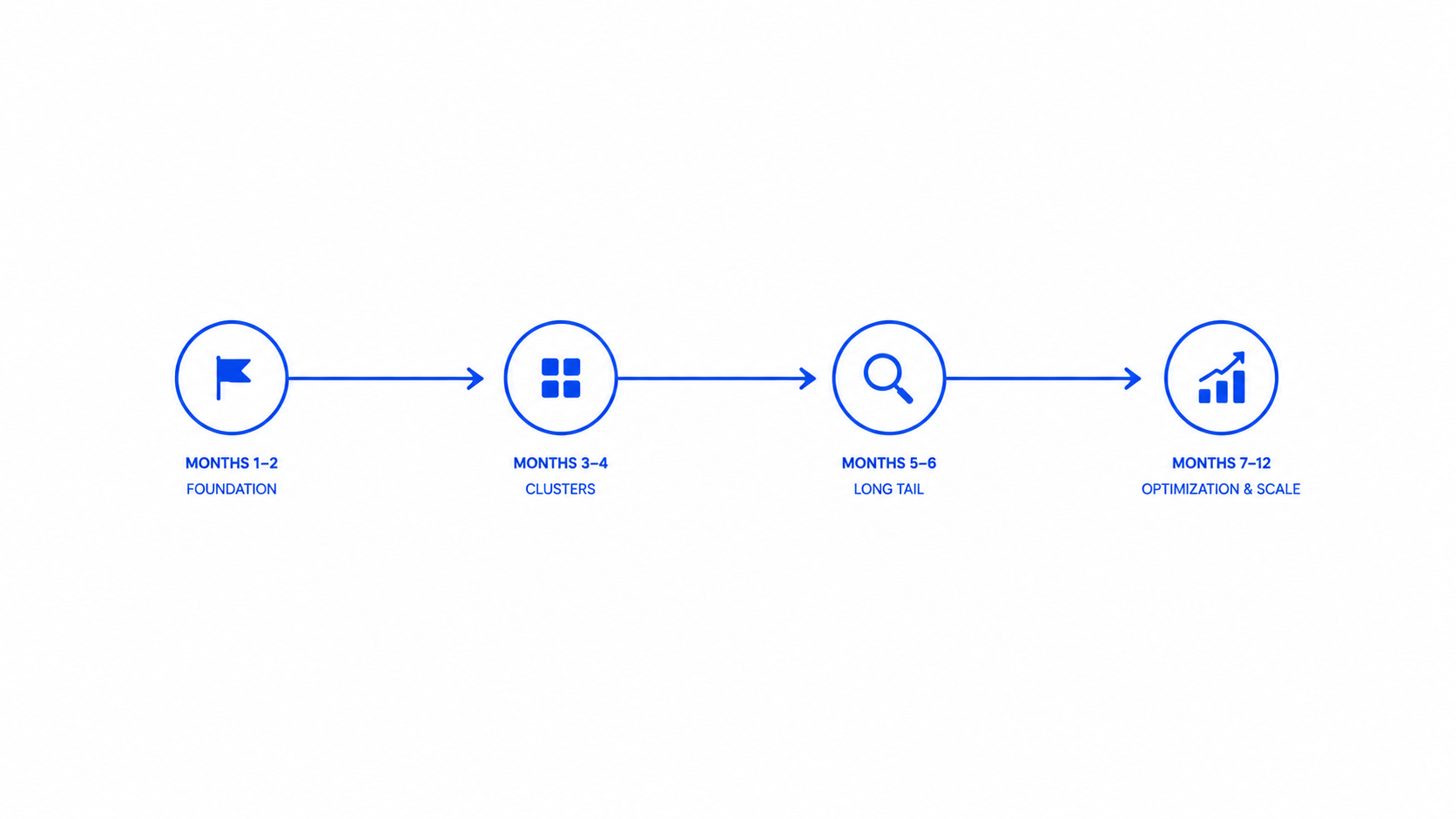
An effective AI SEO for SaaS playbook doesn’t tackle all 200+ identified keywords simultaneously. Instead, it phases keyword targeting strategically, matching your content production capacity with market opportunities. This phased approach is realistic, measurable, and actually executable.

Phase 1 (Months 1-2): Foundation & Authority Building

Focus exclusively on cornerstone content targeting your 5-10 primary, broadest keywords. These are keywords directly aligned with your core product value proposition. If you sell project management software, these primary keywords might be “project management software,” “best project management tools,” and “project management solution for teams.” Using an AI SEO tool, research the top-ranking content for each keyword, then create pieces that exceed them in depth, clarity, real-world usefulness, and comprehensiveness.

Publish 2-4 cornerstone pieces during this phase—not more. These are your heavy-hitting pieces, each 3,000-5,000 words, comprehensively optimized, and internally linked together so Google understands their topical relationships. You won’t see ranking results yet. That’s normal and expected. You’re building the foundation that future content will build upon. This phase typically takes 4-8 weeks depending on your team’s content creation capacity and how thoroughly you research each piece.

Phase 2 (Months 3-4): Topical Authority & Cluster Development

With foundation content published, now build cluster content around 10-20 secondary keywords related to each cornerstone topic. For a project management software company, if your cornerstone is “Project Management Software,” your cluster might include “Project Management Software for Teams,” “Project Management Software for Remote Work,” “Project Management Software Free,” and “Best Free Project Management Tools.” Create 1,500-2,500 word articles addressing each cluster keyword.

Use AI tools to optimize internal linking—each cluster article should link to the cornerstone piece and to related cluster articles, creating a web of topically cohesive content. This structure tells Google: “This site doesn’t just have one page about project management software—it has a comprehensive resource library.” During this phase, maintain your 2-4 articles monthly cadence. By month 4, you should have 8-12 published pieces creating clear topical authority in your primary market.

Phase 3 (Months 5-6): Long-Tail Capture & Conversion Optimization

With broad topical authority established, expand into long-tail keywords and comparison-focused content. An AI tool can identify 50+ long-tail variations of your primary keywords—”best project management software for agencies,” “project management software for nonprofits,” “project management software for healthcare,” etc. These individual keywords have lower search volume, but collectively they drive significant traffic and—importantly—often have higher conversion rates because they’re more specific to particular use cases.

Additionally, create comparison content addressing specific competitive scenarios. If prospects frequently ask “Asana vs Monday” or “Monday vs ClickUp,” create detailed comparison guides. During this phase, you’ll start seeing organic traffic inflection points as earlier content begins ranking. Use AI-powered keyword research tracking to identify which of your published pieces are ranking and for which keywords, then optimize underperformers. A piece ranking position 8-10 might jump to position 5-6 with targeted optimization, increasing traffic by 30-50%.

Phase 4 (Months 7-12): Optimization, Expansion & MQL Tracking

Continue producing new content while systematically optimizing existing pieces. An AI content monitor should flag pieces that have dropped in rankings or are sitting on page 2—content that’s close to breaking through to page 1. Optimize these with improved title tags, better targeting of primary keywords, additional internal links, and fresh statistics or examples. Expand your content strategy to capture emerging keywords—terms you weren’t initially targeting but competitors now rank for.

By month 7-9, you should see consistent organic traffic and initial MQL volume. Track which content pieces drive the most MQLs and highest-quality leads, then expand your strategy around those high-converting topics. If comparison content converts at 8% but awareness-stage content converts at 1%, that insight should shape your month 8-12 content priorities. This is where data-driven iteration becomes essential.

Phased Approach Benefits

This phased strategy works because it matches realistic team capacity while building compounding authority. Rather than overwhelming your team trying to tackle 200 keywords simultaneously, you focus strategically: establish authority in primary areas, then expand systematically. It’s measurable—you can track which phase you’re in and which metrics indicate readiness for the next phase. Most importantly, it’s sustainable. A team that successfully executes all four phases has built a content engine they can continue operating long-term, feeding organic growth consistently.

What’s the Realistic Timeline to See MQLs from Organic Search?

Every SaaS marketer asks this question: how long until organic search drives meaningful lead volume? The honest answer depends on several variables—competition level, content quality, traffic conversion rates—but a realistic timeline follows a predictable pattern. Understanding these phases helps you maintain focus and patience through the early months when results feel invisible.

Months 1-3: Foundation & Visibility Building (Minimal MQL Impact)

During the first three months, you won’t see significant MQL volume from organic search. You’re publishing content, optimizing for search engines, but your domain authority is still establishing and your content is new. Google needs time to crawl and index your content thoroughly. Most new content ranks nowhere initially—if you check search rankings in week 2 after publishing, you’ll likely find nothing. This is frustrating but completely normal. Google doesn’t immediately trust new content from domains without significant authority.

Here’s what you should realistically see: 50-200 monthly organic sessions by month 3 (depending on how competitive your keywords are and how thorough your early content is). MQLs from organic traffic? Probably 1-3, maybe zero. However, you should see increased branded search volume and direct traffic from people discovering your brand through social sharing or other channels. This early period is less about generating leads and more about establishing presence.

Critical point: This is when most SaaS companies abandon SEO. They published content, waited 6 weeks, saw no leads, and concluded “SEO doesn’t work for us.” This is why consistency matters. If you stop in month 3, you’ve invested time and resources with zero return. If you push to month 6, you hit the inflection point and suddenly see why you persisted.

Months 4-6: Ranking Acceleration (MQLs Finally Appear)

Around month 4-5, your earliest published content begins ranking on page 2-3 of search results. This is a crucial milestone—Google has decided your content is relevant enough to show, even if not yet in the premium top-5 positions. By month 5-6, some pieces start appearing on page 1. This is when the inflection point hits.

You’ll notice the shift suddenly. A piece that was getting 0 visits suddenly gets 50-100 monthly. Collectively, organic traffic often jumps from 200 sessions to 500-2,000 monthly. MQL volume increases correspondingly—typically 5-20 MQLs monthly depending on traffic volume and your lead conversion rate.

Conversion rates from organic traffic to MQLs vary significantly by industry and product. B2B SaaS companies with free trials typically see 3-8% conversion (100 organic visitors = 3-8 MQLs). Companies requiring contact for a demo might see 1-3%. Companies with low-friction signups might see 10-15%. At month 5-6 with 1,000 monthly organic visitors and 5% conversion rate, expect approximately 50 MQLs monthly from organic.

Why the acceleration? Three reasons: First, more of your content library is ranking. Second, your domain authority has improved, so new content ranks faster initially. Third, your internal linking structure distributes ranking power across your site more effectively.

Months 7-12: Authority & Consistency Compound (Meaningful MQL Volume)

Months 7-12 show the compounding effect of consistent SEO effort. Your content library grows. Early pieces continue ranking and improving in position. New pieces rank faster due to increased domain authority. Organic traffic often reaches 2,000-5,000+ monthly visitors. MQL volume reaches 50-150+ monthly depending on conversion rates and content quality.

Domain authority improves steadily: Your site gains more credibility over time, making all future content rank faster and higher initially than month 1 content did. This is the compounding effect working in your favor.

Content cross-pollination accelerates: Your internal linking structure creates pathways between pieces, distributing ranking power and improving user experience. A visitor to one guide discovers three related guides, increasing engagement and conversion probability.

Competitive advantages emerge: By month 9-12, your content library in specific niches becomes more comprehensive than competitors’ libraries. You have 5-10 pieces covering project management for agencies, while competitors have maybe one generic piece. This comprehensive coverage creates ranking advantages.

Traffic quality improves: Early organic traffic is often generic and lower-intent. By month 7-12, your targeted content attracts increasingly high-intent visitors converting at higher rates. A visitor finding your “Project Management Software Pricing” comparison is more likely to become an MQL than someone landing on your generic “What is Project Management?” guide.

Month 12+: Sustainable Growth & Scale

By month 12, if you’ve maintained consistent publishing and systematic optimization, organic search should be a reliable, scalable MQL source. Many SaaS companies see organic search representing 20-40% of total MQL volume by this milestone. The beauty of reaching this point is that the compounding continues indefinitely—existing content keeps improving rankings, new content accelerates faster due to domain authority, and your comprehensive content library provides ranking advantages for emerging keywords.

Variable that accelerates timeline: Content quality and optimization directly impacts this entire timeline. A SaaS company publishing optimized, comprehensively researched content ranks 2-3 months faster than one publishing generic content. This is where AI SEO tools create concrete timeline advantages—better-optimized content from day one potentially accelerates your MQL timeline by 1-2 months, which is significant when waiting 6 months for results anyway.

How AI-Powered Content Optimization Improves SEO Performance

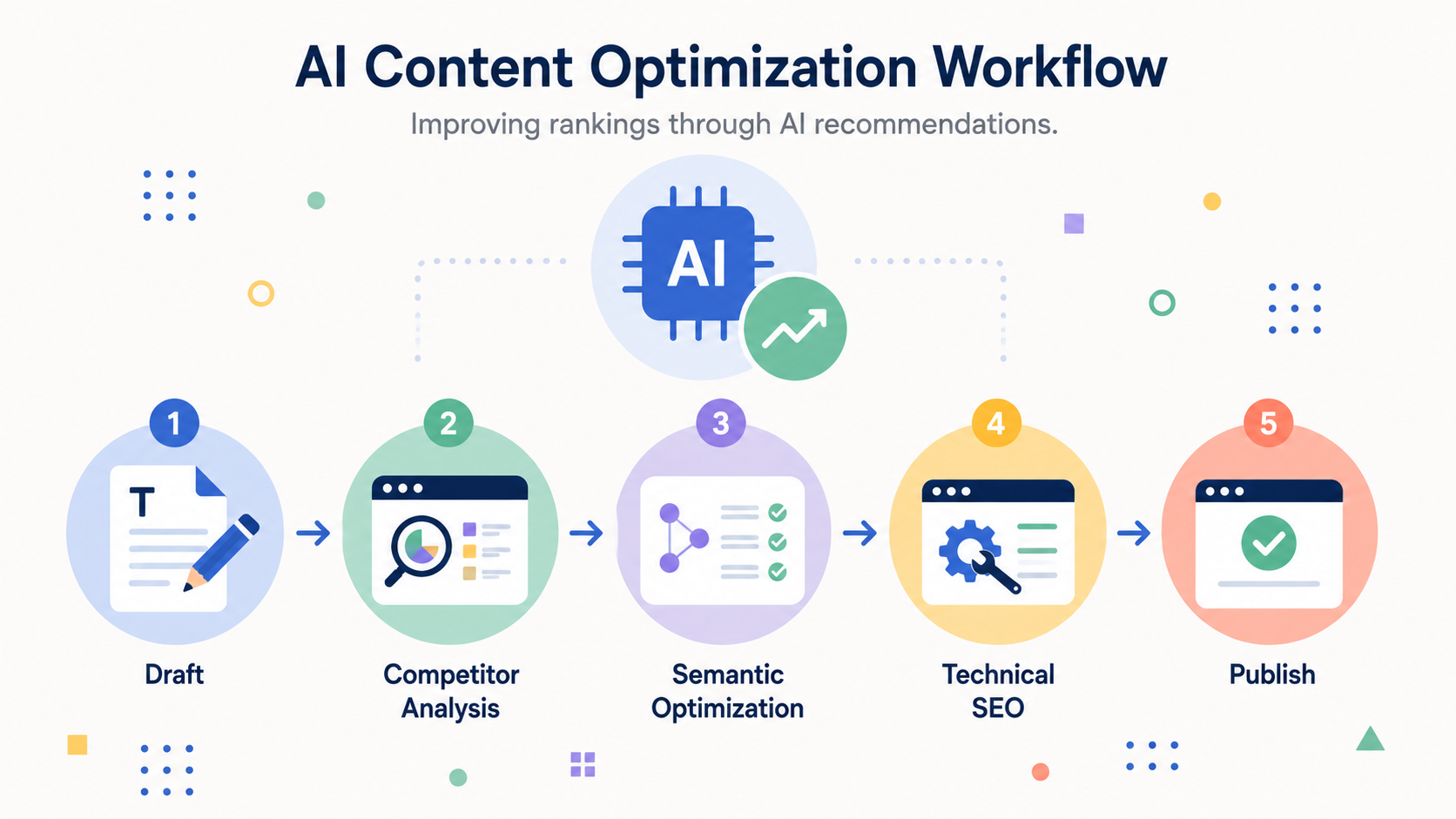
Beyond automating keyword research, modern AI SEO tools optimize the content itself in ways that directly improve search rankings. Content optimization used to require manually comparing your draft against top-ranking pages, noting keyword frequency, analyzing heading structure, checking content length, and adjusting based on what you learned. This process consumed hours per article. AI-powered content optimization handles this automatically, analyzing top 10 ranking pages and providing specific, actionable optimization recommendations.

What AI Content Optimization Actually Does

Keyword analysis and density optimization: AI identifies the exact keywords top-ranking pages use in titles, headings, and body content, recommending optimal keyword density (typically 1.0-1.5% for primary keywords to avoid over-optimization that triggers spam filters). Rather than guessing whether you’ve included keywords enough, AI shows you: your primary keyword appears 0.8% (too low), recommend increasing to 1.2%. This removes guesswork.

Content structure analysis: The tool examines how many H2 and H3 headings top-ranking pages use, their placement, and structure, then recommends similar structure for your piece. If all top-ranking pages about “project management software” use 5-7 H2 headings with 2-3 H3 subheadings each, but your draft has 3 H2s, you’ve identified a structural gap.

Word count and section recommendations: AI analyzes average word count (typically 3,000-3,500 for competitive SaaS keywords), paragraphs per section, and sentences per paragraph, recommending structure matching search-winning patterns. This isn’t about artificially inflating length—it’s about matching the depth Google’s algorithm has learned to reward for specific queries.

Semantic keyword integration: Beyond your primary keyword, top-ranking pages include related terms and concepts (semantic keywords). Tools like Semrush identify these automatically and recommend additions improving topical relevance. For a piece about project management software, semantic keywords might include “task management,” “team collaboration,” “resource allocation,” “project tracking,” etc. Including these naturally throughout your content signals to Google that you comprehensively cover the topic.

Technical On-Page Optimization

AI-powered optimization also includes on-page technical elements: optimizing meta descriptions for click-through rate (CTR), ensuring proper heading hierarchy (H1 → H2 → H3), checking internal link placement and anchor text quality, verifying all images have descriptive alt text, and calculating readability scores. Tools like Google Search Console show how your pages perform against these technical benchmarks, and AI tools recommend specific fixes.

The Real-World Impact of Optimization

The impact of AI content optimization is measurable and significant: articles optimized using AI content tools rank 2-4 positions higher on average than non-optimized versions. A piece about “project management software” might rank position 8 initially but climb to position 4-5 after optimization—translating directly to 30-50% more organic traffic from the same article.

Beyond initial optimization, ongoing updates matter more. Content that ranked position 5 three months ago might be position 7 today as new competitors publish and search results evolve. AI content monitors track this automatically, flagging pieces that have dropped in rankings and recommending updates. Refreshing a piece with current statistics, improved structure, additional internal links, and updated examples often restores previous ranking positions and sometimes improves them.

Scaling Optimization Across Your Content Library

For SaaS companies, continuous optimization compounds significantly. A content library of 50 pieces where 10 are continuously optimized—refreshed quarterly with new data, improved structure, and additional internal links—performs far better than 50 pieces never touched again after initial publication. Without AI tools, continuous optimization isn’t scalable; it requires 10+ hours weekly. With AI tools, one marketer can oversee optimization of 20-30 pieces monthly, keeping your entire library competitive.

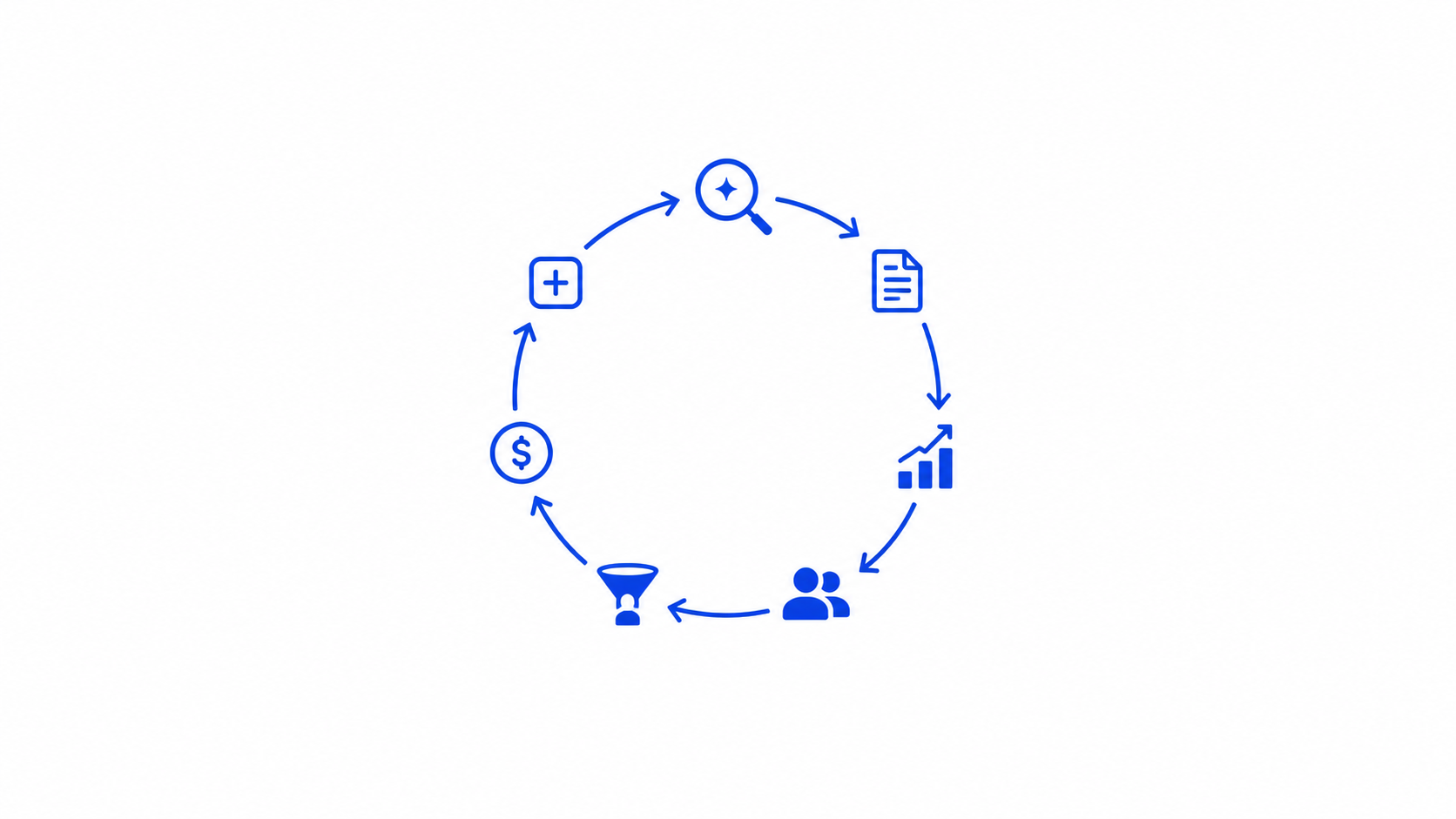
This is where AI tools shift SEO from a one-time effort to a sustainable system. Publish content, optimize it, track its performance, update it quarterly based on competition changes and performance data. Repeat across your entire library. This systematic approach compounds over time, creating widening competitive advantages.

Which AI SEO Tools Best Support the SaaS Playbook

Not all AI SEO tools are created equal, especially for SaaS companies with specific needs. The most effective platforms handle keyword research, content generation or optimization, ranking tracking, and performance monitoring in an integrated way, reducing tool switching and manual handoffs.

Top AI SEO Platforms for SaaS

Surfer SEO excels at content optimization. You input your target keyword and Surfer analyzes top-ranking pages, providing a complete optimization playbook covering keyword usage, content structure, semantic keywords, and readability. For SaaS content creators, this reduces optimization time from 2-3 hours to 20-30 minutes. Surfer provides content score (0-100) indicating how well your piece is optimized against top competitors. Most marketers target 70+ score before publishing. The platform integrates with Google Docs, making editing seamless. Limitation: Surfer focuses on optimization and ranking tracking but doesn’t handle comprehensive keyword research or strategic planning.

Search Atlas combines keyword research, content generation, and optimization in one platform. You research keywords, get AI-generated content outlines, optimize content against top-ranking pages, and track rankings—all within one tool. For SaaS companies seeking an all-in-one solution, Search Atlas reduces tool switching and provides unified reporting. The keyword research module identifies opportunities; the content generation module provides outlines and initial drafts; the optimization module ensures search competitiveness; the rank tracker monitors performance. For small-to-medium teams, this integration simplifies workflows significantly.

Moz (Keyword Explorer + SEO Pro) and Ahrefs offer comprehensive keyword research and competitive analysis. Moz provides domain authority estimates and keyword opportunity scoring. Ahrefs provides detailed backlink analysis and content gap identification showing which topics competitors rank for that you’re missing. Both integrate with Google Search Console and Google Search Analytics for unified performance tracking. For SaaS companies wanting deep competitive intelligence, these tools provide excellent market insights informing strategy.

SEOBrain.IO specifically targets SaaS companies seeking AI-powered SEO automation. By integrating AI keyword research with automated content generation and optimization, SEOBrain.IO reduces the manual effort required to maintain consistent content publishing. For SaaS teams without dedicated content creators, this enables scaling from 2 articles monthly to 6-8 articles monthly with the same resource investment. The platform continuously monitors your keyword rankings and recommends optimization updates, essentially serving as an automated SEO manager.

Building Your Optimal Tool Stack

Most successful SaaS companies don’t use a single tool—they build a stack matching their specific workflow:

Keyword research + planning: Use Moz Keyword Explorer or SEOBrain.IO for identifying opportunities and building your keyword strategy. These tools provide search volume, competition analysis, and opportunity scoring essential for prioritization.

Content optimization: Surfer SEO ensures published content matches top-ranking patterns. Use it for every piece before publishing. The 20-30 minute optimization per article is worth the ranking improvements.

Ranking tracking + monitoring: Google Search Console and Google Analytics provide free performance tracking, supplemented by Semrush or Ahrefs for competitive monitoring and deeper insights.

Integrated automation: Platforms like SEOBrain.IO or Search Atlas combine research, generation, and optimization to reduce tool switching and manual handoffs, particularly valuable for teams without dedicated SEO specialists.

Selecting Tools for Your Team Size

Smaller SaaS companies (5-20 people) benefit from all-in-one platforms requiring minimal setup. You need keyword research, content structure recommendations, and optimization—you don’t need deep competitive backlink analysis yet. Platforms like Search Atlas or SEOBrain.IO provide everything needed without overwhelming new users.

Larger SaaS companies (50+ people) often prefer best-of-breed tools they can integrate into established workflows. You might already have project management and CMS systems—integrating specialized tools into these makes sense. Select best-in-class keyword research (Moz or Ahrefs), best-in-class optimization (Surfer), and best-in-class analytics (Google Search Console + custom dashboards).

The key decision: select tools that reduce manual work while maintaining strategic control. AI automation should accelerate execution, not remove humans from decision-making about strategy.

How Should You Track and Measure SEO Success for SaaS

An effective AI SEO for SaaS playbook includes clear measurement and tracking across three distinct categories. Without proper tracking, you’re flying blind—you might publish content, get some traffic, generate some leads, but have no idea what’s actually working or what to improve.

Three Essential Measurement Categories

Visibility metrics track how well your content ranks. Monitor keyword rankings for your target keywords—specifically, how many keywords you rank in top 10 (highest value), top 20, and top 100. Tools like Google Search Console provide this free. Supplement with rank tracking tools like Semrush or SEOBrain.IO for more detailed tracking. A healthy growth pattern looks like: Month 1-2 (minimal ranking, maybe 0-5 top 100 keywords), Month 3 (5-10 keywords in top 100), Month 4-5 (10-20 keywords in top 20, some pushing into top 10), Month 6+ (5-15 keywords in top 10). Organic visibility score (provided by most SEO tools) shows estimated organic traffic potential based on current rankings—watch this number increase monthly as more keywords rank higher.

Traffic metrics track actual visits from organic search. Google Analytics provides this directly. Key metrics: organic sessions (total monthly visits from search), sessions by page (which specific pieces drive traffic), and average session duration (engagement quality). A healthy traffic pattern for a new SaaS website: Month 1-3 (50-500 monthly sessions), Month 4-6 (500-2,000 monthly sessions), Month 7-12 (2,000-10,000 monthly sessions). Month-over-month growth rate matters more than absolute numbers—you should see 50%+ month-over-month growth early on, gradually slowing to 10-20% growth as you reach scale in your niche.

Conversion metrics track MQL generation from organic search. This requires connecting Google Analytics with your CRM or marketing automation platform (HubSpot, Pipedrive, etc.). Track: organic sessions converting to MQL (conversion rate), cost per MQL from organic (typically $0 since you’ve already paid for tools and content creation upfront), and MQL quality (what percentage of organic MQLs advance through the sales funnel and eventually close). This is where many SaaS companies fail—they optimized for traffic but never set up proper tracking to understand which organic content drives high-quality leads. For example: if your “pricing” page converts at 2% and your “comparison” page converts at 8%, you’ve identified where to focus: double down on comparison content and optimize the pricing page’s conversion path.

Building a Unified Tracking Dashboard

Use Google Data Studio or similar to connect Google Analytics, Google Search Console, your CRM, and ranking tracking data. Create automated monthly reports showing: keyword ranking improvements, organic traffic trends, and MQL funnel from organic visits. Review this dashboard monthly and adjust strategy based on what’s working. A well-designed dashboard answers critical questions: Which pieces drive the most traffic? Which drive the most MQLs? What’s my organic conversion rate trending? How many keywords are in top 10? Are my rankings improving or declining?

Connecting SEO to Revenue Outcomes

Most importantly, tie SEO metrics to business outcomes. Your CEO and finance team care about CAC (customer acquisition cost) and LTV (lifetime value) of organic customers. Calculate organic CAC by taking total SEO investment (tools, content production, salaries) divided by organic customers acquired quarterly. Compare this to CAC from paid acquisition. Most SaaS companies find organic acquisition is 50-80% cheaper than paid by year 2, which justifies the upfront SEO investment. Track not just MQL volume but MQL quality—organic MQLs often have higher close rates than paid leads because they arrive already educated about your solution.

This business-level tracking transforms SEO from a “nice to have” marketing activity into a core acquisition strategy with clear ROI. When you can demonstrate “organic acquisition costs us $X per customer acquired versus $Y per customer from paid,” SEO investment becomes non-negotiable budget.

What Common Mistakes Should SaaS Companies Avoid in SEO

Even with AI SEO tools available, SaaS companies make predictable mistakes that undermine results. Understanding these pitfalls helps you avoid them and accelerate your timeline to meaningful MQL volume.

Mistake 1: Publishing Inconsistently, Then Abandoning When Results Don’t Appear Immediately

This is the most common failure. A startup publishes 10 articles enthusiastically in month 1, then product development demands pull resources away. By month 4, they’ve published only 2 additional articles. When organic traffic doesn’t materialize in 6 weeks, they conclude “SEO doesn’t work for us” and kill the program. The reality: SEO requires 6+ months of consistent effort before meaningful returns. Many SaaS companies have strong SEO potential but never reach the compounding phase because they stop before month 5.

How to avoid it: Plan for a 12-month SEO commitment before starting. If you can’t commit to consistent monthly publishing for a year, delay your SEO program until resources align. Short-term SEO efforts generate minimal ROI.

Mistake 2: Targeting Only High-Volume, Hyper-Competitive Keywords

A project management SaaS company attempts to rank for “project management software”—a keyword with 20,000+ monthly searches but hundreds of established competitors with significant domain authority. They spend months optimizing content and never reach page 1. Meanwhile, they completely miss “project management software for nonprofits” (500 monthly searches, much lower competition, perfect for their customer base). This is a strategic error rooted in misunderstanding keyword strategy.

The right approach: Start with 70%+ of effort on lower-competition, high-opportunity keywords. Once you dominate the mid-tier keywords and your domain authority increases, competitive high-volume keywords become easier. It’s like building a wall—you start with a strong foundation, not reaching for the top first.

Mistake 3: Creating Generic Content That Doesn’t Differentiate

A SaaS company publishes “The Complete Guide to Project Management” but it reads like every other guide—generic advice with no unique perspective. They lack either unique data, unique methodology, or detailed case studies demonstrating their specific value. Content that doesn’t differentiate doesn’t rank well because Google’s algorithms reward content offering new insights or better answers than existing results. Generic content defeats the purpose of publishing at all.

The fix: Ensure every piece includes something competitors don’t: original research, unique data, detailed customer case studies, or expert perspective. If you can’t differentiate on content quality, focus on topics where you have genuine expertise or unique market position.

Mistake 4: Poor Internal Linking Structure and Keyword Cannibalization

A SaaS company publishes 30 pieces addressing similar keywords without strategic internal linking. When Google crawls the site, it can’t determine which page should rank for the primary keyword. They also waste ranking power by spreading link equity across multiple pieces addressing the same keyword. A piece about “best project management tools” and another piece about “top project management software” cannibalize each other rather than reinforce each other.

Strategic linking: Decide which piece is the “hero” page for a keyword and ensure other related pieces link to it with appropriate anchor text. AI SEO tools help identify and fix this automatically, analyzing your content library and recommending optimal internal linking structure.

Mistake 5: Not Optimizing for Conversion Alongside Ranking

A SaaS company publishes comprehensive, well-optimized content that ranks well and drives traffic, but the pages don’t convert to leads. A 50-page guide ranking for “project management software comparison” drives 500 monthly visitors, but zero MQLs because the page doesn’t include a clear CTA, value proposition, or lead magnet. You’ve solved the ranking problem but ignored the conversion problem.

The fix: Always optimize for both ranking (traffic) and conversion (leads) simultaneously. Every piece should have: clear value proposition, compelling CTA, easy conversion path (demo request, pricing inquiry, etc.), and trust signals (customer testimonials, case studies, security badges if relevant).

Mistake 6: Ignoring Analytics and Continuing Underperforming Content

Without proper tracking and quarterly review, SaaS companies continue creating content that drives traffic but not leads. Maybe awareness-stage “how to” content ranks well but converts at 0.5%, while comparison content converts at 8%. Without this insight, they keep producing how-to content because it’s easier to write and ranks well. Analytics should directly inform strategy.

The fix: Review content performance quarterly. Which pieces drive highest-quality leads? Highest traffic-to-MQL conversion rates? Longest visitor engagement? Let data guide your content strategy adjustments. If comparison content outperforms how-to content, shift your resource allocation.

Mistake 7: Over-Relying on AI Tools Without Strategic Oversight

AI content generation tools can produce drafts quickly, but without editing, fact-checking, and strategic customization, generated content lacks authenticity and often contains errors. The best approach: use AI to accelerate content creation (research, outlining, initial drafts), but invest human effort in customization, unique insights, and quality assurance. Content created solely by AI typically performs worse than content where AI accelerates human-created content.

The balance: Use AI for the 50% of work that’s repetitive and automated (research, structure, optimization), keep humans for the 50% requiring judgment (strategy, unique insights, customization, fact-checking).

How Should You Align SEO Strategy with Your SaaS Sales Funnel

The most effective AI SEO for SaaS playbooks align content strategy explicitly with specific sales funnel stages. Rather than creating content randomly, each piece targets a specific funnel stage with specific objectives and expected outcomes. This alignment is what separates SEO programs that generate 10 MQLs monthly from those generating 100+.

Understanding Funnel-Aligned Content Strategy

Awareness Stage Content (Top of Funnel): Prospects don’t yet know your product exists—they’re searching for problems your product solves. A SaaS project management company might create content for: “why teams need project management,” “benefits of centralized task management,” “common project management challenges,” “how to improve team productivity.” These searches have high volume but low commercial intent. Prospects here are early in their journey, often still defining the problem. Content at this stage should educate without selling. Use AI keyword research to identify high-volume, low-competition keywords in this category. Content should position your company as knowledgeable authority rather than pushy salesperson. Goals here: build audience, establish authority, drive initial awareness.

Consideration Stage Content (Middle of Funnel): Mid-funnel prospects have identified their problem and are evaluating solutions. They search for “best project management tools,” “project management software comparison,” “Asana vs Monday,” “project management tools for remote teams.” This is where most SaaS SEO should focus—these keywords have moderate search volume, medium competition, and high commercial intent. Prospects reaching this content are actively evaluating options. Content should comprehensively compare solutions, address tradeoffs transparently, and explain when different tools work best. Your product should be presented as one strong option rather than the only option—this builds credibility. Case studies and feature guides excel here. Goals: position your product as strong fit for specific use cases, build trust through transparent comparison, gather contact information for lead nurturing.

Decision Stage Content (Bottom of Funnel): Late-funnel prospects are ready to buy. They search for “project management software pricing,” “implement project management software,” “project management tool ROI,” “switch to project management software.” These searches have lowest volume but highest conversion rates—someone searching these terms is 20+ times more likely to become an MQL than someone searching awareness-stage queries. Content should address buying criteria, implementation concerns, ROI justification, and objection handling. Product-focused content works well here. ROI calculators, implementation guides, and pricing clarity are valuable. Goals: remove final purchase objections, accelerate buying decision, capture high-intent prospects.
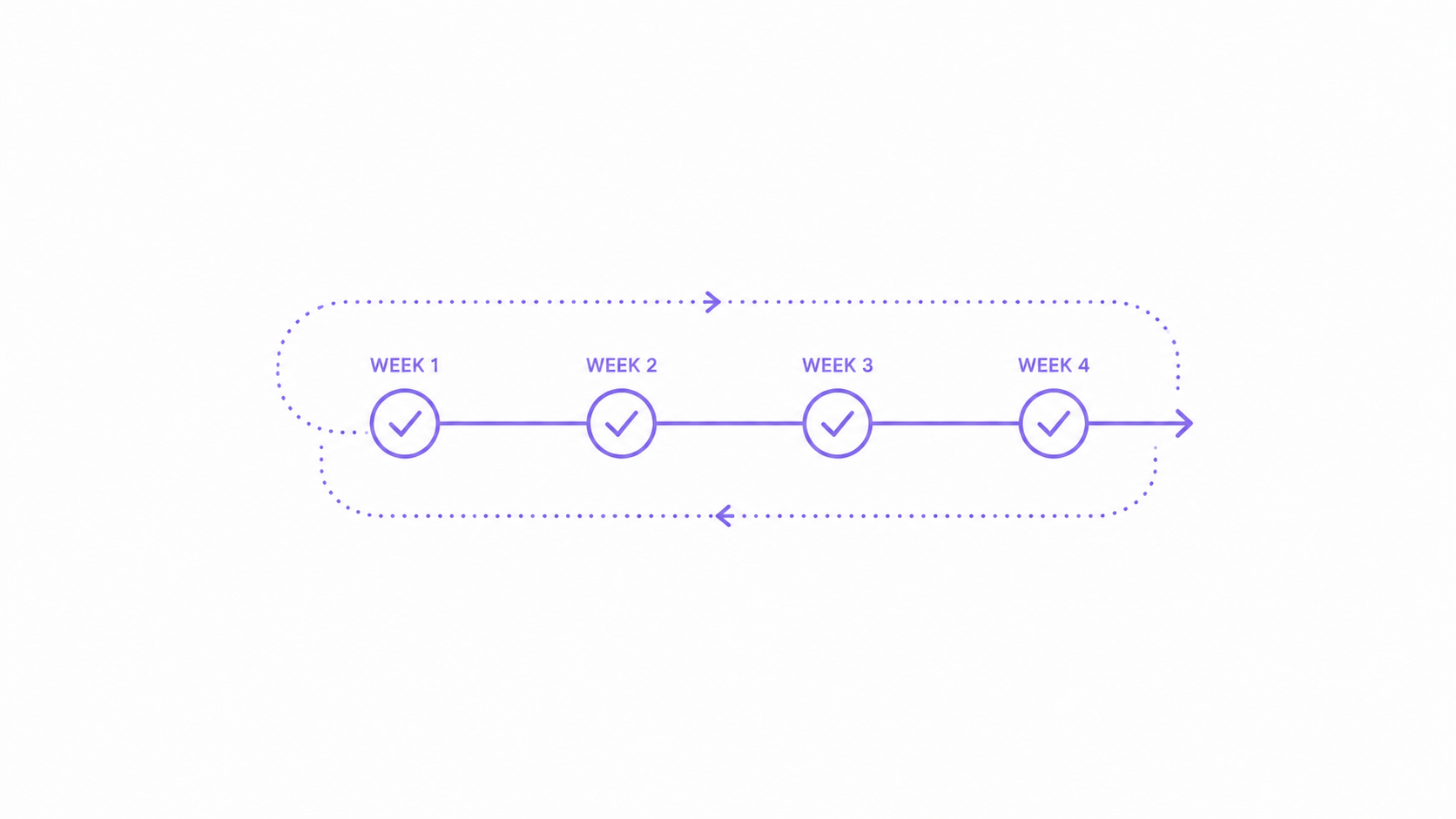
Post-Purchase Stage: After customers buy, they search for “how to use project management software,” “project management best practices,” “maximize project management tool.” Content here improves onboarding and customer success, reducing churn. This often gets overlooked in SaaS SEO strategy but has high impact on customer retention and expansion revenue. Goals: improve onboarding experience, reduce time-to-value, minimize churn.

Optimal Content Allocation by Funnel Stage

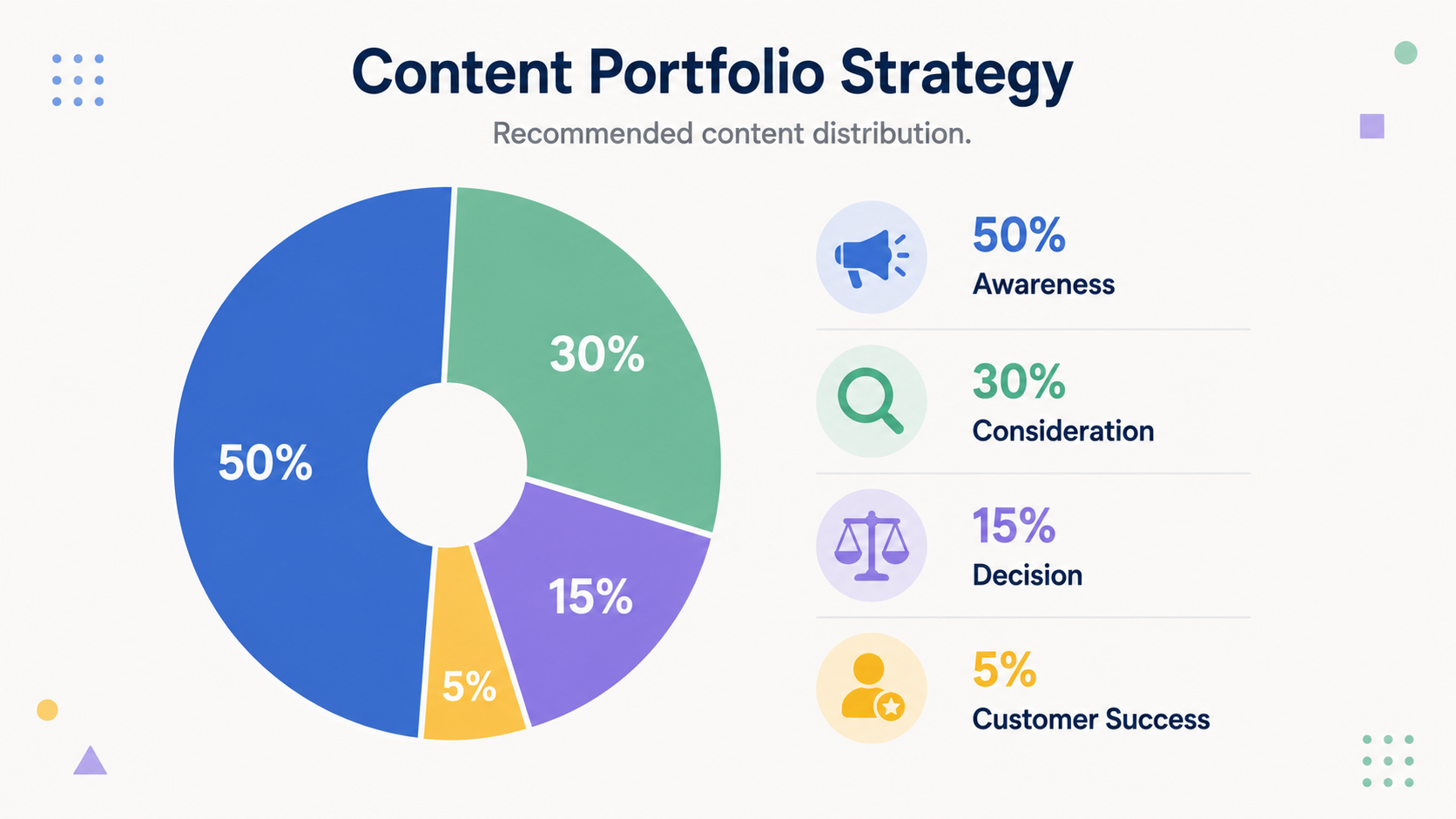
An effective SaaS SEO strategy allocates content investment by funnel impact. The distribution typically looks like: 50% awareness-stage content (building audience at scale), 30% consideration-stage content (where most conversions happen), 15% decision-stage content (high intent but lower volume), and 5% post-purchase content (if applicable for your product). This allocation ensures you’re building awareness at scale while converting that awareness to leads at progressively higher rates.

This allocation doesn’t mean ignoring decision-stage content—those high-intent keywords are extremely valuable. It means recognizing that volume comes from awareness-stage content, while conversion comes from consideration and decision-stage content. You need both.

Implementing Funnel-Aligned Strategy

Implementing this requires reviewing your AI keyword research with funnel stage in mind. Rather than simply targeting highest-volume keywords, explicitly classify keywords by funnel stage. Your 200+ identified keywords become: 100 awareness keywords (high volume, low intent), 70 consideration keywords (medium volume, medium intent), 25 decision keywords (low volume, high intent), and 5 post-purchase keywords.

Then allocate content production: Month 1-3 start with consideration and decision keywords (higher conversion potential). Month 3-6 add awareness-stage content building volume. Your SEO reporting should show not just organic traffic and MQLs, but also MQL quality by funnel stage—helping you identify whether awareness-stage content effectively moves prospects to consideration stage. If awareness content drives 500 monthly visitors but zero consideration-stage conversions, you’re not creating the bridge between awareness and consideration. You might need more explicit calls-to-action encouraging prospects to explore your comparison content.

Building an effective AI SEO for SaaS playbook requires coordinating keyword strategy, content cadence, content types, and realistic timeline expectations. It’s not magic—there’s no way to jump from zero to significant organic MQL volume in weeks. But there is a proven path, and AI tools make that path substantially faster. An AI SEO tool for SaaS companies accelerates this by automating research, optimization, and tracking, but strategy still requires human expertise and judgment. The most successful SaaS companies combine AI automation with strategic oversight: using AI keyword research to identify genuine opportunities, AI content optimization to improve ranking potential, and consistent monthly publishing to build authority over time. Results compound between months 6-12, with most disciplined SaaS companies seeing 50-150+ organic MQLs monthly by month 12 if they maintain consistency. The specific keyword strategy, content mix, publishing cadence, and tool selection depend on your market position and resources, but the fundamental principles remain constant: start with lower-competition high-opportunity keywords where you can realistically win, create comprehensive content exceeding what competitors offer, optimize every piece for both ranking and conversion, and track which content drives highest-quality leads. With proper execution, organic search becomes one of your most cost-effective and scalable acquisition channels—ultimately reducing CAC and improving profitability compared to paid channels. The compounding effect continues: existing content keeps improving, new content ranks faster, and your content library depth creates widening competitive advantages. By year 2, most SaaS companies find organic acquisition costs 50-80% less than paid acquisition, while delivering higher-quality leads with better close rates.

Ready to implement an AI-powered SEO strategy for your SaaS company? SEOBrain.IO combines keyword research, content generation, optimization, and ranking tracking—enabling your team to execute this complete playbook without building an internal SEO department. Start your AI SEO journey today and accelerate your path to consistent organic MQL growth. Your competitors are implementing SEO. Don’t let them get a head start.

Frequently Asked Questions

How long does it take to see organic traffic from SEO for SaaS?

Most SaaS companies see minimal organic traffic in months 1-3, but starting month 4-5, earlier content begins ranking on page 2-3. By month 5-6, you should see organic traffic inflection points—pieces climbing to page 1. Meaningful MQL volume (50+/month) typically arrives month 6-8 with consistent execution. Full compounding benefits appear month 9-12, at which point organic can represent 20-40% of total MQL volume.

What’s the difference between awareness and consideration content for SaaS SEO?

Awareness content (50% of strategy) targets broad, high-volume keywords like ‘what is project management’ and builds audience at scale. Conversion rates are low (0.5-1%) but volume is high. Consideration content (30% of strategy) targets keywords like ‘best project management tools’ and has higher conversion rates (5-10%) because prospects are actively evaluating. Decision content (15%) targets ‘project management pricing’ with highest conversion rates (15-30%) but lowest volume.

How many articles should I publish monthly for effective SaaS SEO?

Early-stage SaaS: 2-3 articles/month. Growth-stage SaaS: 4-6 articles/month. Mature SaaS: 8-12+ articles/month. Consistency matters more than volume—publishing 4/month for 12 months beats 20/month for 2 months. Most teams need 1 person per 3 articles monthly. AI tools can double content output per person without doubling effort.

Which AI SEO tools should SaaS companies use?

For all-in-one solutions: Search Atlas or SEOBrain.IO. For specialized needs: Moz/Ahrefs for keyword research, Surfer SEO for optimization, Google Search Console for free rank tracking. Smaller teams benefit from all-in-one platforms; larger teams prefer best-of-breed tools integrated into existing workflows. The key is reducing manual work while maintaining strategic control.

What conversion rate should I expect from organic SaaS traffic?

B2B SaaS with free trials: 3-8% organic-to-MQL conversion. SaaS requiring demo requests: 1-3%. Low-friction signup products: 10-15%. These rates vary by content type—comparison content converts at 8%, awareness content at 0.5%. Track conversion by content piece to identify which topics drive high-quality leads.

How do I know if my SaaS SEO strategy is working?

Track three metrics: (1) Visibility—keyword rankings for target terms. (2) Traffic—organic sessions trending 50%+ month-over-month early on. (3) Conversions—MQLs from organic traffic and conversion rate by content piece. Create a dashboard showing all three. Healthy SaaS SEO shows rankings improving, traffic accelerating, and MQL volume increasing month 6-12.

Should I focus on ranking high or converting visitors?

Both matter, but prioritize in this order: (1) Rank for high-intent keywords (decision stage) where fewer competitors and you can win. (2) Optimize those pages for conversion (clear CTAs, lead magnets, value props). (3) Build volume with awareness content. A SaaS company that ranks well for low-intent keywords generates traffic but no leads. A company ranking for decision keywords with poor conversion wastes opportunity. Optimize for both.

How do I calculate ROI for my SaaS SEO program?

Calculate organic CAC: (Total SEO investment/Organic customers acquired quarterly). Compare to paid CAC. Most SaaS companies find organic CAC is 50-80% lower than paid by year 2. Additionally track: MQL quality from organic (close rate vs. paid), customer LTV from organic sources, and organic as percentage of total MQL volume. These metrics justify SEO investment to leadership.

Leave a Reply

Your email address will not be published. Required fields are marked *