
Growing businesses face a familiar challenge: you need to scale organic traffic to fuel growth, but you don’t have the dedicated SEO teams that larger enterprises maintain. AI in SEO benefits directly addresses this gap by automating the repetitive, time-intensive tasks that traditionally slow down SEO workflows and drain marketing budgets.
Here’s what’s changed: AI-powered tools now handle keyword research, content creation, technical audits, and performance analysis faster and more accurately than manual processes ever could. This frees your team to focus on strategy and growth rather than getting bogged down in tactical execution. Whether you’re struggling with the time-consuming nature of manual SEO or lack in-house expertise, AI-driven solutions offer a practical path forward.
This comprehensive guide explores exactly how AI transforms SEO for growing businesses—from automated keyword discovery to intelligent content optimization—and provides actionable strategies you can implement starting today.
What Are the Core Benefits of AI in SEO for Growing Businesses?
Let’s get straight to the point: growing businesses need to compete without the resources of larger competitors.
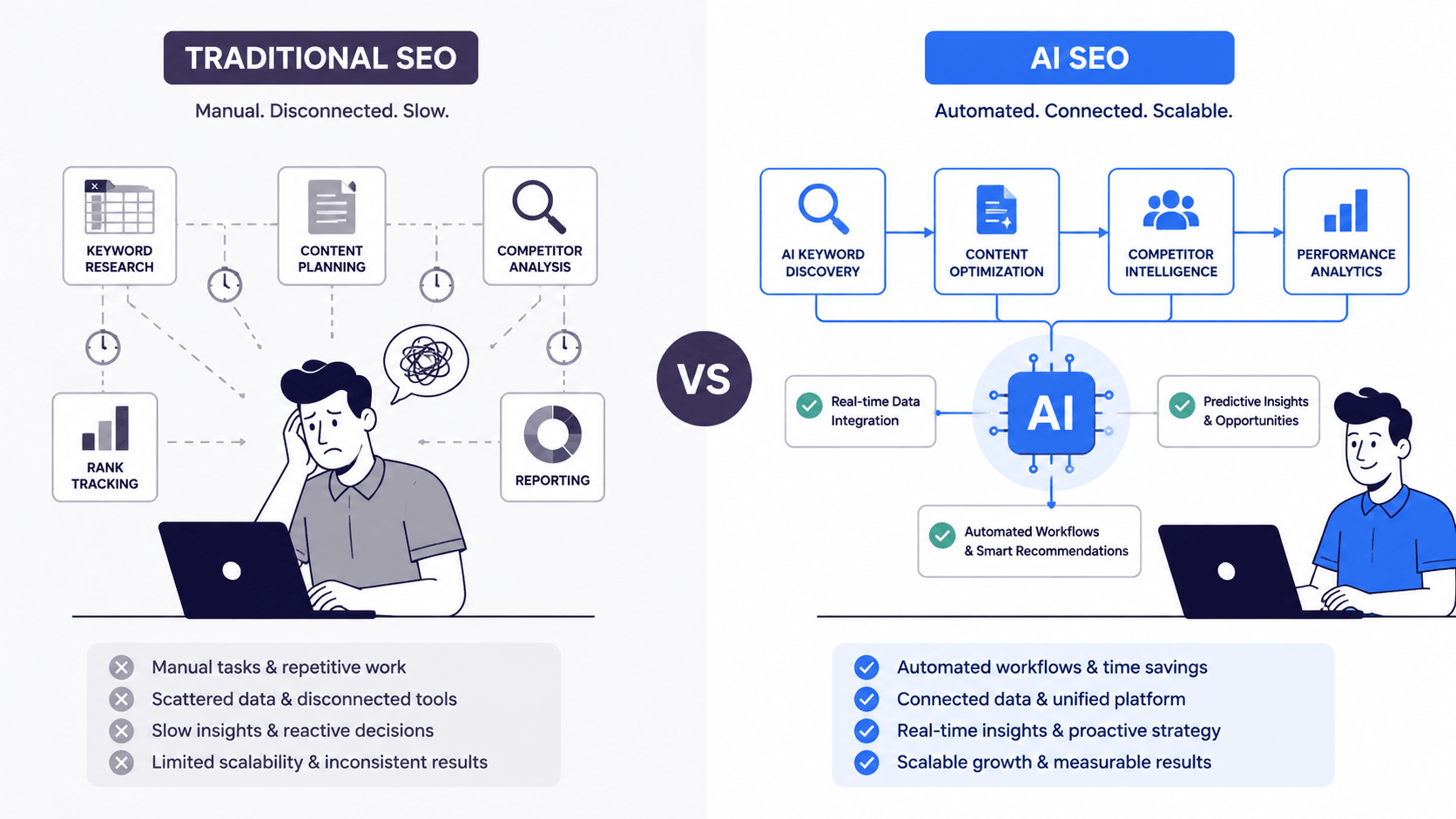
AI in SEO benefits directly solve this resource problem by automating the repetitive, time-intensive tasks that slow down traditional SEO workflows. Think about what’s happening right now at your company. Your marketing team is probably spending hours on keyword research, manually optimizing content, tracking technical issues, and analyzing performance data. Meanwhile, your competitors with bigger budgets are doing the exact same work—except they’re doing it with larger teams. AI changes this equation entirely.
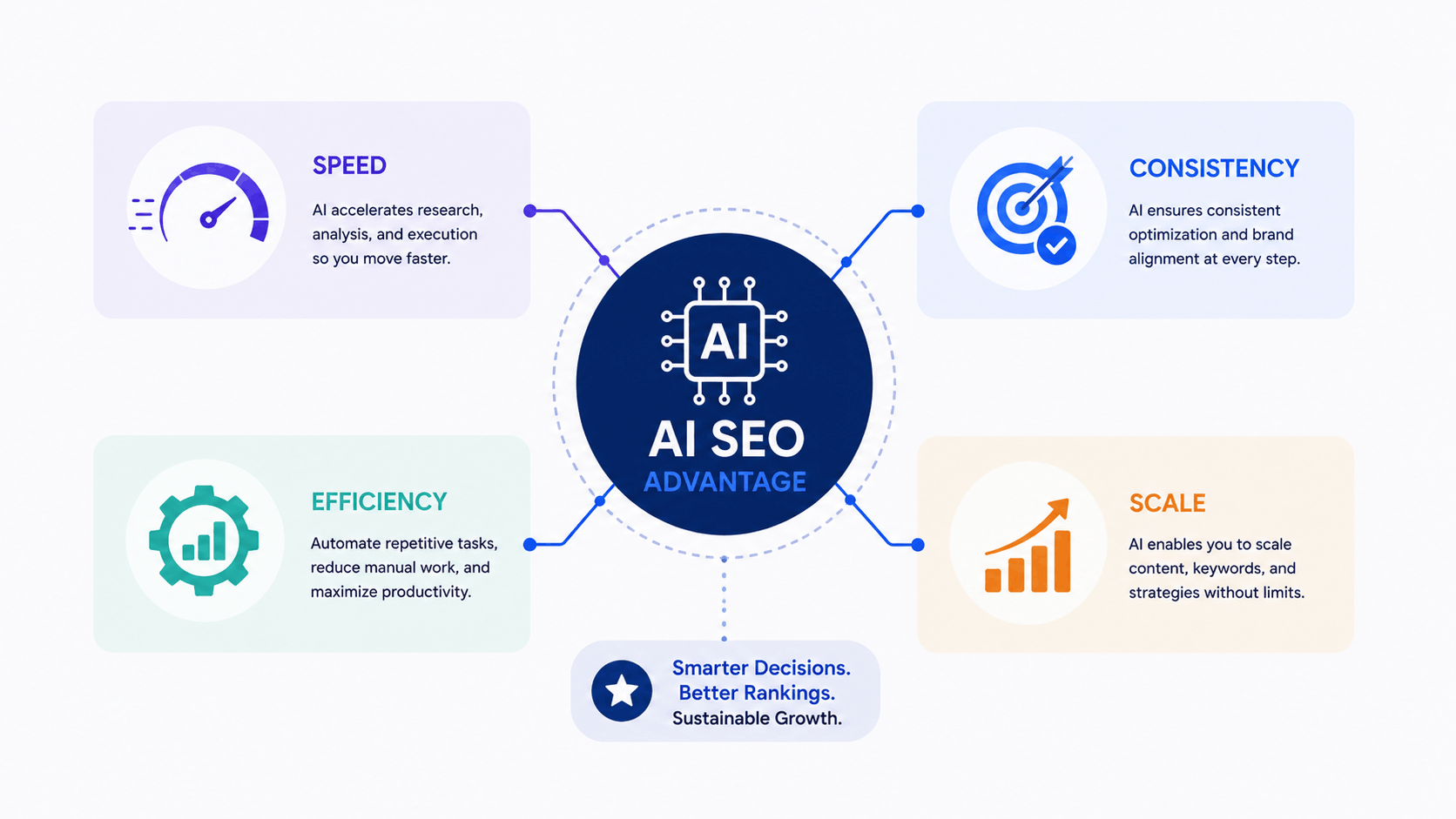
Speed is the first transformative benefit. AI tools analyze competitor strategies, identify keyword opportunities, and generate content recommendations in hours rather than weeks. According to Moz’s SEO Learning Center, businesses using AI-powered tools report 3-5x acceleration in content production timelines. This compounds quickly: a growing business publishing optimized content weekly instead of monthly creates exponentially more ranking opportunities and organic discovery channels.
Consistency is the second game-changer. Manual SEO varies by editor, time pressure, and expertise level. Different team members apply different standards. AI applies the same rigorous standards to every single piece of content—keyword placement, semantic relevance, readability, technical SEO elements—ensuring nothing slips through the cracks. Your 10th article gets the same optimization rigor as your first.
Resource efficiency directly impacts profitability. One marketer using AI-powered tools can accomplish what previously required two or three specialists. This doesn’t mean eliminating positions; it means your team accomplishes more strategic work without proportional headcount increases. The budget you save on additional hires can flow toward paid advertising, sales enablement, or product development.
Key Efficiency Metrics That Matter
Here’s what growing businesses are actually experiencing when they implement AI SEO strategies:
- 70-80% reduction in manual keyword research time—AI identifies long-tail opportunities and search intent variations automatically, collapsing weeks of work into days
- 50-60% faster content optimization—Automated analysis of top-ranking pages informs content structure, depth, and keyword placement without manual competitor analysis
- 40-50% improvement in content consistency—AI enforces standardized optimization across every published piece, eliminating the quality variation that comes with manual processes
- 3-5x faster problem identification—Technical audits and performance analysis complete in real-time rather than quarterly, catching issues before they damage traffic
These improvements create compounding advantages. With faster content production, more consistent optimization, and quicker problem detection, growing businesses can double or triple organic traffic within 12-18 months while keeping headcount flat or even reducing it. That’s not just efficiency—that’s competitive transformation.
How Does AI Transform Keyword Research for Scaling Companies?
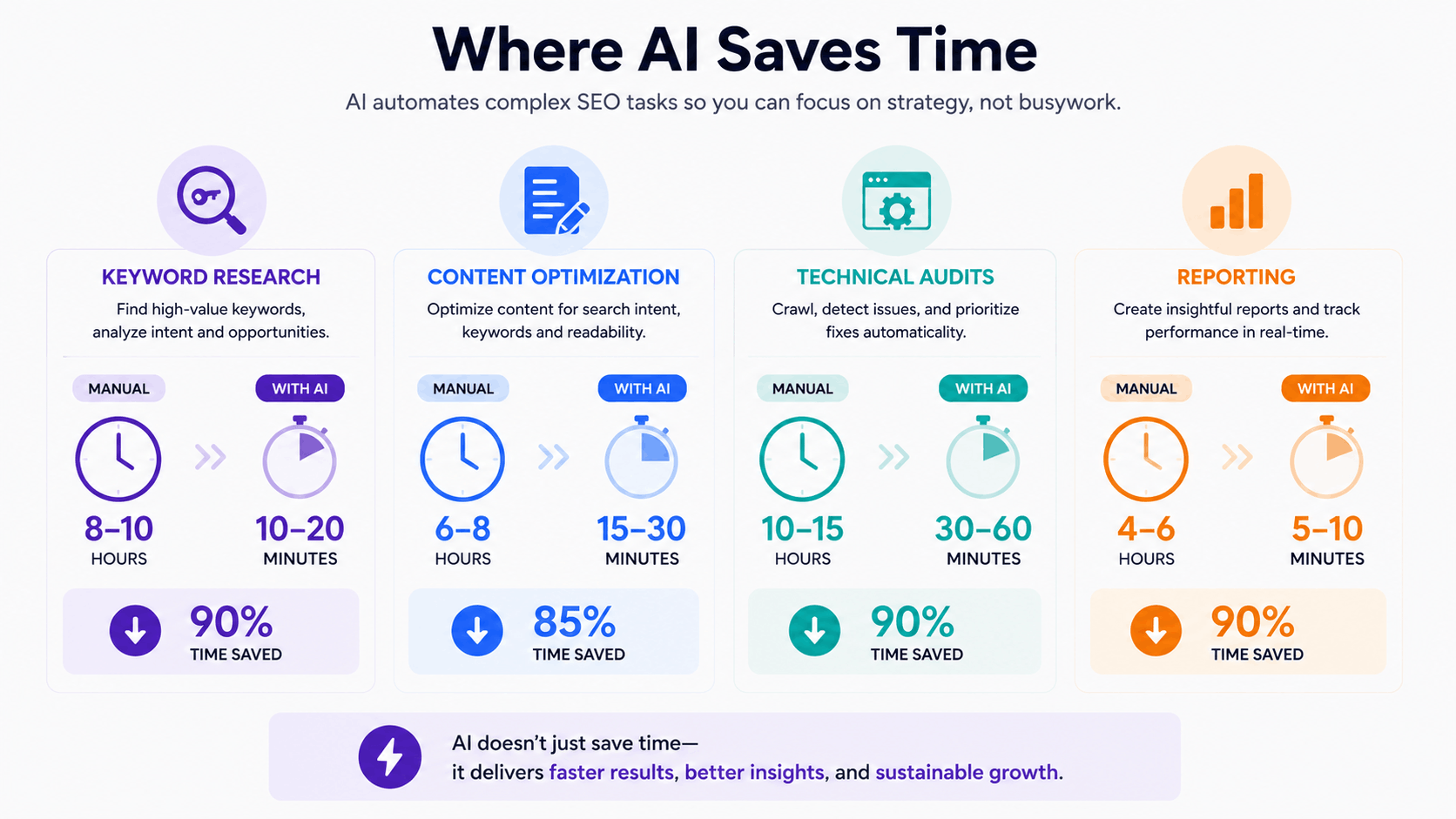
Keyword research traditionally consumes 30-40% of an SEO specialist’s time. For growing businesses with limited resources, this bottleneck directly limits your content strategy scope and how many topics you can realistically cover. AI SEO strategies collapse this bottleneck completely.
Picture the traditional workflow: you brainstorm seed keywords, run them through tools, analyze search volume and competition, assess intent, check current rankings, and compile recommendations. Even with dedicated tools, this process consumes 8-12 hours weekly for a single marketer trying to maintain a comprehensive keyword strategy across multiple topic areas. Now multiply that by the fact that search trends shift constantly, and you’re in an endless cycle of catch-up.
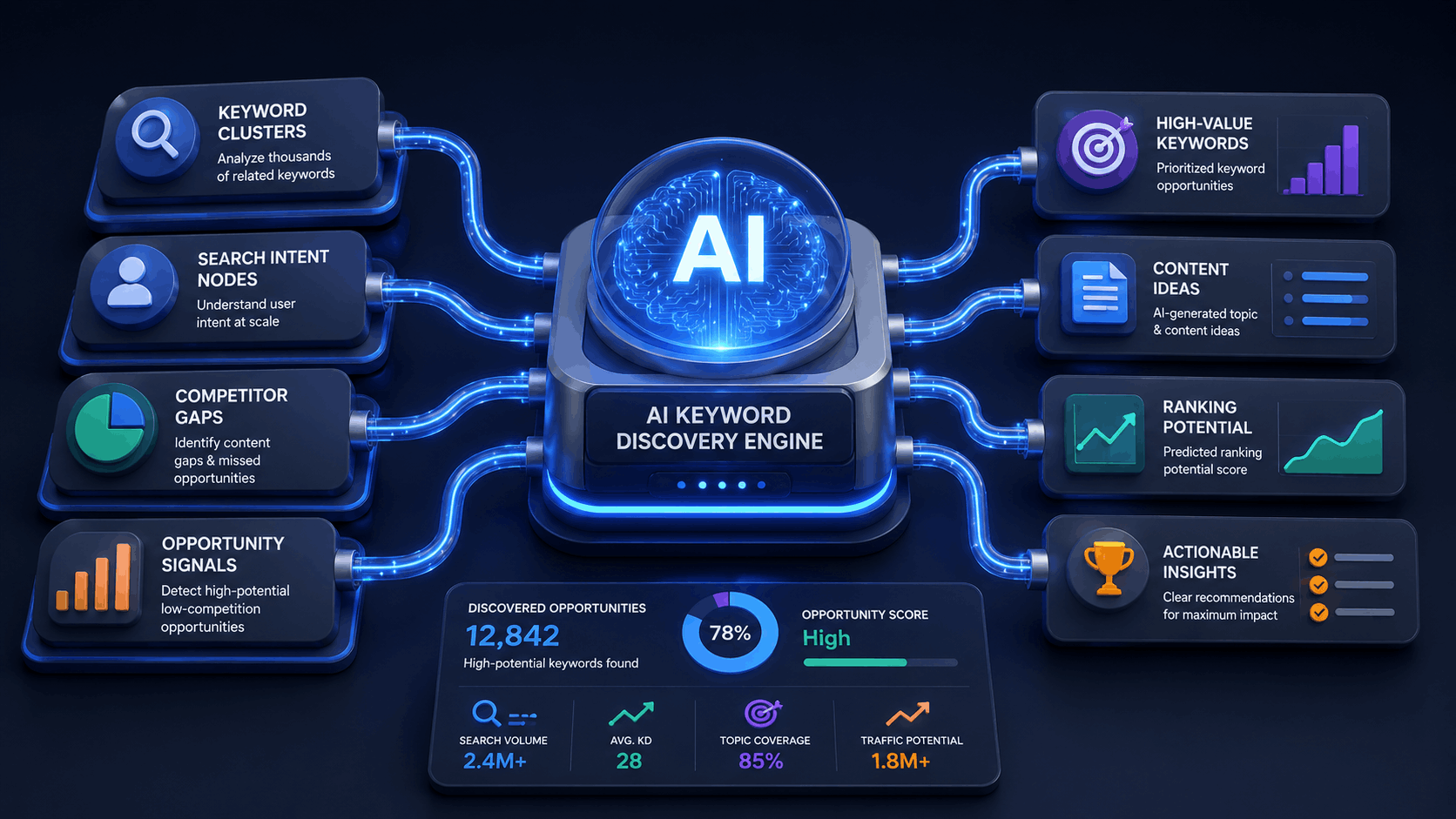
AI-powered keyword research eliminates this cycle. Advanced AI systems analyze your website’s current content, identify topical gaps, examine competitor strategies, predict emerging search trends, and surface long-tail opportunity keywords—all in minutes. Google Search Central documentation confirms that AI-powered keyword analysis can identify search intent with 85%+ accuracy, matching the precision of human experts but at machine speed.
Multi-Dimensional Keyword Intelligence You’ve Never Had Before
AI delivers keyword research insights that go far beyond the basic volume and competition metrics your tools currently show.
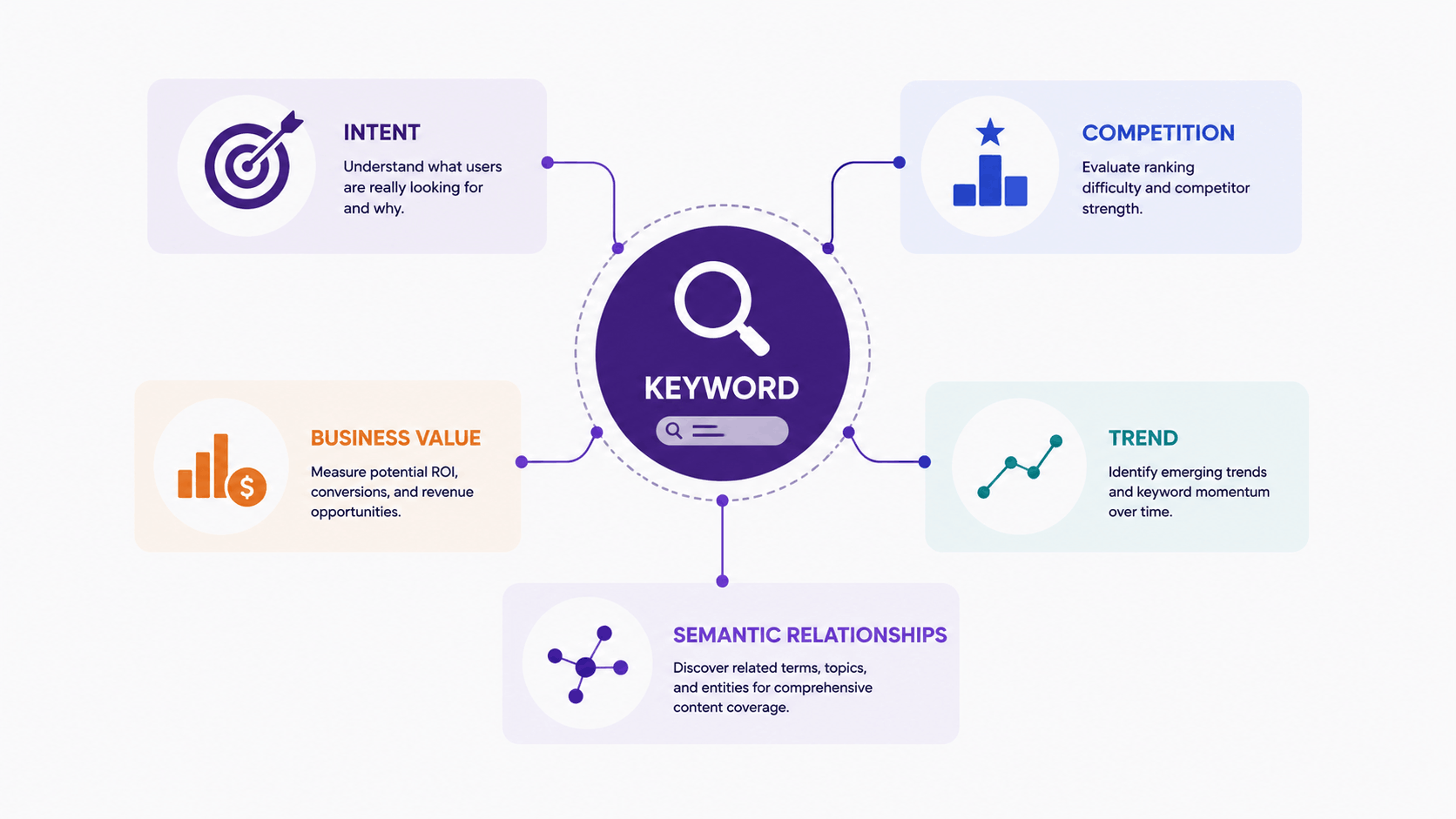
Search Intent Classification: AI automatically categorizes every keyword by intent type—informational, navigational, transactional, commercial investigation. Growing businesses immediately identify which keywords drive qualified leads versus which ones just drive traffic. You can allocate your content strategy accordingly, focusing on keywords that actually convert rather than chasing volume.
Semantic Relationship Mapping: AI identifies related keywords, synonym variations, and question formats people actually use when searching for solutions. Say you’re targeting “project management software.” AI surfaces that prospects also search “best tools for team collaboration,” “how to organize remote teams,” “software for tracking project deadlines,” and dozens of related variations. This multi-angle insight informs your content strategy depth and helps you create comprehensively optimized pieces that capture multiple related searches.
Competitive Gap Analysis: AI compares your current keyword rankings against competitors in your space, identifying high-value opportunities where competitors rank but you don’t. For growing businesses entering competitive markets, this gap analysis reveals exactly which keyword targets would most expand your market footprint or create competitive disadvantage for rivals who currently own them.
Trend Prediction: Machine learning models analyze historical search data to predict which keywords will gain momentum in coming months. Growing businesses can publish content on emerging keywords months before mainstream awareness, capturing first-mover advantage in search rankings. You’re not chasing trends; you’re getting ahead of them.
The practical impact is profound: a marketing team that previously completed keyword research quarterly can now maintain a continuously updated, multi-dimensional keyword strategy with minimal ongoing effort. This enables content production to scale from 4 articles monthly to 12-16 articles monthly without expanding the team. You’re not just working faster; you’re working smarter with data-driven confidence about which keywords deserve your effort.
Why Is AI-Powered Content Optimization Critical for Growing Businesses?
Content optimization represents the single largest opportunity for growing businesses to improve organic performance without spending a penny on ads. Yet manual optimization is time-consuming, error-prone, and inconsistent—exactly the problems that AI-driven SEO solves most effectively.
Here’s what happens when growing businesses publish content without AI optimization: keyword variations aren’t fully explored, subheading structure doesn’t match what top-ranking competitors use, content depth falls 20-30% short of SERP leaders, semantic relationships aren’t fully developed, and internal linking strategy lacks sophistication. Each missed optimization reduces ranking potential by 20-40%. When you’re competing against larger companies with bigger budgets, these gaps compound into ranking disadvantages you can’t overcome.
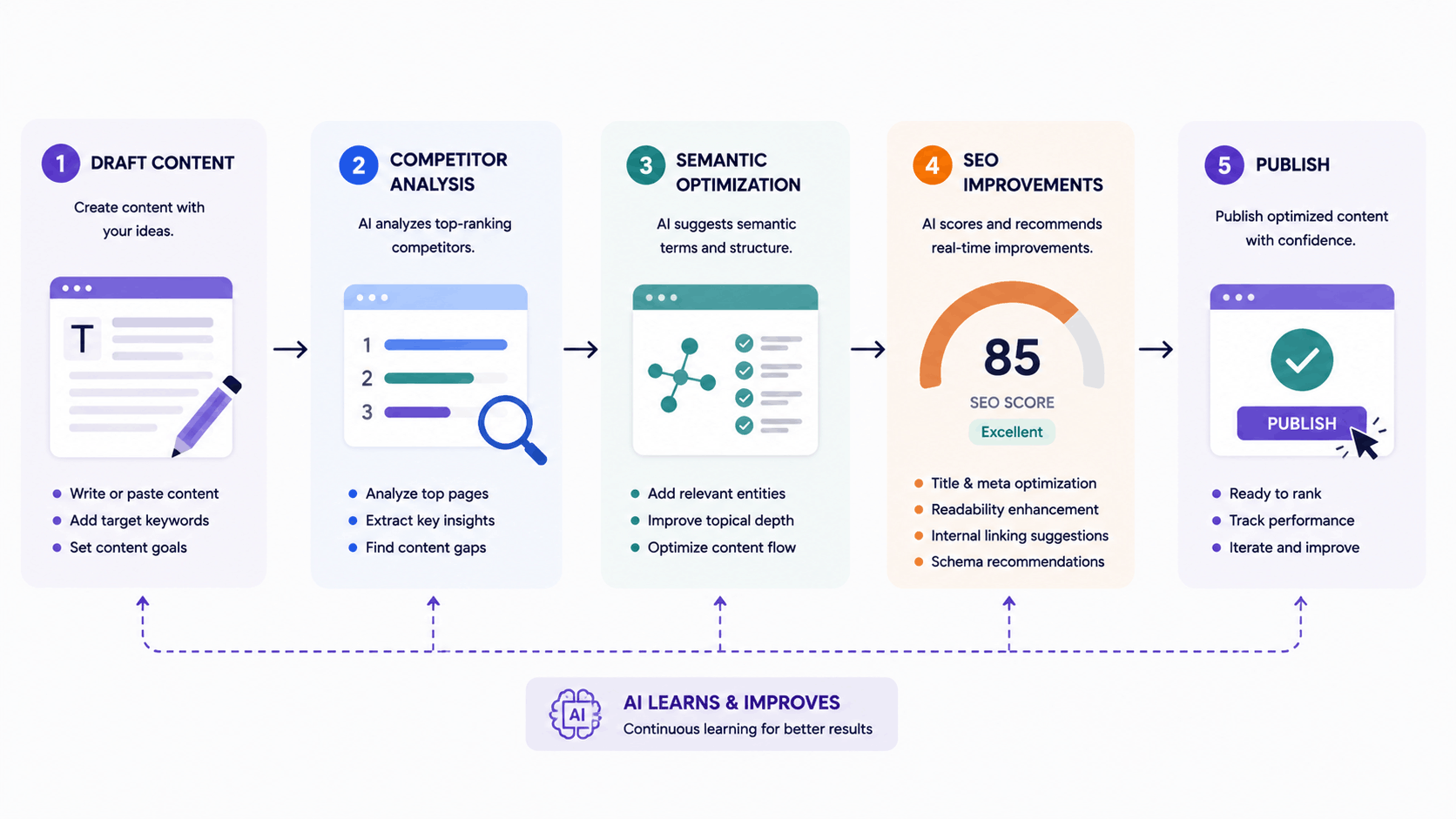
AI-driven optimization changes this equation completely. The system analyzes your content against top-ranking pages in real-time, identifies where you fall short on critical optimization dimensions, then generates specific, actionable recommendations. Instead of a marketer manually analyzing five competitor articles and writing generic optimization notes, you get precision guidance: “Add 300-400 words to the ‘implementation’ section,” “Include the keyword phrase ‘AI in SEO benefits’ 2-3 additional times naturally in the introduction and conclusion,” “Add an H3 subheading for ‘Case Studies’ with at least 200 words.”
The AI Content Optimization Workflow That Actually Works
AI transforms content optimization from a manual, inconsistent process into a scalable system that grows with your business.
Pre-Publication Optimization: Before content goes live, AI analyzes your draft against top-ranking pages for your target keyword. The system checks keyword density and placement, readability metrics, semantic relevance, header structure, content depth, internal linking opportunities, and metadata optimization. Growing businesses catch optimization gaps before publication, which is critical—research shows that content published fully optimized ranks 25-40% faster than content that gets optimized after publication. You’re getting the ranking advantage from day one, not weeks later.
Competitive Benchmarking: AI identifies the top-ranking pages for your target keyword, analyzes their structure, length, tone, and specific elements, then compares your content against each one. The analysis tells you exactly what you need: “Your content is 15% shorter than the average top-ranking page for this keyword. Adding 400-600 words focused on implementation case studies would improve competitiveness.” This removes guesswork from optimization decisions. You know exactly what needs to change and why.
Semantic Enrichment: AI identifies related concepts, entity mentions, and semantic variations that improve topical authority. For a growing SaaS business writing about “project management,” AI recommends discussing “resource allocation,” “team capacity planning,” “workload balancing,” and “sprint forecasting”—concepts semantically related to your main topic that strengthen overall coverage. This semantic approach tells Google that you truly understand the topic at depth, not just surface-level understanding.
Performance Prediction: Machine learning models predict how content will perform based on optimization quality scores. Growing businesses can identify lower-performing content before publication and improve it, rather than discovering ranking failures weeks after launch when it’s too late to fix easily.
The cumulative impact is striking: content published with AI optimization typically ranks 2-3 positions higher initially than content optimized manually, reducing time-to-ranking from 8-12 weeks to 4-6 weeks. For growing businesses competing against established players, this acceleration means capturing ranking positions before competitors even realize you’re targeting those keywords.
How Can Growing Businesses Use AI for Technical SEO and Site Health?
Technical SEO—crawl errors, site speed, mobile responsiveness, structured data implementation, security, and core web vitals—directly impacts both rankings and user experience. Yet many growing businesses lack dedicated technical expertise, and issues compound silently as sites expand.
Here’s the traditional problem: technical SEO audits happen quarterly or semi-annually. By the time problems are identified and fixed, months of traffic damage have accumulated. Site crawl errors waste budget on crawling non-existent pages. Mobile speed issues silently cost conversion rates. Structured data implementation gaps mean reduced rich snippets and lower click-through rates. These issues compound until they become visible crises rather than preventable problems.
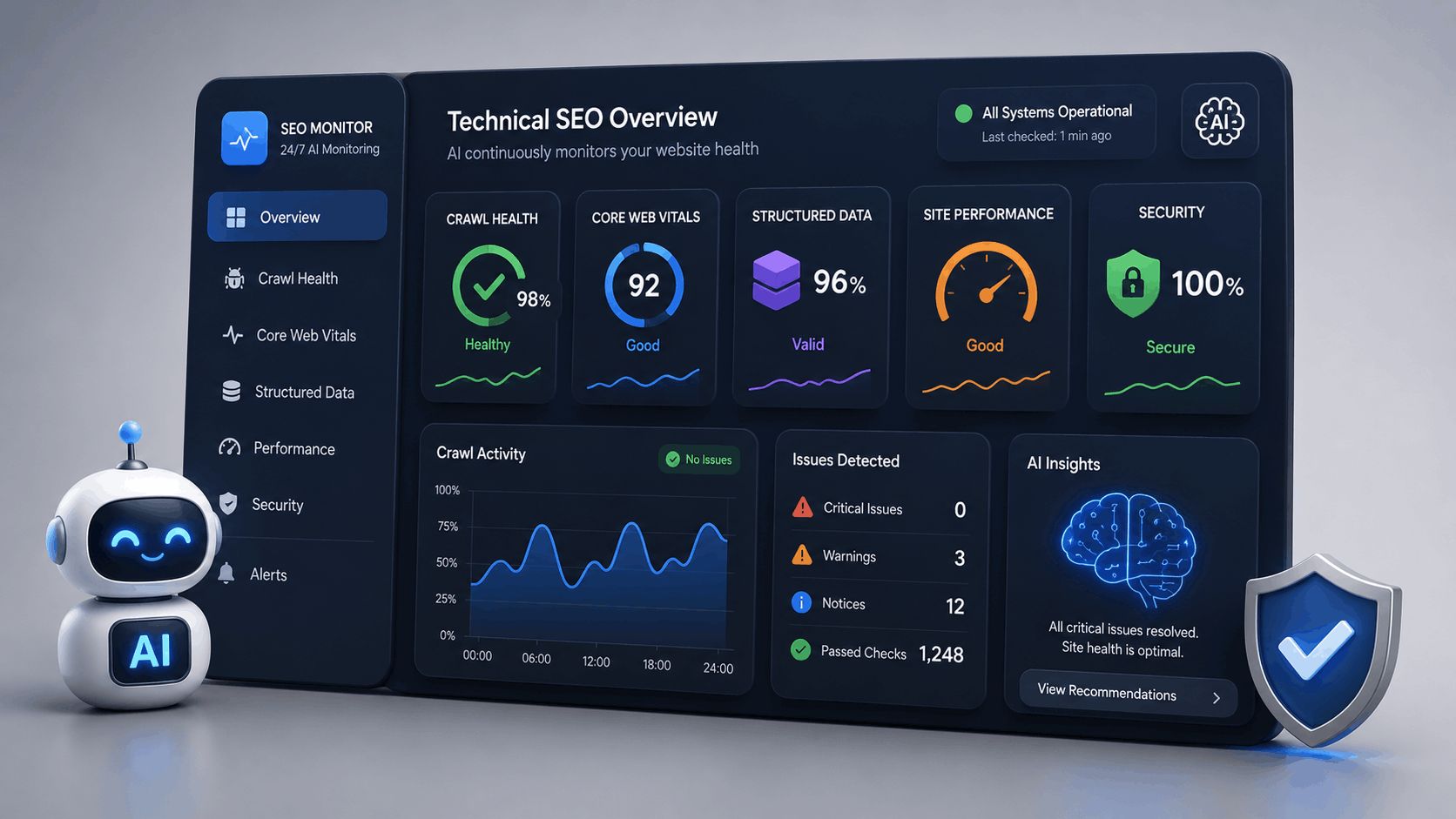
AI-powered technical SEO monitoring changes this from episodic audits to continuous health monitoring. Advanced systems crawl your entire site continuously, identify errors in real-time, categorize by severity and business impact, and generate prioritized fix recommendations. Instead of quarterly surprises, you get daily alerts.
Real-Time Technical Monitoring That Catches Problems Before They Hurt
Crawl Error Detection: AI systems scan your entire site structure continuously, identifying broken links, 404 errors, redirect chains, orphaned pages, and crawl traps instantly. Growing businesses expanding their content libraries can catch errors immediately rather than discovering months later that entire topic clusters are blocked from search visibility. This prevents the silent traffic loss that plagues growing websites.
Core Web Vitals Optimization: AI monitors loading performance, interactivity, and visual stability metrics that Google uses explicitly for ranking. The system identifies pages where these metrics fall below thresholds, pinpoints performance bottlenecks (slow images, render-blocking resources, layout shift issues), and recommends specific fixes with implementation guidance. For growing businesses, this means your expanding content never suffers from performance issues that damage rankings.
Mobile Optimization Verification: As mobile-first indexing becomes absolute, AI verifies that every page renders correctly on mobile devices, text is readable without zooming, clickable elements are properly spaced, and critical content isn’t hidden on mobile view. Growing businesses can scale content confidently knowing mobile experience remains optimized across expanding libraries. This is critical because 60-70% of organic traffic increasingly comes from mobile devices.
Structured Data Implementation: AI scans for missing schema markup opportunities, validates existing structured data against schema.org standards, and flags implementation errors. For a growing e-commerce business, this means ensuring product schema is correctly implemented across thousands of product pages, improving visibility in rich snippets and Google Shopping results. For B2B companies, it means FAQ schema, organization schema, and breadcrumb implementation that improves search visibility and click-through rates.
Security Monitoring: AI alerts growing businesses to potential security issues—mixed content warnings, SSL certificate problems, suspicious files—that could trigger Google search penalties. Real-time detection prevents security issues from silently damaging search visibility. One SSL certificate failure can cause organic traffic to plummet 30-50% as Google deprioritizes your site.
Impact on Growth Trajectory
Growing businesses implementing continuous AI-powered technical SEO typically see: 40-60% reduction in crawl errors within 30 days, 25-35% improvement in core web vitals within 60 days, 15-25% increase in mobile traffic as mobile optimization improves, and 50%+ reduction in time spent on manual technical audits. These improvements compound monthly as new content scales with consistent technical quality. You’re not just fixing problems; you’re building infrastructure that supports aggressive scaling.
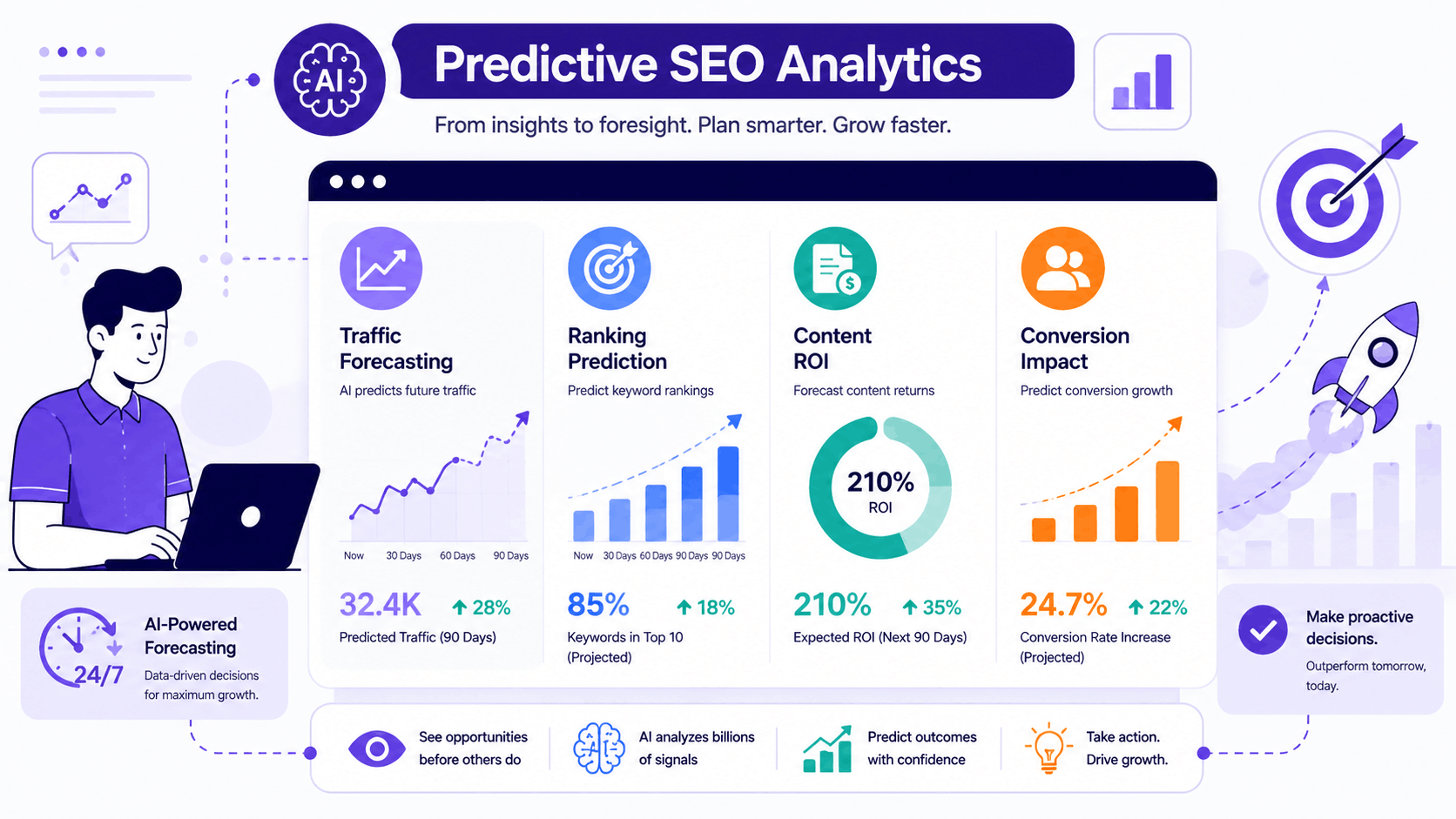
Predictive Analytics Capabilities That Drive Better Decisions
Ranking Trajectory Forecasting: AI models predict how your rankings will change based on current optimization trends, competitor activities, and Google algorithm signals. Growing businesses can forecast whether increased content production will improve market position or if competitive intensity requires strategic adjustments. You’re not guessing about strategy; you’re predicting outcomes with data.
Traffic Volume Predictions: Machine learning analyzes seasonal patterns, content publication schedules, and competitive dynamics to forecast organic traffic 30-90 days forward. Growing businesses use these predictions for resource planning, budget allocation, and growth forecasting with marketing leadership. When your CEO asks “How much organic traffic will we have in Q3?” you have data-backed answers instead of estimates.
Conversion Impact Analysis: AI correlates ranking improvements on specific keywords with actual conversions, revealing which keywords drive profitable traffic versus vanity metrics. A growing company might discover that rankings for “free trial” keywords drive 10x conversion rates compared to “comparison” keywords, immediately shifting content strategy focus. This is crucial because ranking for high-volume keywords that don’t convert is wasted effort.
Content ROI Attribution: AI assigns revenue credit to specific content pieces based on multi-touch attribution models. Growing businesses understand which blog posts, guides, and pillar pages generate the most business value, enabling content strategy to focus on highest-impact topics. You can answer: “Which 20% of our content generates 80% of our revenue?” and focus accordingly.
Emerging Opportunity Detection: Machine learning identifies keywords gaining momentum, topics becoming more searched, and content gaps emerging across your market. Growing businesses can proactively create content addressing these emerging opportunities before mainstream awareness, capturing first-mover ranking advantages. You’re not reacting to trends; you’re anticipating them.
Strategic Impact on Business Outcomes
Growing businesses using AI analytics typically improve SEO ROI by 40-60% by reallocating effort toward highest-impact keywords and topics. They reduce time spent on performance analysis by 70-80%, freeing analysts for strategic thinking rather than data compilation. And they gain predictive capabilities that enable data-driven decision-making about content strategy, budget allocation, and growth forecasting. This transforms SEO from a cost center that management questions into a profit driver with clear business impact.
How Do AI-Driven SEO Tools Scale Content Production for Growing Companies?
Content production represents the largest bottleneck for growing businesses pursuing organic growth. Scaling from 4 articles monthly to 12-16 articles monthly while maintaining quality typically requires hiring additional writers, editors, and SEO specialists—a significant investment that strains budgets and extends hiring timelines.
AI-powered content creation doesn’t replace writers. It amplifies them. Advanced AI systems generate research outlines, organize competitor insights, draft sections, optimize copy, and create multiple content variants from a single source—multiplying what each writer can accomplish monthly without quality degradation.
The typical workflow transformation is dramatic: A single writer spends 40-60 hours monthly producing 4 thoroughly researched articles. With AI assistance, the same writer produces 12-16 articles monthly by spending 15-20 hours on strategy and final editing while AI handles research, outlining, initial drafting, and optimization. This 3-4x productivity increase comes without quality loss—in fact, AI optimization typically improves initial quality through consistent application of SEO fundamentals.
The AI Content Production Workflow in Practice
Research and Outline Generation: Rather than spending 6-8 hours researching a single topic, writers provide keywords and target audience information. AI rapidly compiles competitor analysis, identifies content gaps, organizes key points, suggests section structure, and creates detailed outlines—collapsing research time from 6-8 hours to 30-45 minutes. Writers inherit fully structured outlines with research compiled, eliminating the research bottleneck entirely.
Content Drafting Acceleration: AI generates initial drafts or section outlines that writers refine and customize. Instead of starting with blank pages, writers inherit structured content with relevant research, examples, and logical flow—dramatically accelerating the drafting process. A 3,000-word article that traditionally requires 8-10 hours of writing can be drafted in 3-4 hours when writers work from AI outlines. The AI handles the structure and research; the writer brings judgment, voice, and expertise.
SEO Optimization Integration: Rather than completing content and then optimizing (a separate 2-3 hour step), AI recommends optimization during drafting. Writers see real-time guidance: “This paragraph needs 150 more words of explanation,” “Consider adding the keyword variation ‘AI-powered SEO’ naturally here,” “This section would benefit from a bulleted list.” Optimization happens during creation, not after. This reduces total production time and ensures optimization happens naturally rather than forced at the end.
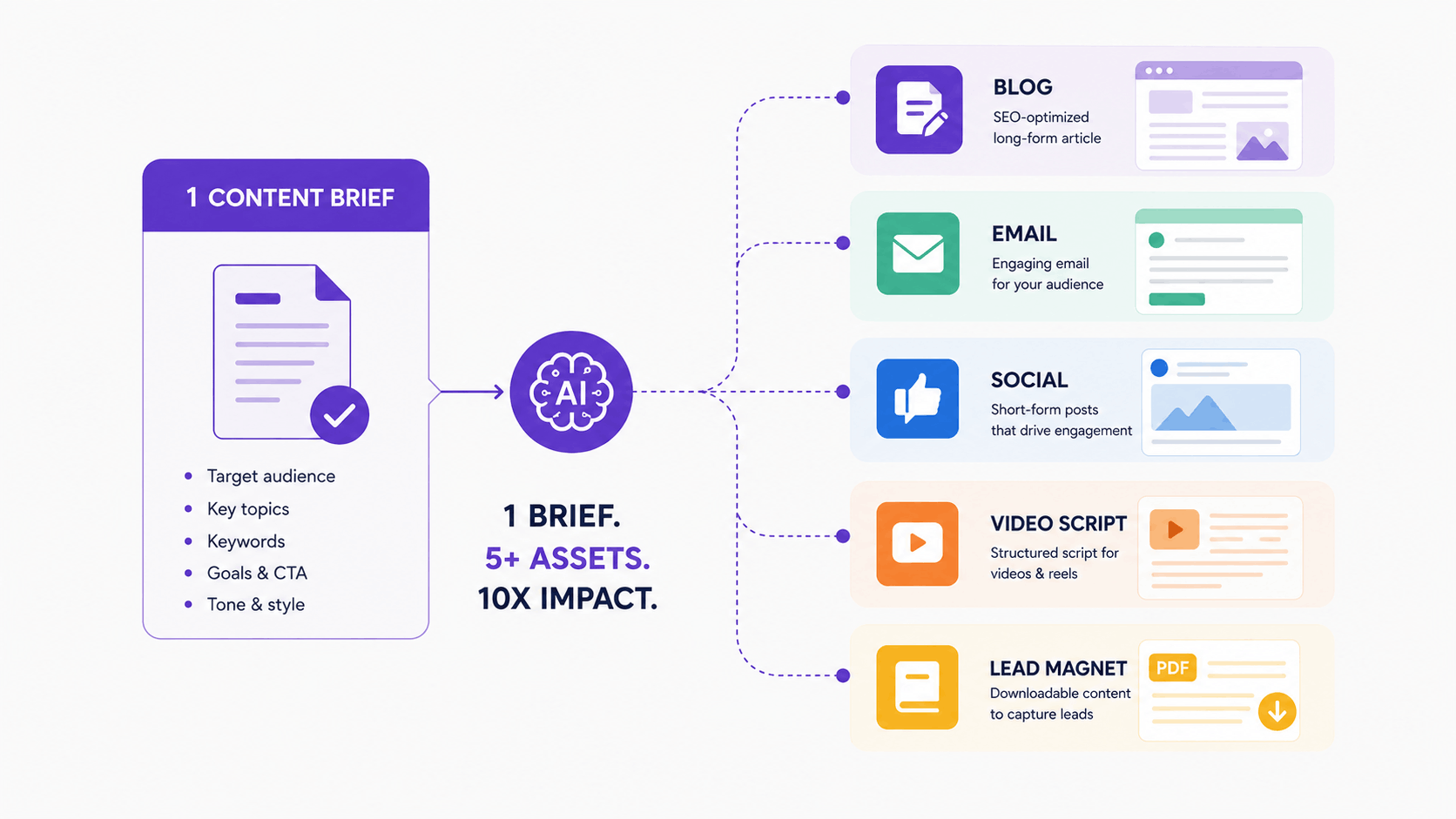
Content Variant Generation: From a single comprehensive article, AI generates blog variations, social media summaries, email newsletter segments, video scripts, and infographic outlines. One piece of research effort and one piece of comprehensive content creates multiple assets across different channels, amplifying content value exponentially. Your investment in research compounds across distribution channels.
Quality Assurance Automation: AI checks final content against brand guidelines, style standards, SEO requirements, and readability targets before publication. Growing businesses catch quality issues before they reach readers, maintaining consistent brand voice across scaling content production. This automated QA catches errors that humans miss consistently.
Production Scaling Reality Check
Growing businesses implementing AI content production tools typically scale from 4-6 pieces monthly to 12-16 pieces monthly without proportional staff increase. They report 40-50% reduction in time-to-publish for equivalent quality. And they maintain or improve content quality through AI optimization that catches issues humans miss—incomplete keyword optimization, readability issues, structural weaknesses.
For a growing business targeting organic growth, this scaling capability is transformative. More content means more keywords targeted, more entry points for organic discovery, and more opportunities to rank for emerging search terms. The business grows traffic 2-4x within 12 months by publishing 3x more optimized content with flat or reduced headcount. That’s not just efficient; that’s game-changing for competitive positioning.
What Competitive Advantages Do Growing Businesses Gain Through AI SEO?
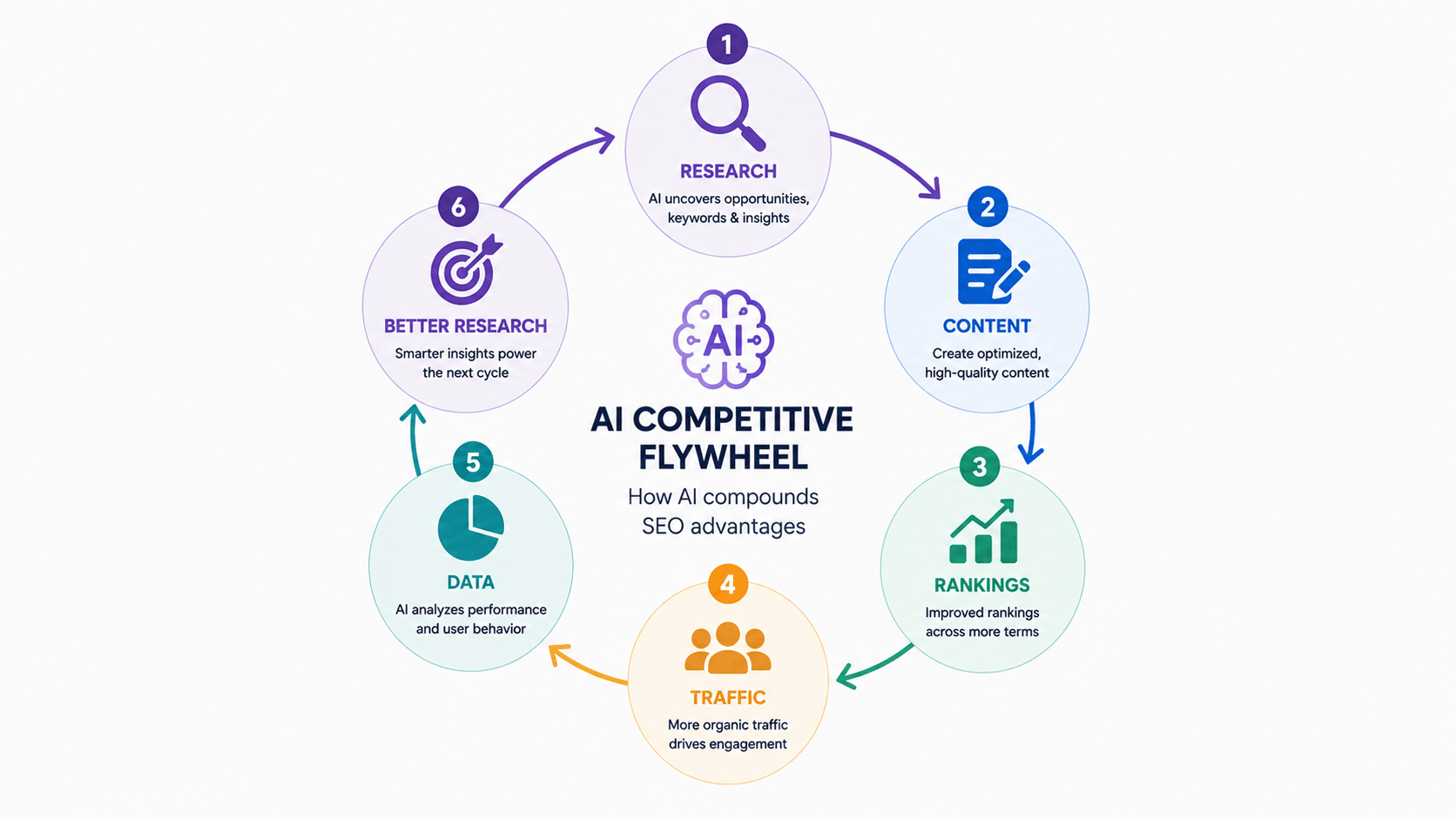
Growing businesses operating in competitive markets face an intimidating challenge: established competitors with larger budgets, more staff, and more published content dominate search results. Yet AI SEO strategies create asymmetric competitive advantages that enable growing companies to punch above their weight class.
Here’s the key insight that changes everything: AI doesn’t favor the biggest spenders. It favors the smartest spenders. A company with $50,000 annual SEO budget using AI tools can outcompete companies spending $200,000 on traditional SEO services, because AI multiplies the impact of available budget. You’re not trying to match competitor resources; you’re outsmarting them with technology.
Competitive Advantage Mechanisms That Create Market Dominance
Speed-to-Market for Content: Growing businesses can publish optimized content faster than competitors. When a new search trend emerges, AI-powered companies identify opportunity within days and publish optimized content within weeks. Competitors still operating on quarterly content planning schedules miss the opportunity window entirely. First-mover advantage in search rankings becomes tangible reality rather than theoretical concept.
Comprehensive Topical Authority: Rather than focusing limited content effort on highest-volume keywords, AI enables growing businesses to comprehensively cover entire topic areas. A growing B2B software company can publish 50 detailed articles across every aspect of project management, creating topical authority that outweighs competitors with 10-15 scattered articles. This comprehensive coverage improves ranking for the primary keyword while also capturing hundreds of long-tail variations. Google rewards topic mastery, not just individual keyword optimization.
Continuous Optimization: While competitors publish content and move forward, AI systems continuously optimize existing content based on performance, ranking changes, and emerging opportunities. A blog post published 6 months ago remains competitive because AI identified that competitors added new sections, and the system recommended similar updates. Growing businesses gain compound ranking advantages from optimization that competitors ignore or lack resources to maintain.
Predictive Strategy Execution: AI identifies emerging opportunities before they’re obvious, enabling growing businesses to position themselves as authorities on emerging topics. A business using AI trend analysis can publish comprehensive guides on “AI in SEO benefits” months before broader market awareness, capturing branded keywords and first-mover authority. You’re not following trends; you’re establishing thought leadership on topics before they’re mainstream.
Efficient Resource Allocation: Growing businesses using AI make smarter choices about which keywords deserve effort. AI identifies keywords with high business value despite moderate search volume, enabling focused effort on true business drivers rather than vanity metrics. This efficiency advantage compounds: competitors might chase high-volume keywords with low conversion, while AI-enabled businesses focus on keywords driving qualified traffic and customers.
Real-World Competitive Dynamics That Reveal AI Advantage
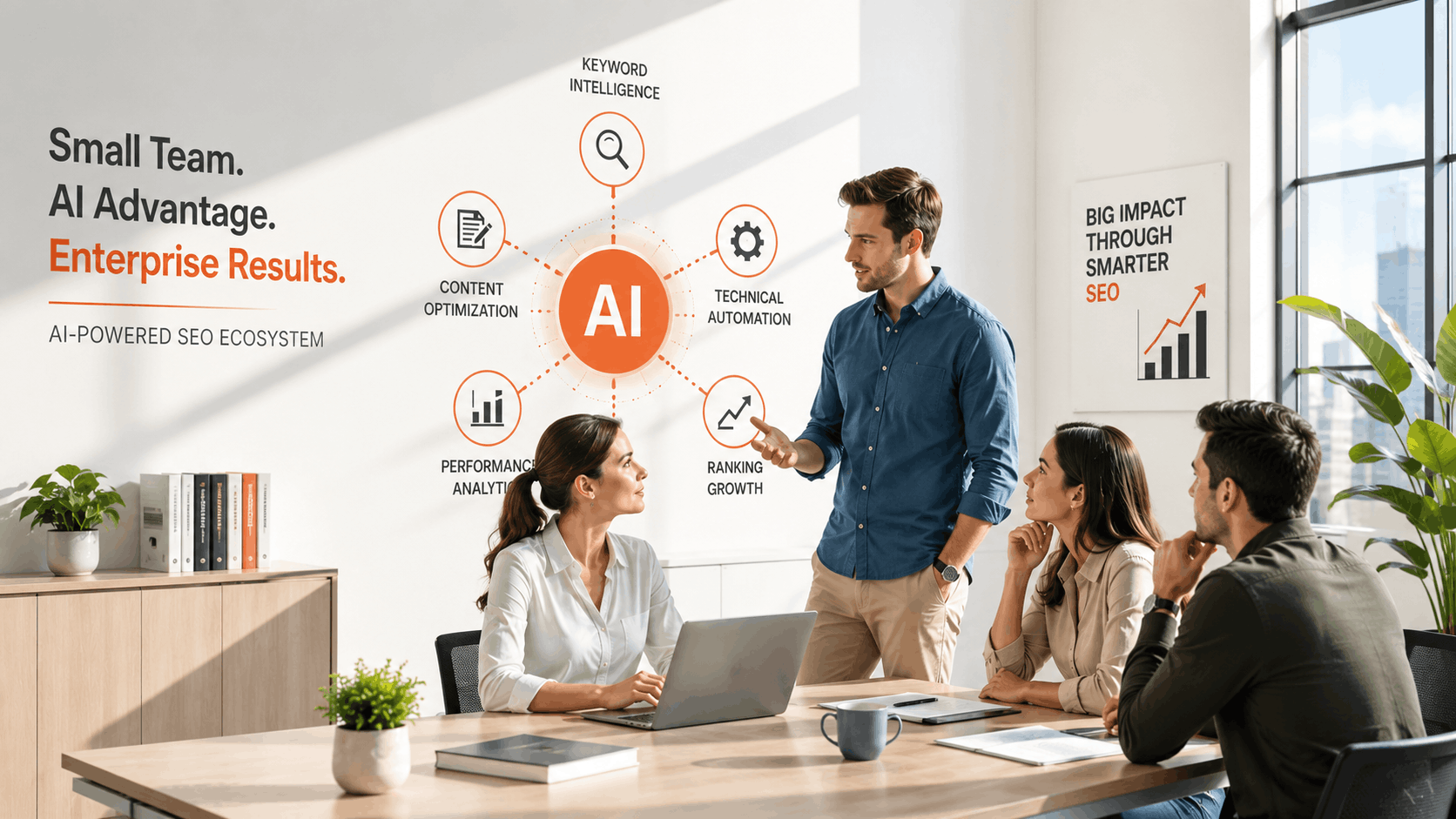
Consider two growing SaaS companies entering the same market. Company A spends $15,000 monthly on an SEO agency that produces 6-8 articles monthly with traditional optimization. Company B spends $8,000 monthly on AI tools that enable their single marketer to produce 16 optimized articles monthly plus continuous optimization of existing content.
After 12 months, Company B has 192 high-quality articles indexed versus Company A’s 96 articles. Company B’s content is continuously optimized based on performance data while Company A’s content remains static. Company B’s topic coverage is 2x deeper, their content stack is 2x larger, and their optimization is continuous. Company B captures 3-4x more organic traffic despite spending 50% less on SEO.
This scenario repeats across thousands of growing businesses: AI enables smarter, more efficient SEO execution that creates overwhelming competitive advantages despite smaller budgets. You don’t need bigger resources; you need better leverage of the resources you have. That’s what AI provides.
How Should Growing Businesses Implement AI SEO Strategies Effectively?
Understanding AI in SEO benefits is one thing. Implementing these benefits effectively is entirely different. Growing businesses often struggle with implementation because they’re juggling multiple priorities, lack deep SEO expertise, and need results quickly. Thoughtful implementation strategy prevents common pitfalls and accelerates time-to-value.
Here’s the biggest mistake growing businesses make: treating AI tools as magic solutions that work without human direction. Reality check: AI works best when humans provide clear strategy and guidelines, then AI amplifies execution. Vague prompts generate vague results. Weak editorial oversight allows poor quality through. Lack of strategic direction creates AI output that doesn’t align with business goals. This collaborative approach works; hands-off AI usage fails consistently.
Implementation Framework for Growing Businesses (12-Week Timeline)
Phase 1: Strategy and Goal Setting (Weeks 1-2)
Before touching AI tools, growing businesses need clarity on SEO strategy. What keywords will drive your growth? What topics should you own? What’s your realistic 12-month organic traffic goal? What business outcomes matter most—leads, customers, brand awareness? This foundation prevents AI tools from producing irrelevant content that doesn’t serve business objectives.
Answer these strategic questions:
- What are our top 20-30 target keywords for year one?
- What topics represent our business’s authority areas?
- What content gaps exist between us and top competitors?
- How many articles can we realistically publish monthly?
- Which keywords drive our most valuable customer types?
This strategic clarity takes 4-6 hours of marketing and product leadership discussion, but prevents months of wasted AI output. You’re not just producing content; you’re producing strategically aligned content that serves business growth.
Phase 2: AI Tool Selection and Setup (Weeks 2-3)
Different AI SEO tools serve different needs. Some specialize in keyword research, others in content creation, others in technical optimization. Growing businesses should assess their biggest bottleneck—usually keyword research or content production—and select tools addressing that first.
Selection criteria for growing businesses:
- Does this tool integrate with our existing CMS and analytics platforms?
- Does output quality meet our brand standards without extensive editing?
- What’s the monthly cost relative to hiring additional staff?
- Does the tool address our most critical bottleneck?
- Can we implement it within 2-3 weeks?
Starting with one tool focused on your biggest bottleneck is smarter than trying five tools simultaneously. Master one tool, gain results, then expand. This focused approach ensures adoption and creates quick wins that build organization momentum.
Phase 3: Team Training and Process Design (Weeks 3-4)
AI tools are only effective when your team knows how to use them. Growing businesses should invest time in training, creating templates, and designing workflows that integrate AI into existing processes naturally.
Key training elements:
- How to write effective AI prompts that generate on-brand output
- When to use AI recommendations versus override them with judgment
- Quality standards for AI-generated content before publication
- How to interpret AI recommendations and data
- Integration points with existing content and SEO workflows
A single 2-hour training session prevents months of suboptimal tool usage. Creating templates and checklists ensures consistent, high-quality implementation. Templates accelerate adoption because team members don’t have to guess about best practices.
Phase 4: Initial Execution and Measurement (Weeks 5-12)
Start with a focused pilot: commit to publishing 8-12 AI-assisted articles over 8 weeks, track performance, and measure results. This pilot approach reveals what works before scaling organization-wide. You’re not going all-in; you’re testing before committing.
Measure specifically:
- Time investment per article with AI assistance versus traditional creation
- Initial ranking position for articles at 4 weeks, 8 weeks, 12 weeks
- Traffic generated compared to traditionally-created content
- Conversion performance of AI-assisted content
- Team satisfaction and adoption of AI tools
- Quality feedback from readers and customers
This measurement phase creates data supporting broader organization adoption. When you present results to leadership showing 50% faster content production with equal or better quality, adoption becomes easy.
Phase 5: Optimization and Scaling (Weeks 13+)
Based on pilot results, optimize processes and scale strategically. If pilot articles achieved 50%+ higher initial rankings compared to traditional content, expand the program. If implementation revealed that AI content needed significant editing, adjust prompts and templates to improve output quality.
Scaling decisions for growing businesses:
- Should we hire additional writers to produce more content with AI assistance, or optimize existing processes?
- Which AI tools are genuinely improving results versus adding complexity?
- Where should we invest additional budget: content production, technical optimization, analytics?
- How does AI fit into our longer-term hiring and team strategy?
Thoughtful scaling prevents growing businesses from adding tools that complicate processes rather than improving results. You’re building sustainable competitive advantage, not adding complexity.
What Common Mistakes Should Growing Businesses Avoid With AI SEO?
Growing businesses implementing AI-driven SEO often encounter predictable challenges. Understanding and avoiding these mistakes accelerates time-to-value and prevents wasted investment on approaches that won’t work.
Mistake #1: Overestimating AI Autonomy
The biggest mistake: treating AI tools as fully autonomous systems that work without human oversight. Here’s the reality: AI works best with clear human direction. Vague prompts generate vague content. Weak editorial oversight allows poor quality through. Lack of strategy guidance creates AI output that doesn’t align with business goals.
Growing businesses should view AI as an amplifier, not automation. You provide direction; AI amplifies execution. You set quality standards; AI helps maintain them at scale. This collaborative approach generates exceptional results. Hands-off AI usage generates mediocre results every single time.
Mistake #2: Ignoring Content Depth and Quality
Some growing businesses attempt to scale content production purely for volume—publishing 30 articles monthly when 12 high-quality articles would generate better results. Search engines reward depth, topical authority, and content quality far more than they reward raw volume. Growing businesses should optimize for quality-first, then scale quantity once quality is proven.
A growing business publishing 12 deeply-researched, comprehensively optimized articles monthly will outrank a competitor publishing 30 surface-level articles every time. Quality compounds; volume without quality doesn’t. Focus on creating content worth linking to, worth reading, worth sharing—then scale that quality.
Mistake #3: Neglecting SEO Fundamentals
AI doesn’t replace SEO fundamentals. Keyword research, topical authority, user intent, and technical optimization remain critical. Growing businesses sometimes expect AI to automatically handle these, then wonder why content doesn’t rank. AI enhances fundamentals; it doesn’t replace them.
Successful AI implementation requires strong SEO fundamentals:
- Clear understanding of target keywords and topical authority areas
- Solid technical foundation (site speed, mobile optimization, SSL)
- Logical information architecture
- Strategic internal linking
- Author expertise and topical relevance
AI improves execution of these fundamentals; it doesn’t create fundamentals from scratch. You still need sound SEO strategy; AI just helps you execute it better.
Mistake #4: Lack of Performance Measurement
Growing businesses sometimes implement AI tools without establishing clear metrics for success. Without measurement, they can’t distinguish genuine improvements from perceived improvements, and can’t justify continued investment to leadership.
Establish baseline metrics before implementation:
- Current organic traffic by channel and keyword
- Average time-to-ranking for published content
- Conversion rate by traffic source
- Content production time and cost
Then measure impact 30, 60, and 90 days after implementation. Clear data guides optimization decisions and justifies continued investment. Numbers don’t lie; they tell leadership exactly what’s working.
Mistake #5: Tool Proliferation Without Integration
Growing businesses sometimes adopt six different AI tools without ensuring they integrate or align. This creates workflow complexity, redundant data, and confusion about which tool is responsible for which result. You end up with multiple tools competing rather than complementing.
Instead, growing businesses should: select 1-2 core tools addressing primary bottlenecks, ensure they integrate with existing systems, master them thoroughly, then carefully evaluate whether additional tools address genuine needs versus creating complexity.
Mistake #6: Expecting Immediate Results
AI accelerates SEO execution, but SEO still requires time for Google to crawl, index, and rank content. Growing businesses sometimes expect AI-generated content to rank immediately, then abandon the approach when weeks pass without ranking changes.
Realistic timelines: AI-optimized content typically ranks 4-8 weeks faster than traditionally-optimized content. So rather than 12-week ranking timelines, expect 6-8 weeks. But “faster” isn’t “immediate.” Growing businesses should plan for 90-day performance evaluation, not 30-day assessment. Patience combined with data-driven optimization creates sustainable competitive advantage.
Successful AI implementation for growing businesses requires avoiding these pitfalls while focusing on strategic deployment, quality maintenance, and measurement-driven optimization. You’re building long-term competitive advantage, not chasing short-term wins.
What’s the Future of AI in SEO for Growing Business Growth?
AI in SEO benefits are expanding rapidly as technology advances. Growing businesses should understand emerging capabilities to stay competitive and plan for future strategic advantage.
The evolution of AI in SEO follows predictable patterns: each new capability cycle becomes table-stakes within 2-3 years. AI-powered keyword research was differentiated five years ago; today it’s standard. AI content optimization was advanced two years ago; it’s increasingly expected. Understanding the next wave of AI capabilities helps growing businesses position for sustained competitive advantage rather than just keeping pace.
Emerging AI Capabilities That Will Reshape SEO
Zero-Click Search Optimization: Google’s increased display of direct answers, knowledge panels, and featured content means search results evolve toward zero-click information consumption. Users get answers directly in search results without visiting websites. AI systems are developing to optimize content for these zero-click formats—structuring information to appear in knowledge panels, creating content formatted for featured snippets, and ensuring direct answer extractability.
Growing businesses using AI systems optimized for zero-click formats will capture visibility even when searchers don’t click through to websites. This represents a significant evolution from traditional ranking-focused optimization. You’re not just chasing top rankings; you’re optimizing for direct visibility in search results.
Multi-Channel Content Intelligence: AI increasingly creates content across channels (blog, social media, email, video, podcasts) from single research and optimization effort. Growing businesses will handle content strategy holistically, with AI managing adaptation across channels while maintaining message consistency and optimization. One piece of research effort creates multiple assets optimized for different platforms and audiences.
Generative Search Optimization: As Google and competitors expand AI-generated search summaries, optimization requirements shift fundamentally. Future AI tools will optimize content for inclusion in generative search results, positioning brands in AI-powered search summaries alongside traditional rankings. You’ll need to think about how your content appears when an AI system summarizes search results for users.
Real-Time Personalization: AI will personalize content recommendations and optimization based on individual user context, location, device, search history, and intent. Growing businesses will move beyond one-size-fits-all content toward AI-powered personalization that adapts content presentation and recommendations based on visitor context. Your content will change based on who’s reading it.
Attribution and Revenue Optimization: AI attribution models will improve dramatically, enabling precise correlation between content topics, keywords, and customer lifetime value. Growing businesses will optimize SEO strategy not for traffic volume but for business value, focusing resources on keywords and topics that generate most valuable customers. This shifts focus from vanity metrics to actual business outcomes.
Strategic Positioning for Sustained Growth
Growing businesses should adopt AI SEO gradually, focus on proven benefits today (keyword research, content optimization, technical monitoring, analytics), while remaining aware of emerging capabilities. This balanced approach captures current competitive advantages while building organizational capability for future developments.
The businesses most successfully leveraging AI in SEO benefits in 2026 and beyond will be those that:
- Treat AI as strategic capability rather than tactical tool
- Invest in understanding their specific business application
- Maintain focus on SEO fundamentals as AI handles execution
- Measure impact rigorously
- Evolve strategy as AI capabilities advance
For growing businesses, AI in SEO represents an opportunity to compete with larger, better-funded competitors by being smarter, faster, and more data-driven. This advantage compounds over time, transforming small, resource-constrained teams into formidable organic growth engines. You’re not competing on budget; you’re competing on intelligence and execution speed.
AI in SEO benefits for growing businesses extend far beyond simple productivity improvements. By automating keyword research, optimizing content consistently, monitoring technical health continuously, analyzing performance predictively, and scaling content production efficiently, AI enables growing companies to compete with much larger competitors while operating lean teams and tight budgets.
The strategic advantage isn’t just time saved or content produced—it’s the ability to execute sophisticated, data-driven SEO strategy that would previously require dedicated specialists and substantial budgets. Growing businesses implementing AI-driven SEO strategies thoughtfully see 2-4x organic traffic growth within 12-18 months, achieve sustainable competitive advantages in search rankings, and free team capacity for strategic thinking rather than manual execution.
The businesses that will dominate search results over the next few years won’t be those with the biggest budgets. They’ll be those using AI most intelligently. If you’re ready to transform your SEO strategy and accelerate organic growth for your growing business, now is the time to embrace AI-powered optimization. The competitive window for first-mover advantage is open—but it won’t stay open forever. As more companies adopt AI SEO strategies, the advantage for early adopters increases.
Ready to see how AI can transform your SEO strategy and accelerate organic growth? Discover how Aegasis Labs‘ AI-powered platform automates keyword research, content optimization, and technical monitoring—enabling your team to scale organic traffic without hiring additional specialists. Start with a free SEO audit to identify quick wins and see the AI advantage firsthand. Let’s turn your SEO challenge into competitive advantage.
