
Visibility in a crowded SaaS market is hard to win. Manual SEO drags on for months, from keyword research to content optimization to tracking what actually moved. An AI SEO tool for SaaS companies rewrites that math by taking over the heavy lifting and leaving the strategic calls with you. These tools speed up keyword research, tighten content optimization, and watch performance across hundreds of keywords at once.
For SaaS businesses, pairing an AI-powered SEO strategy with the right keyword approach and a steady publishing rhythm can cut your time-to-MQL by 60-70% and lift search visibility sharply.
This guide walks you through a complete AI SEO for SaaS playbook: which keywords to target, publishing frequency that drives results, content types that convert, realistic timelines to qualified leads, and the specific tools that deliver.
Five-person startup or growth-stage company with a real marketing team, either way you’ll find strategies you can act on to turn organic search into your cheapest acquisition channel.
Why AI SEO Matters for SaaS Companies
SaaS lives in a competitive landscape where the old marketing playbook keeps coming up short. Your buyers aren’t sitting around waiting for a sales call. They’re out searching for solutions right now. When someone types “project management software” or “customer support automation,” that’s buying intent showing itself. They’re self-educating, comparing alternatives, checking pricing, and qualifying vendors well before anyone on your sales team hears from them. SEO is what puts you in that moment.
Whoever ranks first in those results owns the moment. Your product could be the perfect fit, but if a competitor sits on page one and you’re stuck on page three, you never get to make the case. And the cost adds up fast. Every day without strong SEO visibility is another day qualified prospects land on a competitor instead.
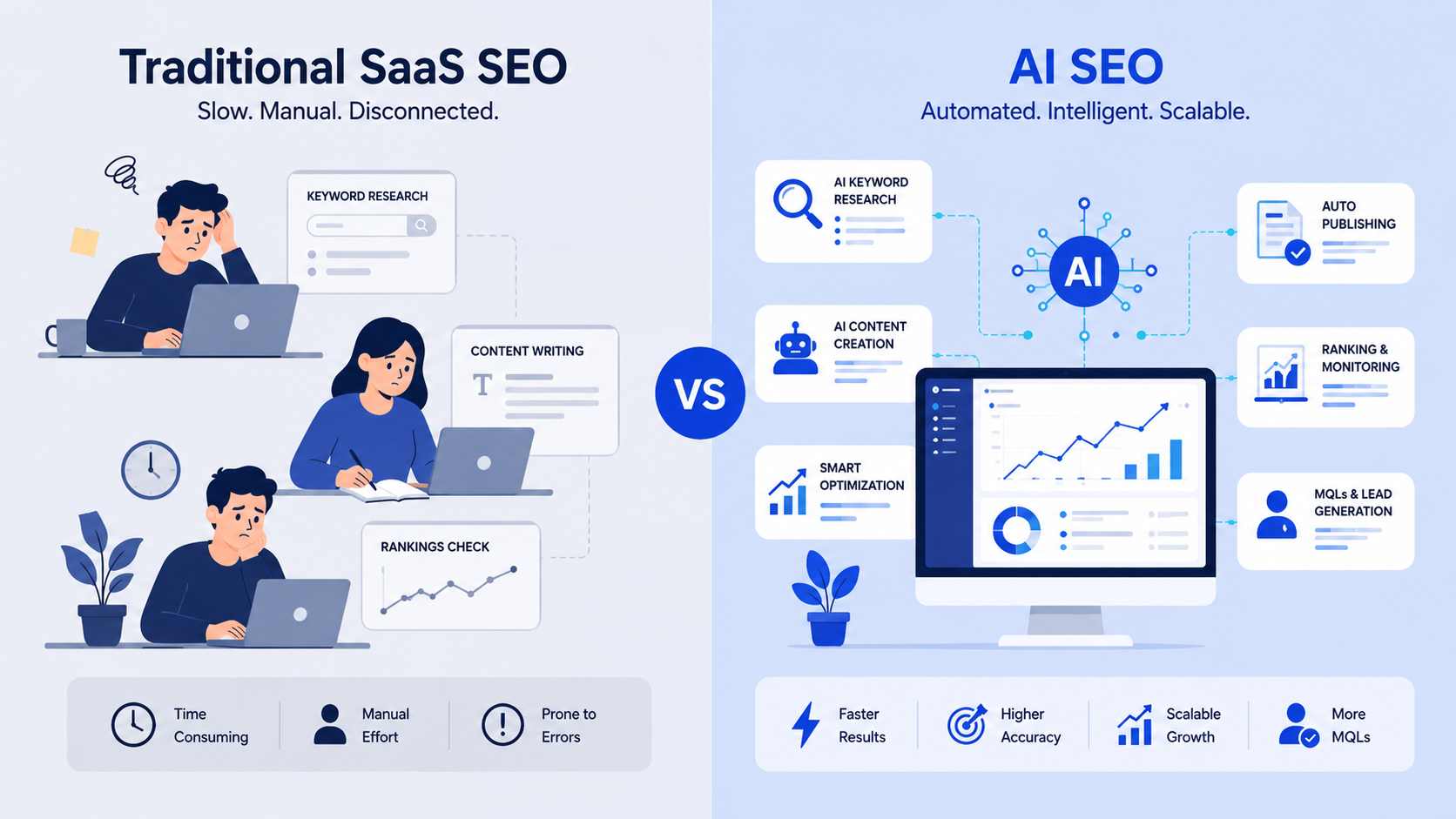
The catch? Manual SEO for SaaS eats resources. Traditional keyword research means picking apart search intent, competition levels, and ranking difficulty. Content creation demands a real grip on buyer personas, answers to objections at every funnel stage, and pages tuned for search engines and conversions at the same time. Then there’s the publishing question, which forces a balance between quality and frequency. Publish too rarely and momentum dies. Publish without a plan and you burn resources on content that neither ranks nor converts.
For a growing SaaS team with no dedicated SEO agency, that pile gets overwhelming quickly. You have to move fast without dropping quality. You need to publish consistently while your team keeps getting yanked back toward product work. That tension is exactly where AI SEO tools do real work.
How AI SEO Tools Level the Playing Field
Modern AI SEO solutions take over the repetitive tasks and leave the strategy where it belongs. According to Semrush’s industry analysis, companies using AI-assisted SEO see 40-50% faster content production without giving up quality. For SaaS in particular, AI-powered keyword research catches high-intent buyer keywords your team would likely miss working by hand. AI content optimization makes sure every article hits the right keywords, answers user questions in full, and follows search engine best practices on its own.
Here’s where the compounding kicks in: more content out the door faster, better-optimized from day one, and refreshed on performance data. Over 6-12 months that pace opens a real gap between your organic visibility and competitors still grinding it out manually. For SaaS companies running 5-50 person teams, AI SEO tools basically erase the advantage larger competitors get from a dedicated SEO department.
The tangible benefit: AI-assisted SaaS SEO programs usually hit their first meaningful page-one rankings 2-3 months faster than manual approaches, which means earlier traffic, earlier leads, and earlier proof that organic acquisition works for your business.
How AI Keyword Research Works for SaaS
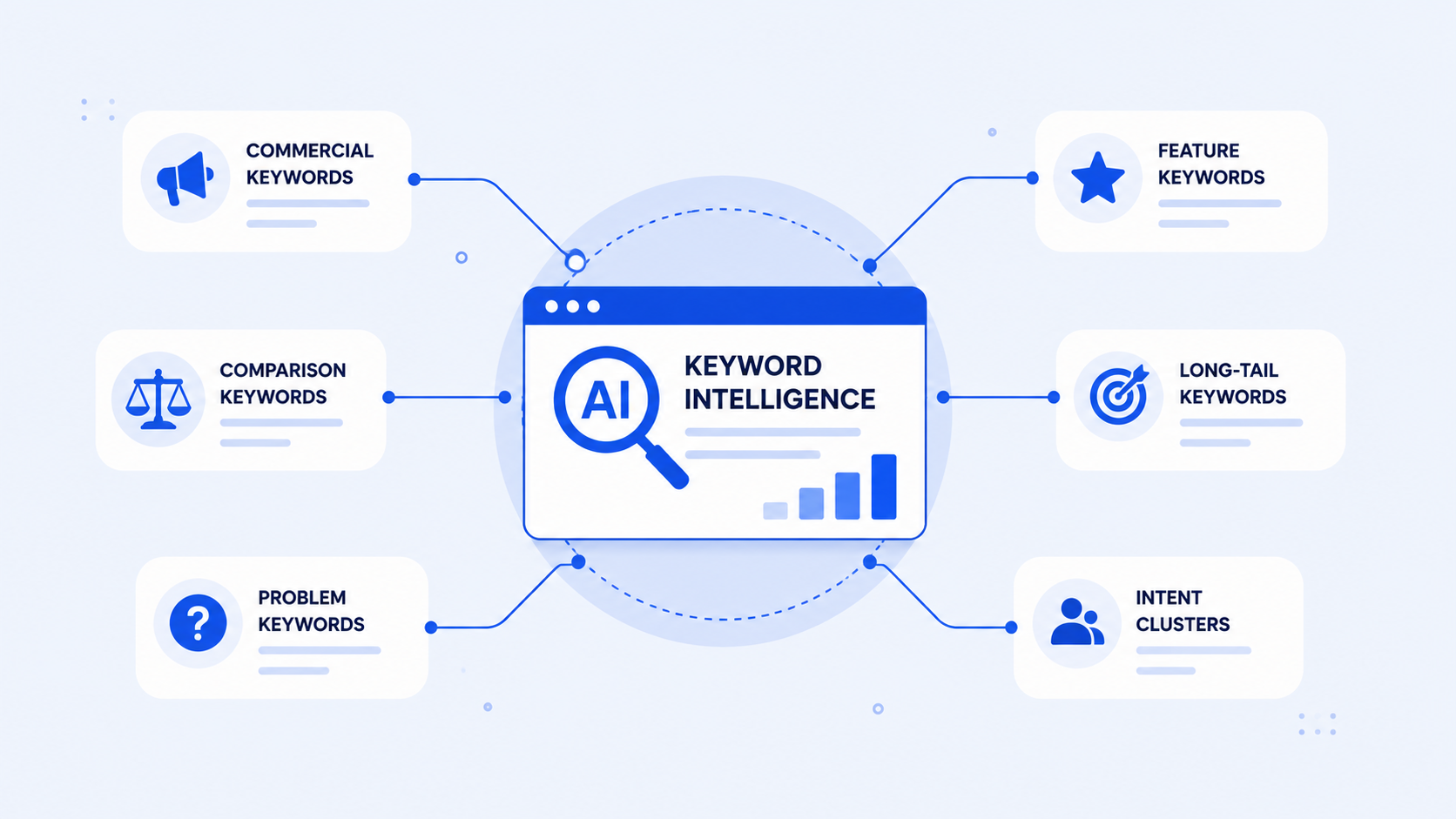
Traditional keyword research for SaaS has you manually digging through tools like Google Search and Moz Keyword Explorer to surface opportunities. You might sink hours into finding keywords, then more hours analyzing each for search volume, competition, and whether your site could realistically rank. An AI SEO tool for SaaS companies squeezes that whole thing down. Minutes, not hours, and the recommendations come back already analyzed for opportunity and strategic fit.
The AI Keyword Research Process Explained
Here’s how it plays out in practice. The AI first reads your SaaS website, product, and existing content to figure out your market position and what you’re currently optimized for. Then it scans competitor sites and content to spot the keywords they rank for and, more usefully, the gaps where you have an opening. Next it works through large-scale search volume and competition data from sources like Google Search Central, pinpointing keywords your domain can realistically win based on current authority and content depth.
And here’s where AI pulls ahead: it clusters keywords by user intent. That means telling apart someone searching “what is project management” (informational, early awareness) from someone searching “buy project management software” (transactional, ready to purchase). That intent-based clustering shapes your entire content plan, which is why it matters so much for SaaS.
The output isn’t a giant keyword dump that buries your team. AI sorts the recommendations by strategic priority and flags which keywords are the best openings for your specific situation.
How Should You Structure Your Keyword Strategy Timeline
A good AI SEO for SaaS playbook doesn’t swing at all 200+ identified keywords at once. It phases the targeting, matching your content production capacity against market opportunities. Realistic, measurable, and something a team can actually pull off.
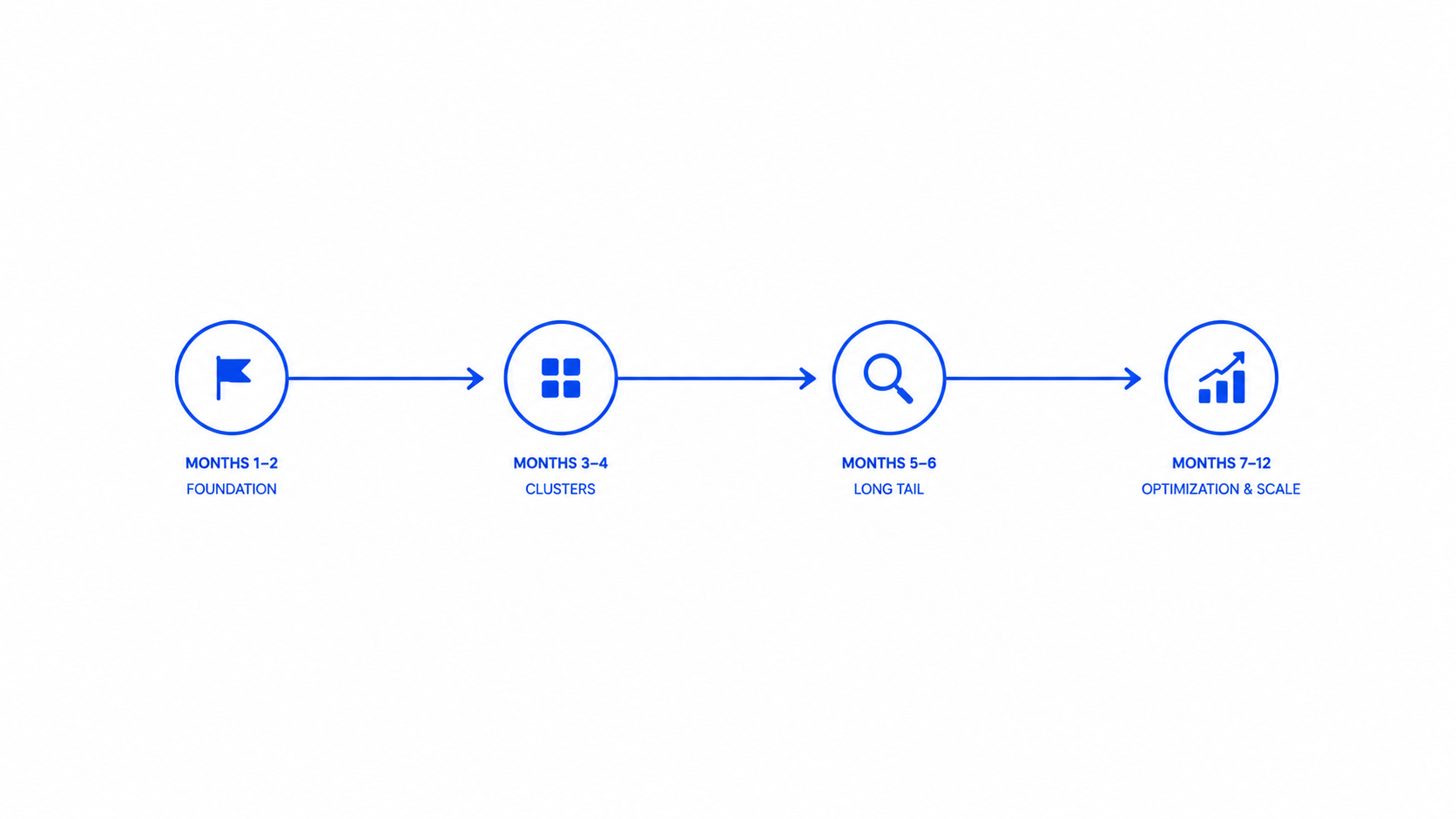
Phase 1 (Months 1-2): Foundation & Authority Building
Put everything into cornerstone content aimed at your 5-10 primary, broadest keywords. These map straight to your core product value proposition. Sell project management software and your primary keywords might be “project management software,” “best project management tools,” and “project management solution for teams.” Use an AI SEO tool to study the top-ranking content for each, then build pieces that beat it on depth, clarity, real-world usefulness, and comprehensiveness.
Publish 2-4 cornerstone pieces in this phase, no more. These are the heavy hitters, each 3,000-5,000 words, fully optimized, and internally linked so Google reads the topical relationships between them. You won’t see rankings yet. That’s normal, and it’s expected. You’re laying the foundation everything else stands on. This phase usually runs 4-8 weeks depending on your team’s capacity and how deep you research each piece.
Phase 2 (Months 3-4): Topical Authority & Cluster Development
Foundation content is live, so now you build cluster content around 10-20 secondary keywords tied to each cornerstone topic. For a project management software company, if the cornerstone is “Project Management Software,” the cluster might run “Project Management Software for Teams,” “Project Management Software for Remote Work,” “Project Management Software Free,” and “Best Free Project Management Tools.” Write 1,500-2,500 word articles for each cluster keyword.
Lean on AI tools to optimize internal linking. Every cluster article should point back to the cornerstone and out to related cluster articles, weaving a web of topically cohesive content. That structure sends Google a clear message: this site doesn’t just have one page about project management software, it has a full resource library. Hold the 2-4 articles monthly cadence through this phase. By month 4 you should have 8-12 published pieces staking clear topical authority in your primary market.
Phase 3 (Months 5-6): Long-Tail Capture & Conversion Optimization
With broad topical authority in place, push into long-tail keywords and comparison-focused content. An AI tool can surface 50+ long-tail variations of your primary keywords: “best project management software for agencies,” “project management software for nonprofits,” “project management software for healthcare,” and so on. Each has lower search volume on its own, but together they pull serious traffic and often convert better because they map to a particular use case.
Build comparison content too, aimed at specific competitive matchups. If prospects keep asking “Asana vs Monday” or “Monday vs ClickUp,” write detailed comparison guides. This is the phase where organic traffic starts inflecting as your earlier content begins to rank. Use AI-powered keyword research tracking to see which published pieces are ranking and for what, then fix the underperformers. A piece sitting at position 8-10 can jump to 5-6 with targeted optimization, adding 30-50% more traffic.
Phase 4 (Months 7-12): Optimization, Expansion & MQL Tracking
Keep producing new content and keep optimizing the old. An AI content monitor should flag pieces that have slipped in rankings or are parked on page 2, close to breaking onto page 1. Fix them with sharper title tags, tighter targeting of primary keywords, more internal links, and fresh statistics or examples. Widen the strategy to grab emerging keywords, the terms you weren’t chasing at first but competitors now rank for.

By month 7-9 you should see steady organic traffic and your first real MQL volume. Track which pieces drive the most MQLs and the highest-quality leads, then build out around those high-converting topics. If comparison content converts at 8% while awareness-stage content converts at 1%, that gap should steer your month 8-12 priorities. Data-driven iteration is the whole game here.
Phased Approach Benefits
This phased strategy works because it respects what a real team can handle while stacking compounding authority. Instead of drowning your team under 200 keywords at once, you concentrate: lock authority in primary areas, then expand from there. It’s measurable, so you always know which phase you’re in and which metrics say you’re ready for the next. And it holds up. A team that runs all four phases has built a content engine it can keep operating for the long haul, feeding organic growth without let-up.
How AI-Powered Content Optimization Improves SEO Performance
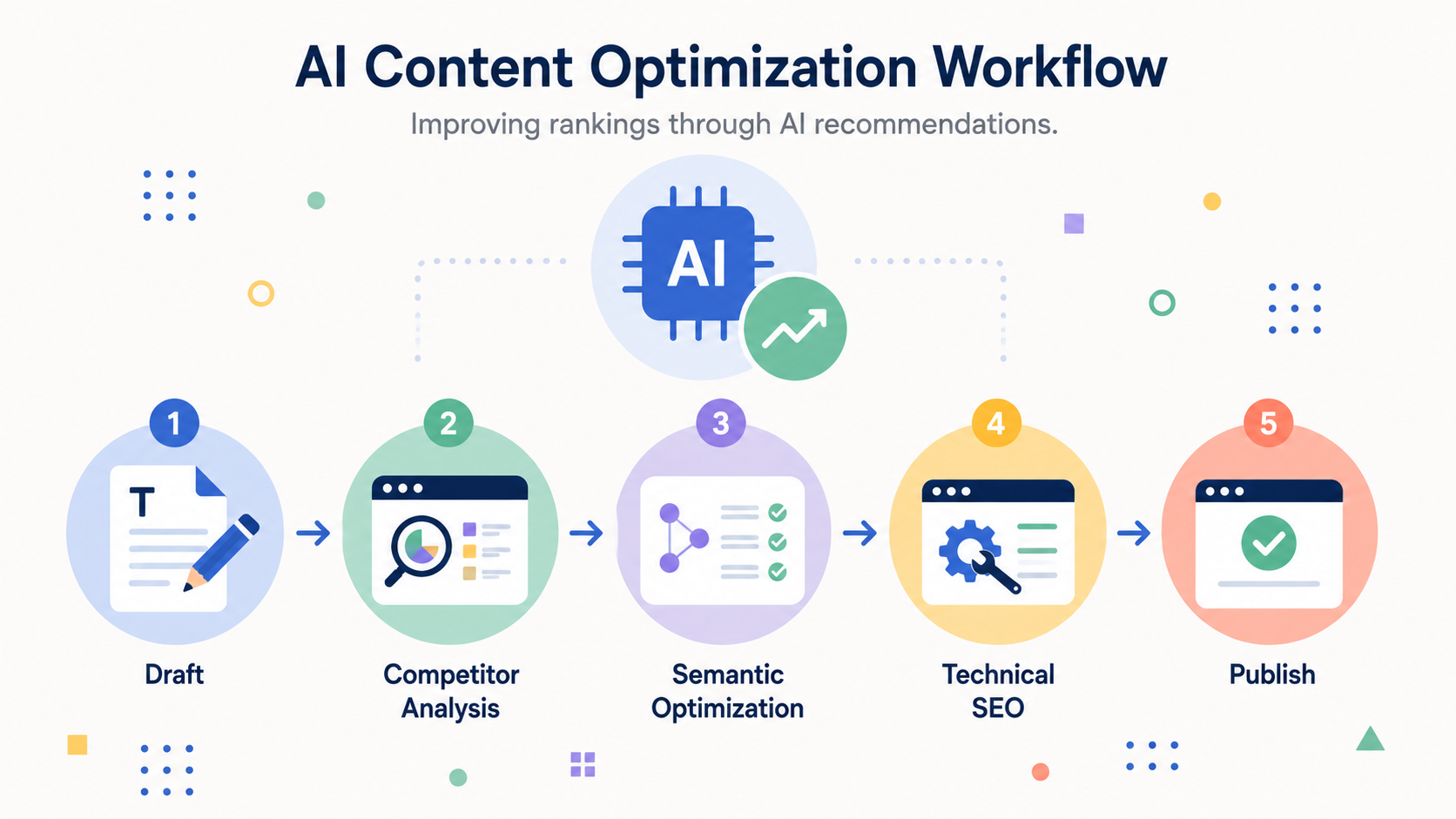
Keyword research is only half of it. Modern AI SEO tools also work on the content itself in ways that move rankings directly. Content optimization used to mean manually stacking your draft against top-ranking pages, counting keyword frequency, studying heading structure, checking length, and tweaking as you learned. Hours per article, gone. AI-powered content optimization does it automatically, reading the top 10 ranking pages and handing back specific recommendations you can act on.
What AI Content Optimization Actually Does
Keyword analysis and density optimization: AI pulls the exact keywords top-ranking pages use in titles, headings, and body, then recommends an optimal density (usually 1.0-1.5% for primary keywords, low enough to dodge the over-optimization that trips spam filters). No more guessing whether you’ve used a keyword enough. AI just tells you: your primary keyword shows up at 0.8% (too low), push it to 1.2%.
Content structure analysis: The tool counts how many H2 and H3 headings top pages use, where they sit, and how they’re structured, then recommends a matching layout. If every top-ranking page for “project management software” runs 5-7 H2 headings with 2-3 H3 subheadings apiece and your draft has 3 H2s, that’s a structural gap staring back at you.
Word count and section recommendations: AI checks average word count (typically 3,000-3,500 for competitive SaaS keywords), paragraphs per section, and sentences per paragraph, then recommends a structure that matches the search-winning pattern. This isn’t padding for the sake of length. It’s matching the depth Google’s algorithm has learned to reward for a given query.
Semantic keyword integration: Beyond your primary keyword, top pages carry related terms and concepts, the semantic keywords. Tools like Semrush spot these automatically and recommend additions that lift topical relevance. For a piece on project management software, the semantic set might include “task management,” “team collaboration,” “resource allocation,” “project tracking,” and more. Weave them in naturally and you signal to Google that you cover the topic fully.
Technical On-Page Optimization
AI-powered optimization also handles on-page technical elements: sharpening meta descriptions for click-through rate (CTR), keeping heading hierarchy clean (H1 → H2 → H3), checking internal link placement and anchor text quality, confirming every image has descriptive alt text, and scoring readability. Tools like Google Search Console show how your pages stack up against these technical benchmarks, and AI tools recommend the specific fixes.
The Real-World Impact of Optimization
The payoff from AI content optimization is measurable and it’s real. Articles optimized with AI content tools rank 2-4 positions higher on average than the versions left alone. A piece on “project management software” might open at position 8 and climb to 4-5 after optimization, which translates straight into 30-50% more organic traffic from the same article.
The initial pass matters, but the ongoing updates matter more. Content that ranked position 5 three months ago might be sitting at position 7 today as new competitors publish and the results shift under you. AI content monitors track this on their own, flagging the pieces that dropped and recommending updates. Refresh a piece with current statistics, a better structure, more internal links, and updated examples, and you often win back the old position, sometimes better.
Scaling Optimization Across Your Content Library
For SaaS companies, continuous optimization compounds hard. A library of 50 pieces where 10 stay in rotation, refreshed quarterly with new data, improved structure, and more internal links, beats 50 pieces nobody touches after launch. Do this by hand and it doesn’t scale. You’re looking at 10+ hours a week. With AI tools, one marketer can ride herd on 20-30 pieces a month and keep the whole library competitive.
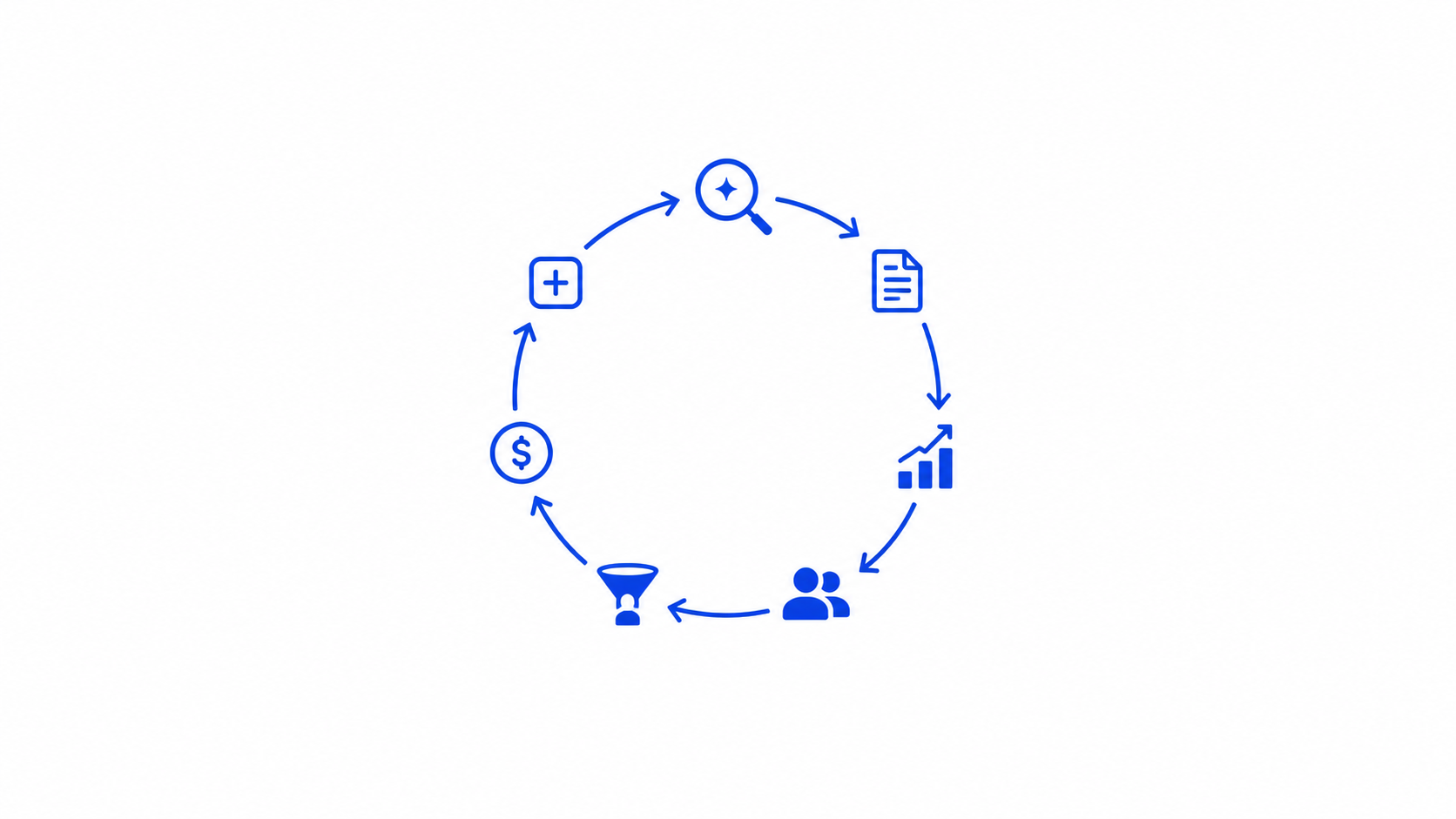
This is the shift AI tools make possible, from SEO as a one-time push to SEO as a system that holds. Publish content, optimize it, track its performance, update it quarterly against competition changes and performance data. Then run it again across the whole library. That systematic loop compounds, and the competitive gap keeps widening in your favor.
Which AI SEO Tools Best Support the SaaS Playbook
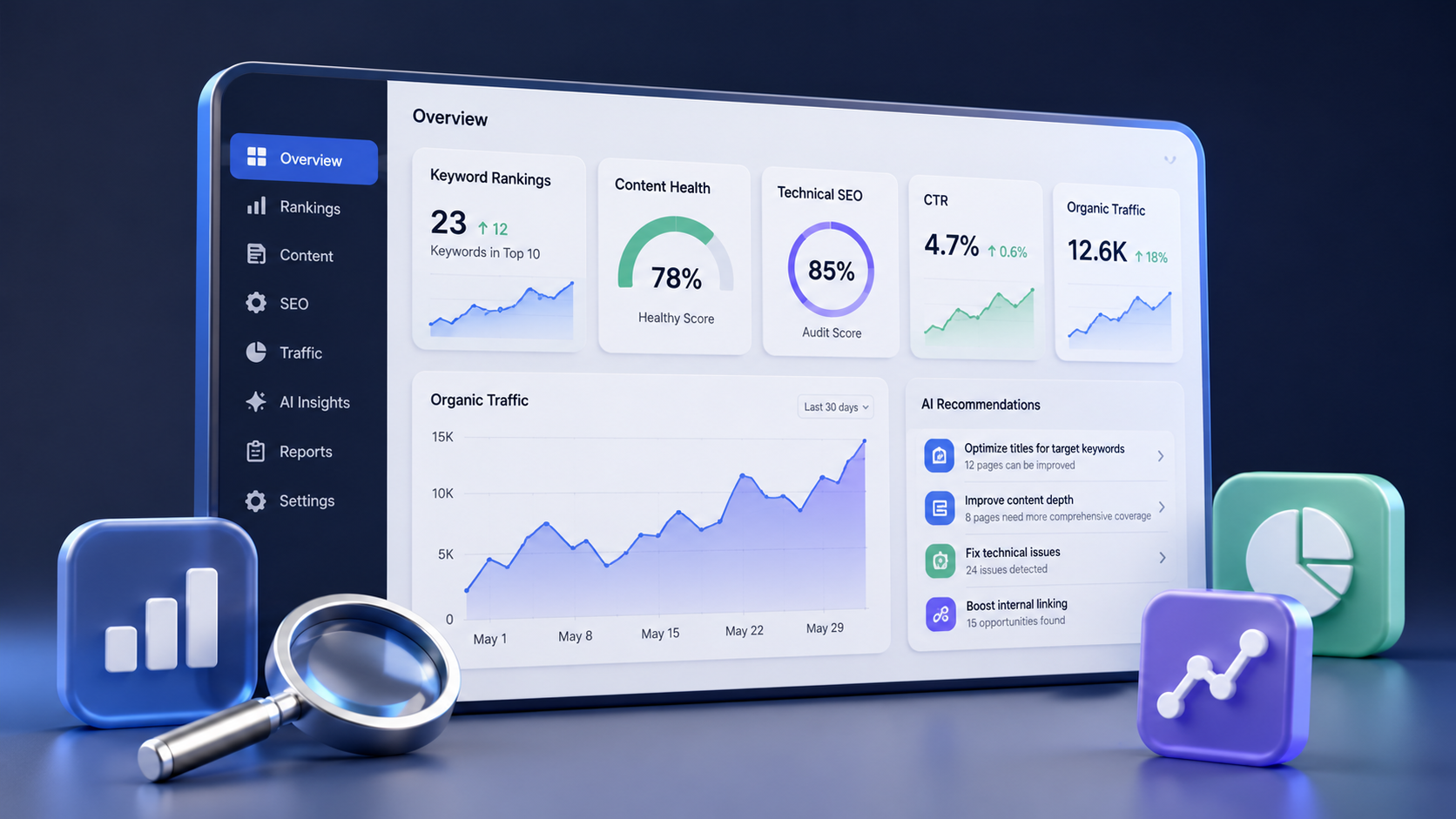
AI SEO tools aren’t interchangeable, and SaaS companies have needs that expose the differences. The strongest platforms handle keyword research, content generation or optimization, ranking tracking, and performance monitoring together, which cuts the tool-switching and manual handoffs that slow teams down.
Top AI SEO Platforms for SaaS
Surfer SEO excels at content optimization. Feed it your target keyword and Surfer reads the top-ranking pages, then hands back a full optimization playbook across keyword usage, content structure, semantic keywords, and readability. For SaaS content creators, that drops optimization time from 2-3 hours to 20-30 minutes. Surfer gives you a content score (0-100) that shows how well your piece stacks against top competitors, and most marketers aim for 70+ before publishing. It plugs into Google Docs, so editing stays smooth. The limitation: Surfer is built for optimization and ranking tracking, not comprehensive keyword research or strategic planning.
Search Atlas combines keyword research, content generation, and optimization in one platform. You research keywords, get AI-generated content outlines, optimize against top-ranking pages, and track rankings, all inside one tool. For SaaS companies chasing an all-in-one setup, Search Atlas cuts the tool-switching and reports everything in one place. The keyword research module surfaces opportunities, the content generation module builds outlines and first drafts, the optimization module keeps you competitive in search, and the rank tracker watches performance. For small-to-medium teams, that integration cleans up the workflow a lot.
Moz (Keyword Explorer + SEO Pro) and Ahrefs offer comprehensive keyword research and competitive analysis. Moz gives you domain authority estimates and keyword opportunity scoring. Ahrefs digs into backlink analysis and content gap identification, showing which topics competitors rank for that you don’t. Both integrate with Google Search Console and Google Search Analytics for unified performance tracking. For SaaS companies that want deep competitive intelligence, these tools deliver the market insight that shapes strategy.
SEOBrain.IO specifically targets SaaS companies seeking AI-powered SEO automation. By wiring AI keyword research into automated content generation and optimization, SEOBrain.IO strips out the manual effort of keeping a consistent publishing schedule. For SaaS teams with no dedicated content creators, that means scaling from 2 articles monthly to 6-8 on the same resource budget. The platform keeps watching your keyword rankings and recommends optimization updates, basically running as an automated SEO manager.
Building Your Optimal Tool Stack
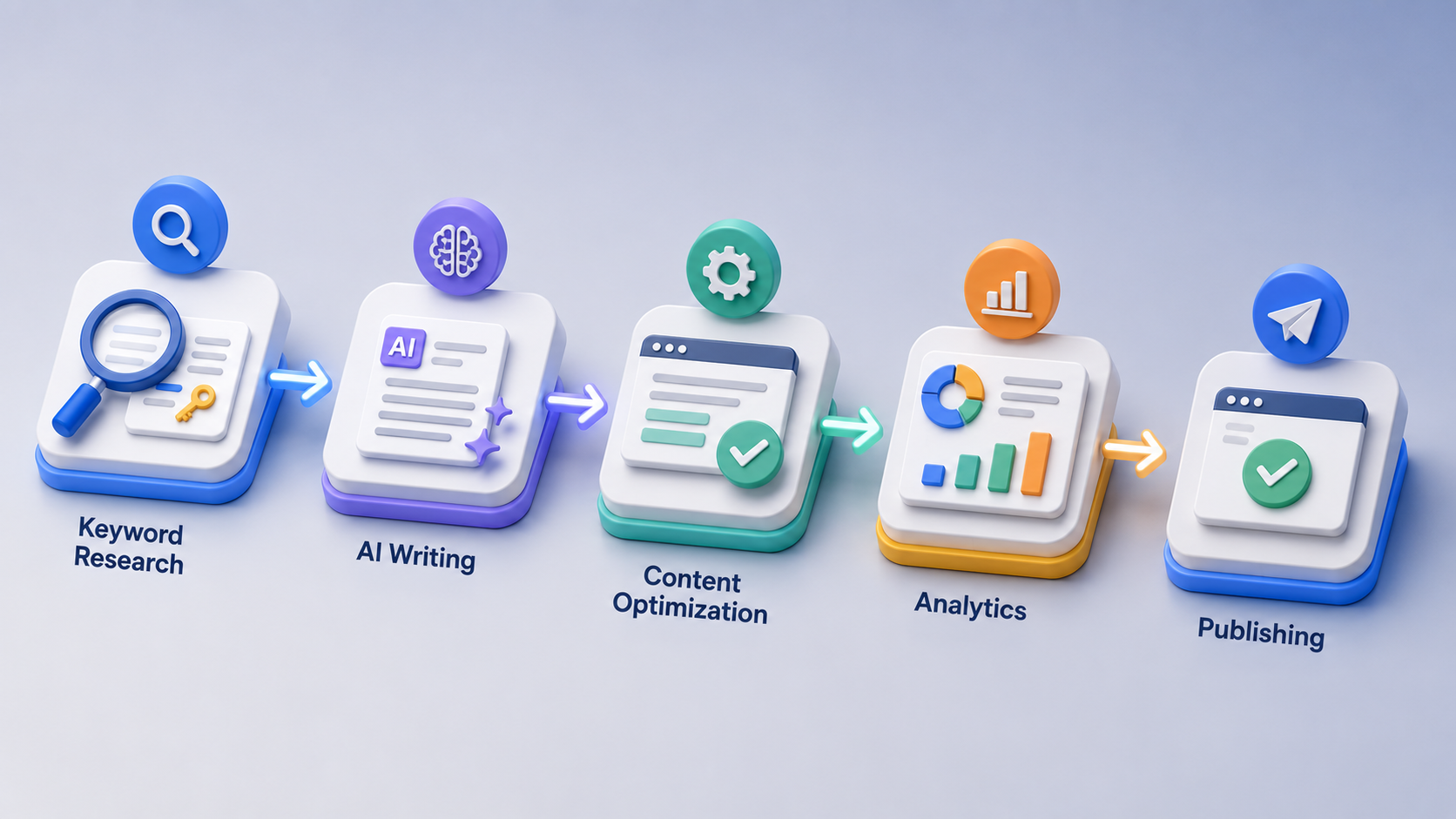
Most successful SaaS companies don’t run one tool. They build a stack that fits their workflow:
Keyword research + planning: Use Moz Keyword Explorer or SEOBrain.IO to surface opportunities and shape your keyword strategy. These give you search volume, competition analysis, and opportunity scoring, all of which you need for prioritization.
Content optimization: Surfer SEO keeps published content in line with top-ranking patterns. Run it on every piece before you publish. The 20-30 minutes per article pays for itself in ranking gains.
Ranking tracking + monitoring: Google Search Console and Google Analytics give you free performance tracking, and you can layer on Semrush or Ahrefs for competitive monitoring and deeper insight.
Integrated automation: Platforms like SEOBrain.IO or Search Atlas fold research, generation, and optimization together to kill the tool-switching and handoffs, which matters most for teams without a dedicated SEO specialist.
Selecting Tools for Your Team Size
Smaller SaaS companies (5-20 people) get the most from all-in-one platforms that need almost no setup. You want keyword research, content structure recommendations, and optimization. You don’t need deep competitive backlink analysis yet. Platforms like Search Atlas or SEOBrain.IO cover the essentials without swamping a new user.
Larger SaaS companies (50+ people) tend to reach for best-of-breed tools they can slot into existing workflows. You’ve probably already got project management and CMS systems in place, so plugging specialized tools into those makes sense. Pick best-in-class keyword research (Moz or Ahrefs), best-in-class optimization (Surfer), and best-in-class analytics (Google Search Console + custom dashboards).
One decision drives the rest: pick tools that cut manual work while keeping the strategy in human hands. AI automation should speed up execution, not push people out of the strategic calls.
How Should You Align SEO Strategy with Your SaaS Sales Funnel
The best AI SEO for SaaS playbooks tie content strategy directly to specific sales funnel stages. No random content. Every piece hits a specific stage with specific objectives and expected outcomes. That alignment is the line between SEO programs that pull 10 MQLs a month and ones that pull 100+.
Understanding Funnel-Aligned Content Strategy
Awareness Stage Content (Top of Funnel): These prospects don’t know your product exists yet. They’re searching for the problems it solves. A SaaS project management company might build content around “why teams need project management,” “benefits of centralized task management,” “common project management challenges,” and “how to improve team productivity.” High volume, low commercial intent. People here are early, often still naming the problem. Content at this stage should teach, not sell. Use AI keyword research to find high-volume, low-competition keywords in this bucket. Position your company as the knowledgeable authority, never the pushy salesperson. The goals: build audience, establish authority, drive initial awareness.
Consideration Stage Content (Middle of Funnel): Mid-funnel prospects have named their problem and are weighing solutions. They search “best project management tools,” “project management software comparison,” “Asana vs Monday,” “project management tools for remote teams.” Most SaaS SEO should live here. These keywords carry moderate volume, medium competition, and high commercial intent. Whoever reaches this content is actively shopping. So the content should compare solutions thoroughly, own the tradeoffs, and explain when each tool fits best. Present your product as one strong option rather than the only one, because that’s what builds credibility. Case studies and feature guides shine here. Goals: frame your product as a strong fit for specific use cases, earn trust through honest comparison, and capture contact info for nurturing.
Decision Stage Content (Bottom of Funnel): Late-funnel prospects are ready to buy. They search “project management software pricing,” “implement project management software,” “project management tool ROI,” “switch to project management software.” Lowest volume, highest conversion rates. Someone typing these is 20+ times more likely to become an MQL than someone at the awareness stage. Content here should tackle buying criteria, implementation worries, ROI justification, and objection handling. Product-focused content lands well. ROI calculators, implementation guides, and clear pricing all earn their place. Goals: clear the last purchase objections, speed the buying decision, capture high-intent prospects.
Post-Purchase Stage: After the sale, customers search “how to use project management software,” “project management best practices,” “maximize project management tool.” Content here strengthens onboarding and customer success, which trims churn. SaaS SEO strategy skips this stage too often, even though it hits retention and expansion revenue hard. Goals: improve onboarding, shorten time-to-value, hold down churn.
Optimal Content Allocation by Funnel Stage
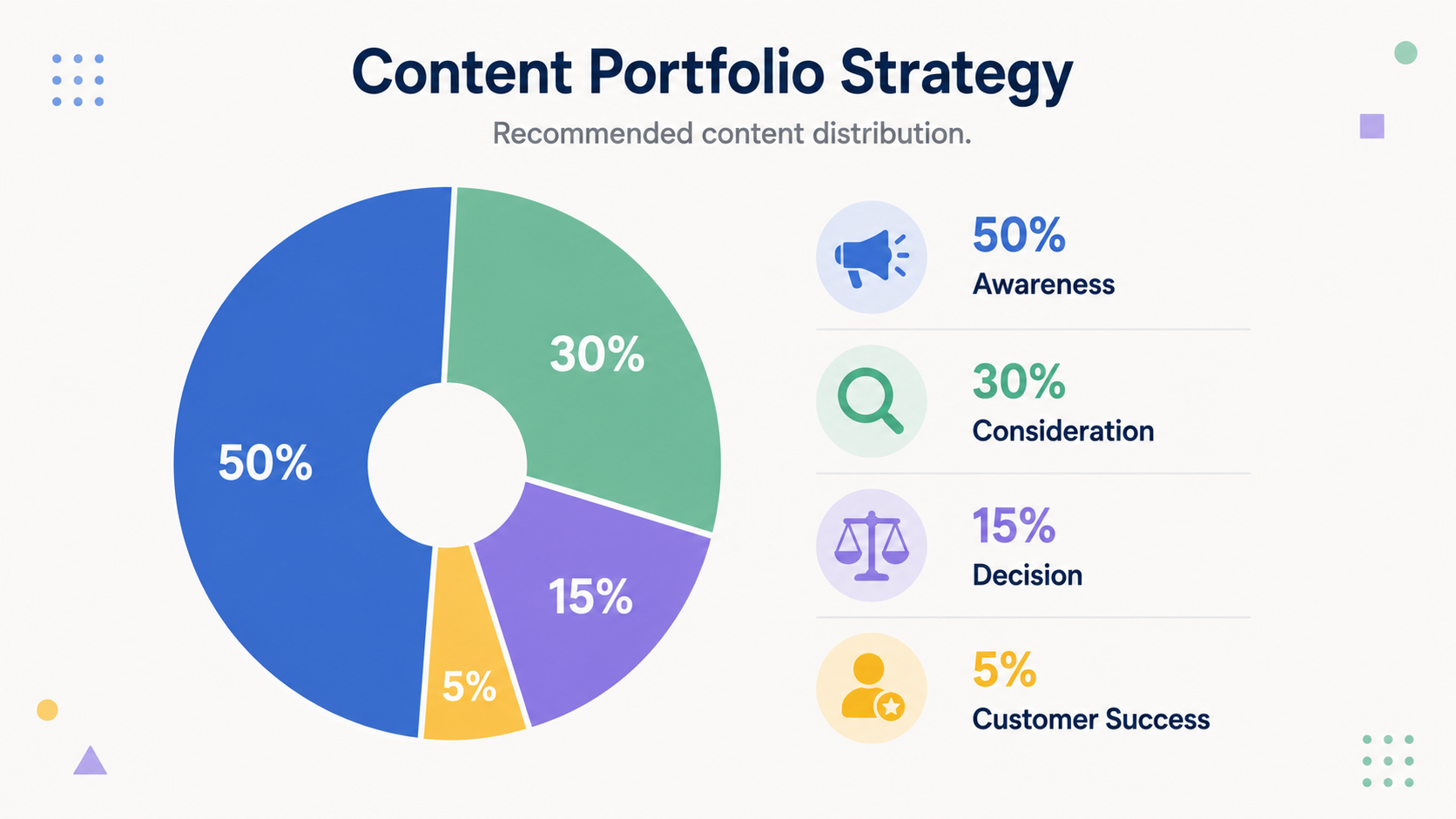
An effective SaaS SEO strategy splits content investment by funnel impact. The usual distribution: 50% awareness-stage content (building audience at scale), 30% consideration-stage content (where most conversions happen), 15% decision-stage content (high intent, lower volume), and 5% post-purchase content (if it applies to your product). That split builds awareness at scale while converting it to leads at steadily higher rates.
This doesn’t mean shrugging off decision-stage content, since those high-intent keywords are gold. It means seeing clearly that volume comes from awareness content while conversion comes from consideration and decision content. You need both working.
Frequently Asked Questions
How long does it take to see organic traffic from SEO for SaaS?
Most SaaS companies see barely any organic traffic in months 1-3. Then around month 4-5, earlier content starts ranking on page 2-3. By month 5-6 you should hit organic traffic inflection points, with pieces climbing onto page 1. Meaningful MQL volume (50+/month) usually shows up month 6-8 if you keep executing. The full compounding effect lands month 9-12, and by then organic can be 20-40% of total MQL volume.
What’s the difference between awareness and consideration content for SaaS SEO?
Awareness content (50% of strategy) chases broad, high-volume keywords like ‘what is project management’ and builds audience at scale. Conversion rates run low (0.5-1%) but volume is high. Consideration content (30% of strategy) targets keywords like ‘best project management tools’ and converts better (5-10%) because prospects are actively evaluating. Decision content (15%) targets ‘project management pricing’ with the highest conversion rates (15-30%) but the lowest volume.
How many articles should I publish monthly for effective SaaS SEO?
Early-stage SaaS: 2-3 articles/month. Growth-stage SaaS: 4-6 articles/month. Mature SaaS: 8-12+ articles/month. Consistency beats volume every time. Publishing 4/month for 12 months beats 20/month for 2 months. Most teams need 1 person per 3 articles monthly. AI tools can double content output per person without doubling the effort.
Which AI SEO tools should SaaS companies use?
For all-in-one solutions: Search Atlas or SEOBrain.IO. For specialized needs: Moz/Ahrefs for keyword research, Surfer SEO for optimization, Google Search Console for free rank tracking. Smaller teams do better with all-in-one platforms. Larger teams prefer best-of-breed tools wired into existing workflows. The point is cutting manual work while holding onto strategic control.
What conversion rate should I expect from organic SaaS traffic?
B2B SaaS with free trials: 3-8% organic-to-MQL conversion. SaaS requiring demo requests: 1-3%. Low-friction signup products: 10-15%. These rates swing by content type. Comparison content converts at 8%, awareness content at 0.5%. Track conversion by content piece to see which topics bring in high-quality leads.
How do I know if my SaaS SEO strategy is working?
Track three metrics. (1) Visibility: keyword rankings for target terms. (2) Traffic: organic sessions trending 50%+ month-over-month early on. (3) Conversions: MQLs from organic traffic and conversion rate by content piece. Build a dashboard that shows all three. Healthy SaaS SEO shows rankings climbing, traffic accelerating, and MQL volume rising through month 6-12.
Should I focus on ranking high or converting visitors?
Both matter, but work them in this order. (1) Rank for high-intent keywords (decision stage) where competitors are fewer and you can actually win. (2) Optimize those pages to convert, with clear CTAs, lead magnets, and value props. (3) Build volume with awareness content. A SaaS company ranking well for low-intent keywords gets traffic and no leads. A company ranking for decision keywords with weak conversion throws away the opportunity. Do both.
How do I calculate ROI for my SaaS SEO program?
Calculate organic CAC: (Total SEO investment/Organic customers acquired quarterly). Compare it to paid CAC. Most SaaS companies find organic CAC runs 50-80% lower than paid by year 2. Track a few more things too: MQL quality from organic (close rate vs. paid), customer LTV from organic sources, and organic as a percentage of total MQL volume. Those numbers are what justify the SEO investment to leadership.
