

What Is E-E-A-T and Why Does It Matter for AI-Generated Content?
E-E-A-T is how Google decides whether your content is credible enough to rank. The acronym breaks into four parts: Expertise (demonstrated knowledge in a subject area), Experience (firsthand understanding or personal involvement), Authoritativeness (recognized authority on the topic), and Trustworthiness (accuracy, transparency, and reliability). Google’s Search Quality Raters Guidelines say it plainly. E-E-A-T sits at the center of ranking decisions, and it matters most for Your Money or Your Life (YMYL) content across healthcare, finance, and legal domains.
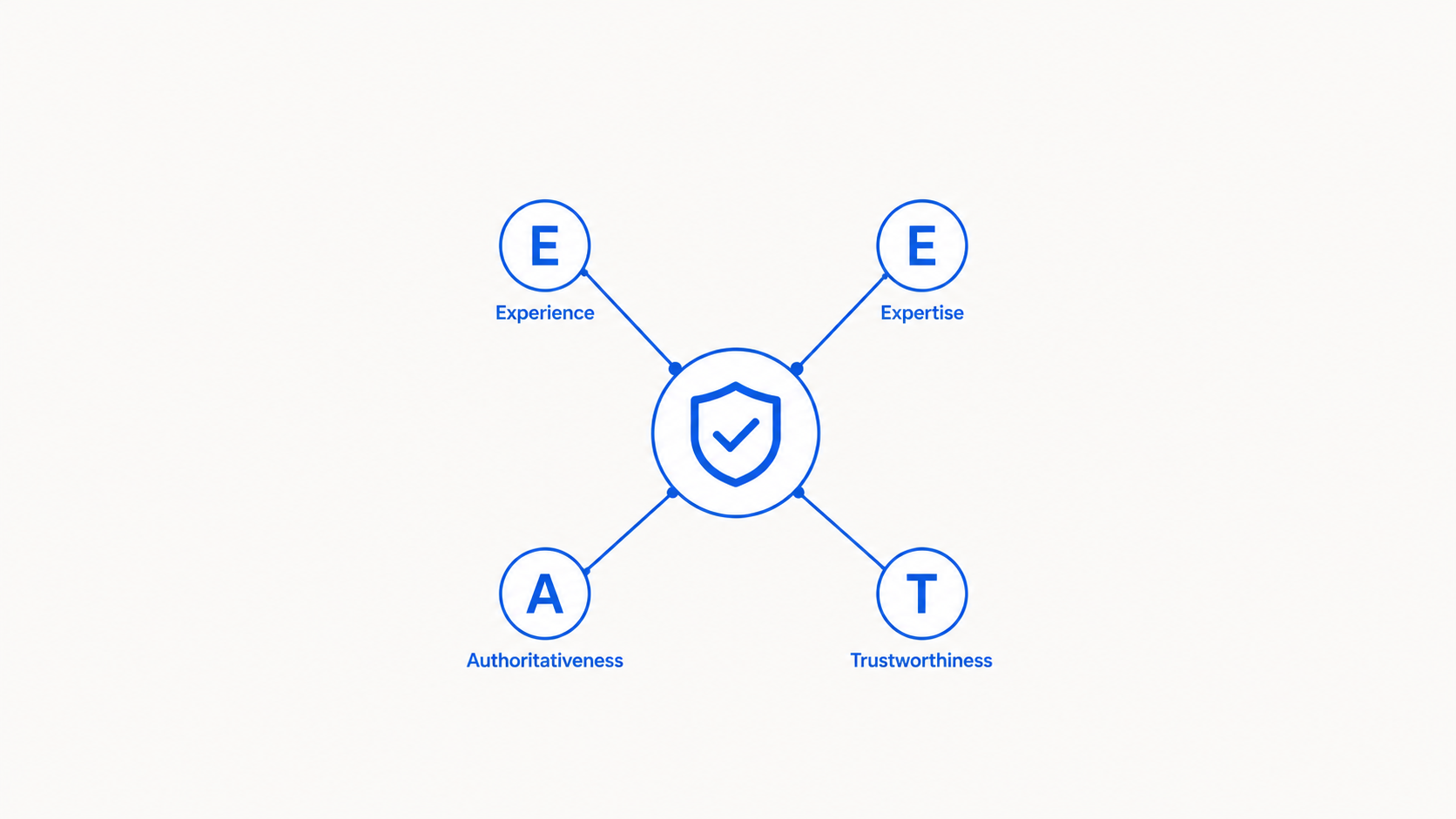
Here’s where AI content runs into a wall. The tools write fast, and the grammar is clean, but they often lack real expertise, can’t point to personal experience, and sometimes produce information that’s flat-out wrong or years out of date. Google Search Central explains that the search engine’s systems weigh whether content genuinely reflects expert knowledge or was simply stitched together from training data. Skip the human oversight and deliberate policies, and AI-generated content fails E-E-A-T checks more often than not.
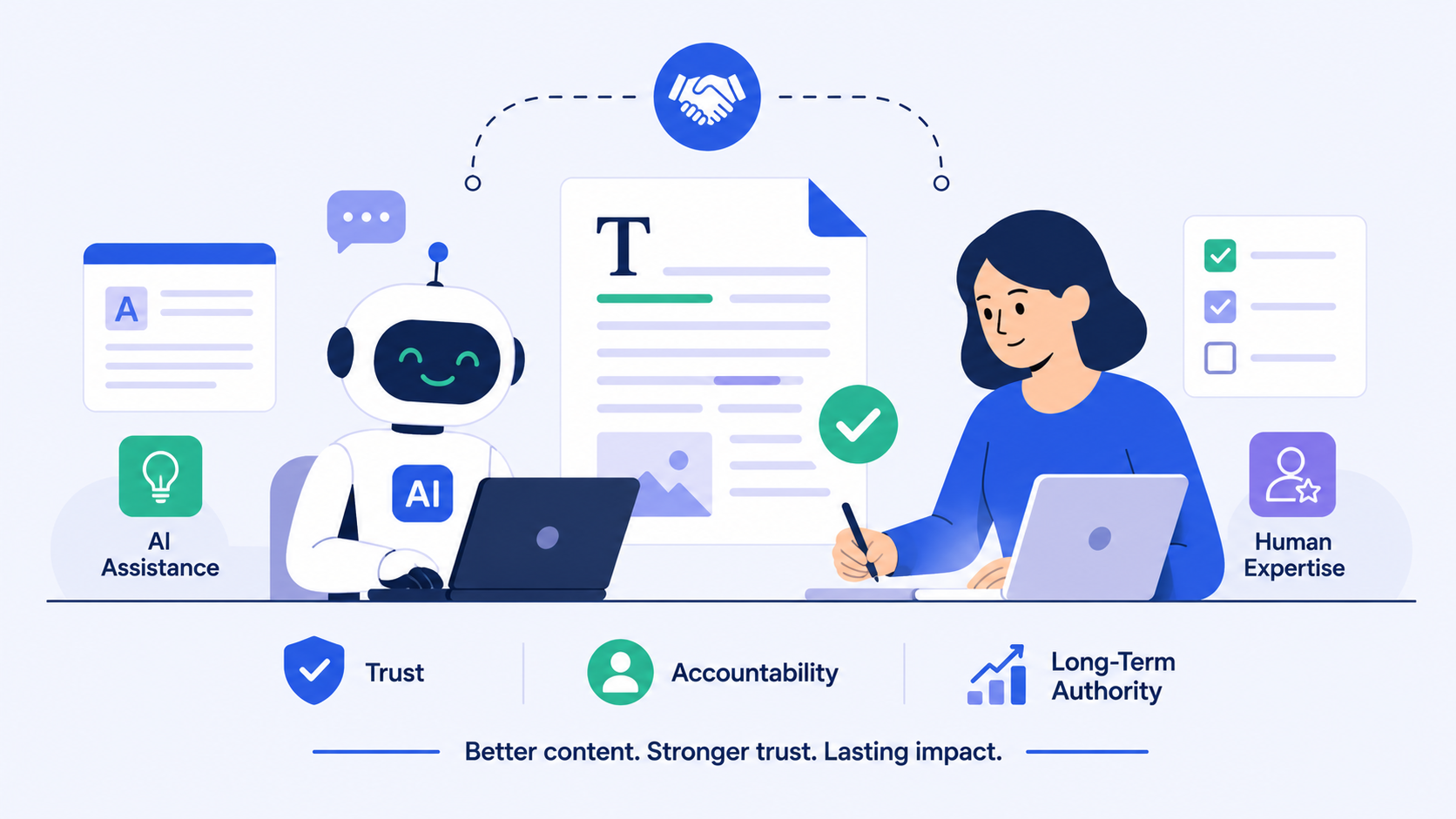
So for teams using AI to scale production, the real question was never whether to use AI. It’s how to do it without torching your credibility. That means workflows that pair AI speed with human expertise, editorial oversight, and data quality controls. Get it right, and human-in-the-loop (HITL) systems let you ship high volume while keeping the authenticity, accuracy, and authority that search engines actually reward.
Why E-E-A-T Matters More in 2026
Google’s attention to E-E-A-T sharpened after the 2023-2024 algorithm updates, which went straight for low-quality, AI-generated content clusters. Sites cranking out undifferentiated AI content at scale watched their rankings fall. The sites that paired AI automation with genuine human expertise, original research, and transparent authorship? They held steady or climbed. Read the trend for what it is. E-E-A-T compliance stopped being optional and became the floor you build SEO on when AI is in the mix.
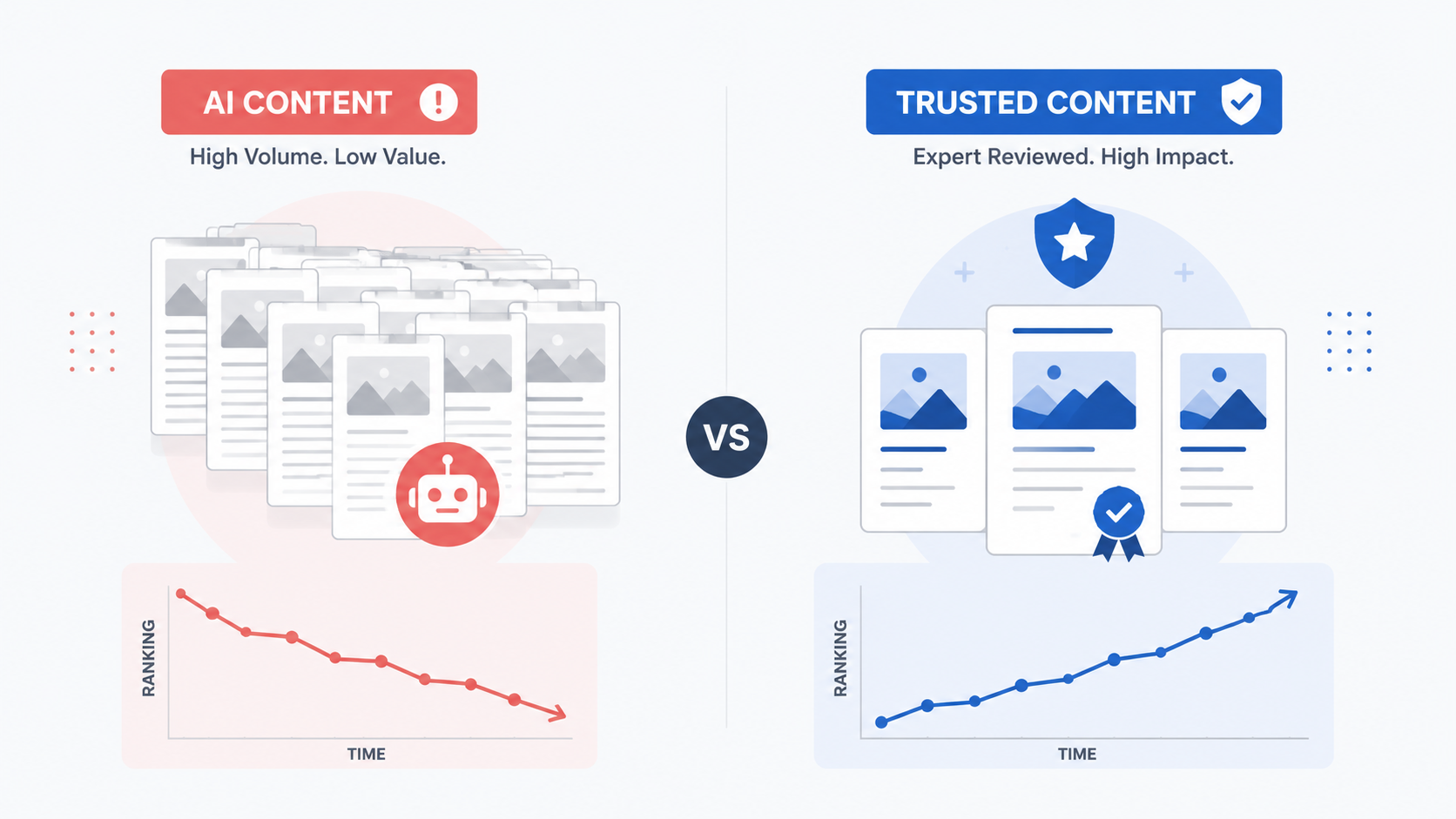
Picture the math. Publish 50 articles a month with no real fact-checking or expert review, and you’re not just burning hours on content that won’t rank. You’re actively eroding your domain authority. Every thin piece tells Google your site has no genuine expertise behind it. Now flip it. Ten articles a month, each one held to real E-E-A-T standards, and you start stacking trust signals that build on each other. Quality wins. E-E-A-T is simply the yardstick Google uses to measure it.
How Do You Structure a Human-in-the-Loop Content Workflow?
Human-in-the-loop (HITL) systems put human decisions inside automated processes at the moments that count. AI isn’t the replacement for human oversight here. It’s the productivity tool that humans steer, review, and correct. That framing is what keeps expertise, accuracy, and brand voice under human control instead of letting them drift.
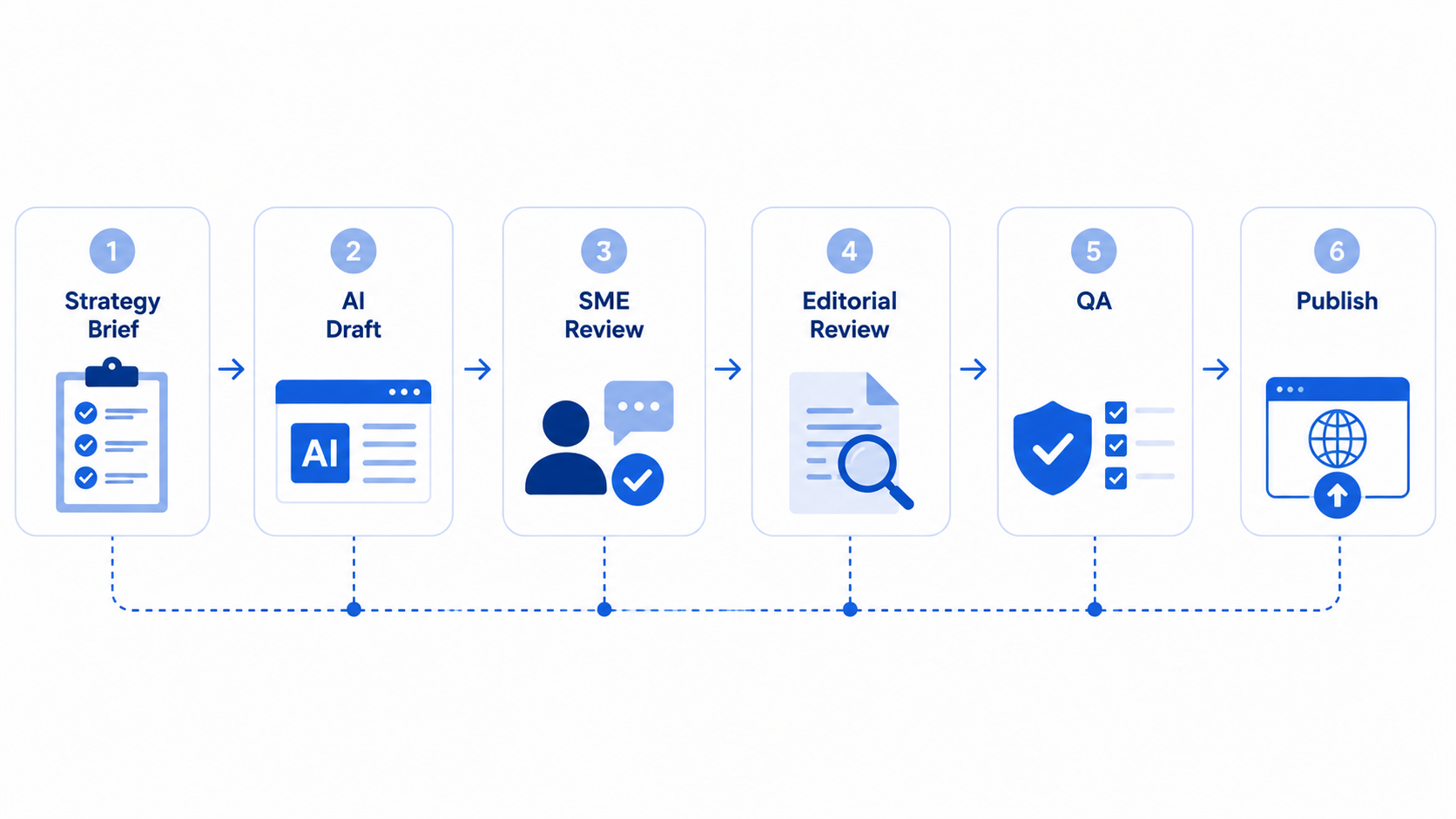
A basic HITL workflow for AI-generated content runs through five stages, and together they build accountability while holding the line on quality:
- Brief and Strategy Phase: A human expert sets the angle, names the target audience, calls out required sources or expertise, and spells out the E-E-A-T requirements specific to the topic. Do this well and the strategy reflects genuine knowledge aimed at real user needs, not just a list of keyword targets. Skip the strong brief and AI hands you something plausible but shallow, the kind of draft that reads fine and demonstrates nothing.
- AI Content Generation: The AI tool produces a first draft from the brief, the guidelines, and whatever source material you fed it. This stage delivers the foundational structure and synthesis. How good it is depends entirely on how clear and complete that brief was.
- Expert Review and Fact-Checking: A subject matter expert (SME) or seasoned editor goes through the AI draft for accuracy, completeness, and whether it actually shows expertise. Inaccuracies get caught and corrected right here. An SME spots the claims that sound right but aren’t, which generic QA will never catch.
- Brand Voice and Authorship Refinement: The content gets revised to match your organization’s voice and tone, and author bylines or credentials go in to establish authoritativeness. AI prose tends to land somewhere neutral and corporate. Pulling the tone toward your distinct voice signals expertise and earns reader trust.
- Final QA and Publishing: A last quality check confirms every edit, verifies links and citations, and clears E-E-A-T compliance before anything goes live. This is your final gate.
Five stages, and the whole point is to kill the “publish and hope” habit. Human expertise sits at multiple checkpoints, so AI speed never comes at the cost of credibility.
Assigning Roles and Responsibilities
HITL workflows fall apart without clear roles. At minimum, assign:
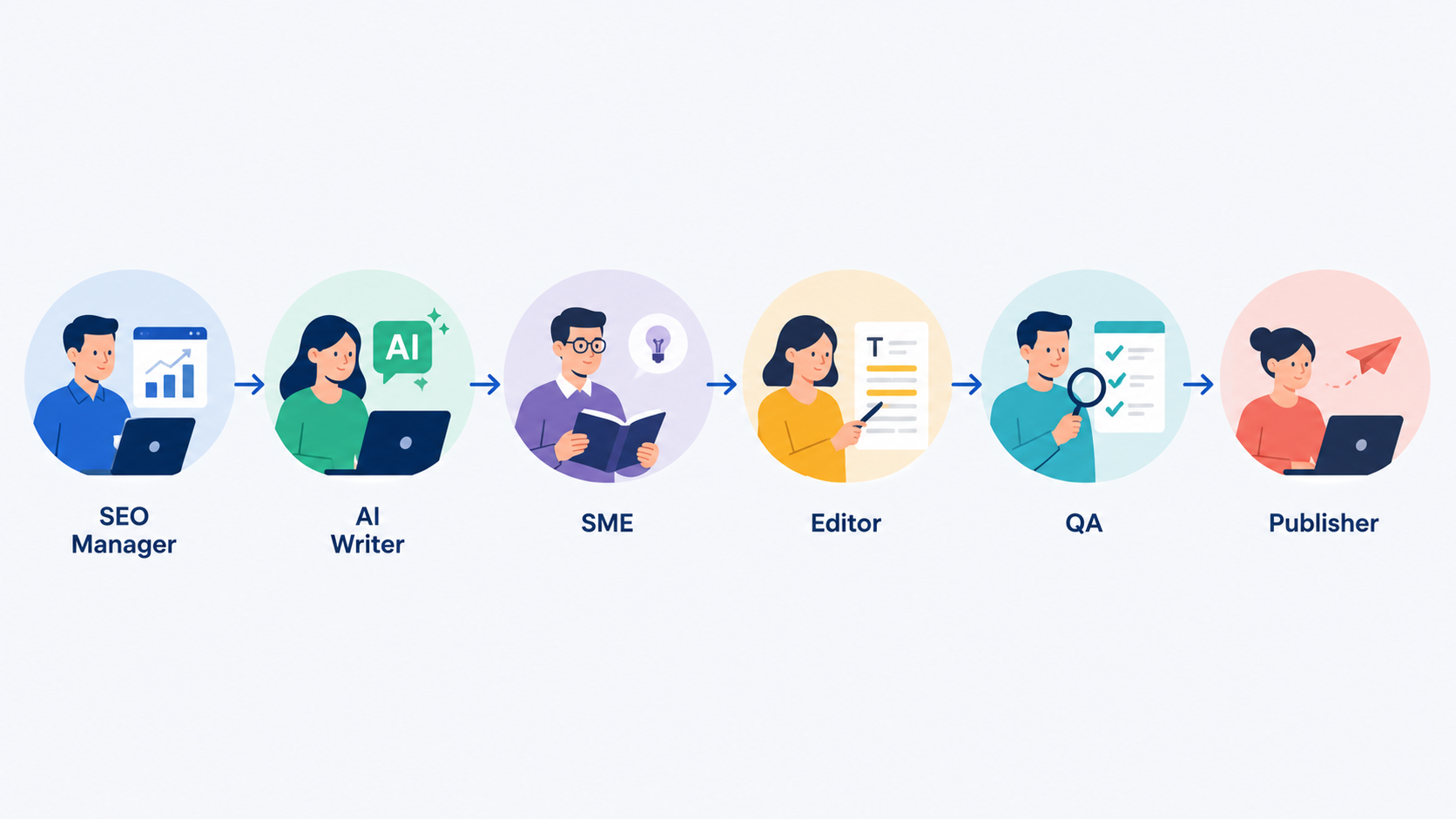
- Strategy Lead (usually a senior marketer or SEO manager) who sets content direction and E-E-A-T expectations. This person owns the brief and makes sure keyword targeting lines up with genuine expertise.
- Subject Matter Expert (SME) or domain expert who validates accuracy and demonstrates expertise. On technical content, this is often your highest-value team member. Don’t skip this role.
- Editor who sharpens tone, structure, and brand voice. A good editor turns generic AI prose into something that reads like your organization wrote it.
- QA Lead who runs the final compliance checks. Nothing substandard reaches publication on their watch.
Smaller teams can hand one person several of these hats. Even then, write down who owns what. This is where most teams go wrong. Leave expectations fuzzy and the critical steps quietly get skipped. Document responsibilities before you generate a single AI draft.
A responsibility matrix helps: a simple table mapping team members to workflow stages. Ownership changes behavior. Name a specific person for fact-checking and inaccuracies drop hard compared to the vague “someone should check this” that catches nothing.
What Are the Core Elements of an E-E-A-T Editorial QA Checklist?
An editorial QA checklist turns E-E-A-T from an idea into a set of concrete questions and validation steps every AI-generated piece clears before it publishes. It’s a control mechanism. Consistency goes up, and low-quality content stops reaching your audience.
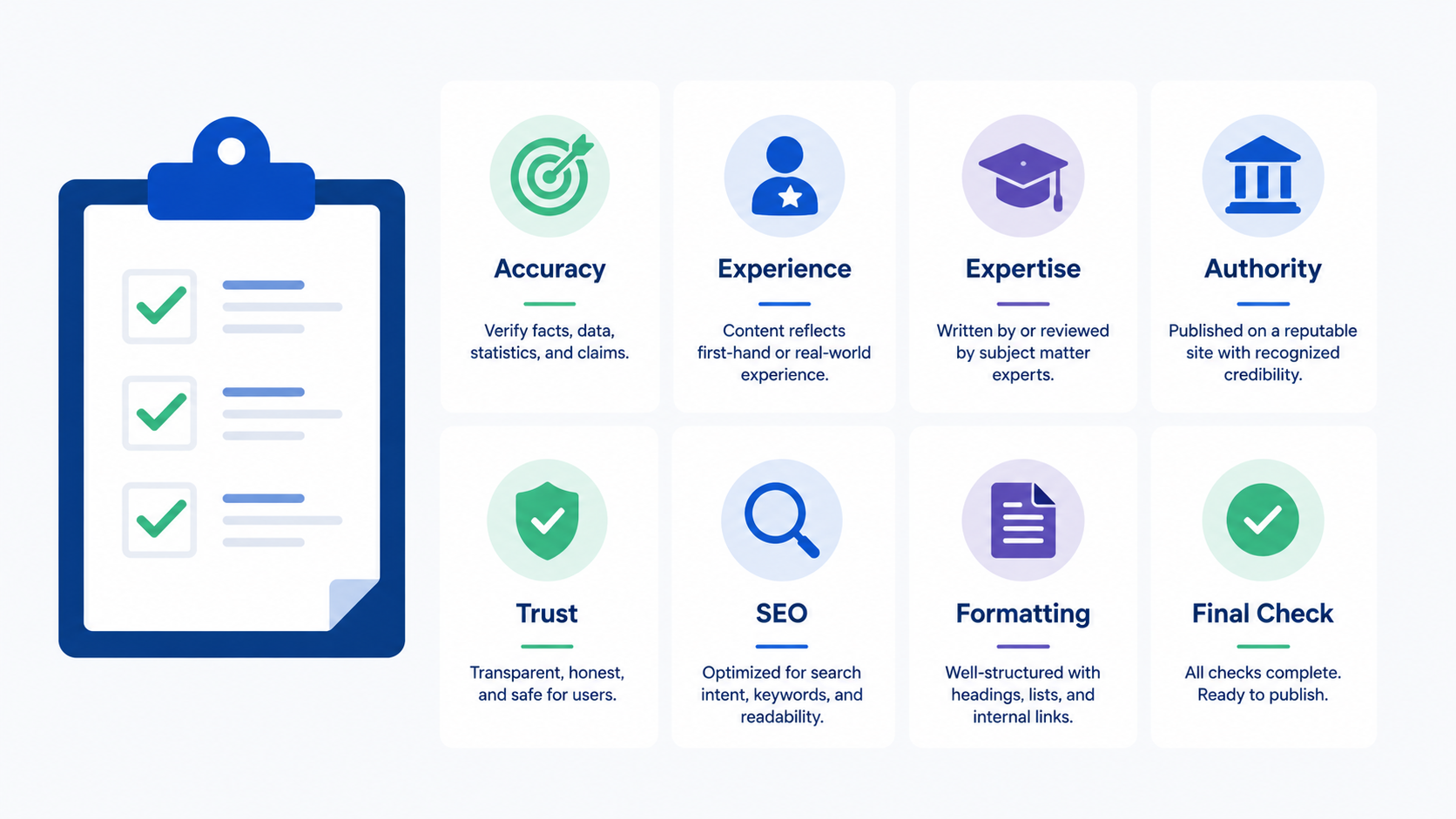
A solid E-E-A-T editorial QA checklist carries a section for each pillar:
Expertise Section
- Does the content demonstrate deep knowledge of the subject, or is it surface-level summary?
- Are technical terms used correctly and defined appropriately for the audience?
- Does the content reflect current industry standards and best practices?
- Are any claims or methodology statements supported by evidence?
- If the content makes recommendations, are they justified by the writer’s expertise or referenced to authoritative sources?
Expertise comes down to depth. Shallow content can sound authoritative and still teach a reader nothing they couldn’t pull from a dictionary. So your reviews need to ask one blunt question: would an expert in this field get value from this article, or would they spot the gaps and the oversimplifications on the first read?
Experience Section
- Does the content include relevant examples, case studies, or real-world applications that demonstrate practical understanding?
- Are there indications of firsthand knowledge or direct involvement rather than secondhand synthesis?
- Does the author have demonstrated experience in this field, and is it credible to the audience?
- Are personal insights or lessons learned included where relevant?
- For how-to content: does it reflect practical implementation experience, or does it read like a theoretical exercise?
Experience is what separates your piece from every other article recycling the same facts. A line like “I tested this” or “In working with 50+ clients, we found…” carries an authority that no amount of generic synthesis ever will. Readers feel the difference immediately.
Authoritativeness Section
- Is the author clearly identified with credentials or relevant background linked to their expertise?
- Are external sources cited from authoritative domains (Google, industry-specific leaders, peer-reviewed research)?
- Does the organization have recognized authority in this topic area, or is it an adjacent area?
- Are citations recent and from reputable sources, or are you referencing outdated research?
- Does the content link to your own authoritative resources or established expertise, creating a web of authority?
Authority stacks up over time. Each citation to a credible source adds a little. Each link back to your own strong content adds more. And when the authoritative sources just aren’t there, both readers and search engines read the piece as opinion rather than expertise.
Trustworthiness Section
- Is all information factually accurate? (Spot-check 5-10 key claims from authoritative sources)
- Are there outdated statistics or references that need updating?
- Are limitations or caveats acknowledged where appropriate, or does the content make overstated claims?
- Is the author transparent about potential biases or conflicts of interest?
- Are all external links active and relevant to the claims made?
- Does the content avoid exaggerated claims or unsupported promises?
Trust usually comes down to being honest about the edges of what you know. An article that admits “this approach works well for X but has limitations in Y scenarios” earns more of it than one selling a universal fix.
Implementation Best Practice
Build this checklist as a digital form (Google Form, Asana, or similar) that reviewers fill out before they approve anything. Require a “Yes” on every critical item before publishing. When a piece fails specific criteria, route it back through a revision workflow to the right person, SME for accuracy problems, editor for trust signals, instead of shipping it anyway. E-E-A-T compliance is not a negotiation. A piece that fails review gets fixed or it stays unpublished.
How Should You Establish Author Credentials and Brand Authority Policies?
Demonstrable authorship tied to clear credentials is one of the strongest E-E-A-T signals you have. When readers and search engines can see who wrote something and confirm that person knows the subject, trust climbs. AI content muddies this. If a tool wrote the draft, who gets the byline: the human who directed it, the organization, or a disclosure that AI was involved?
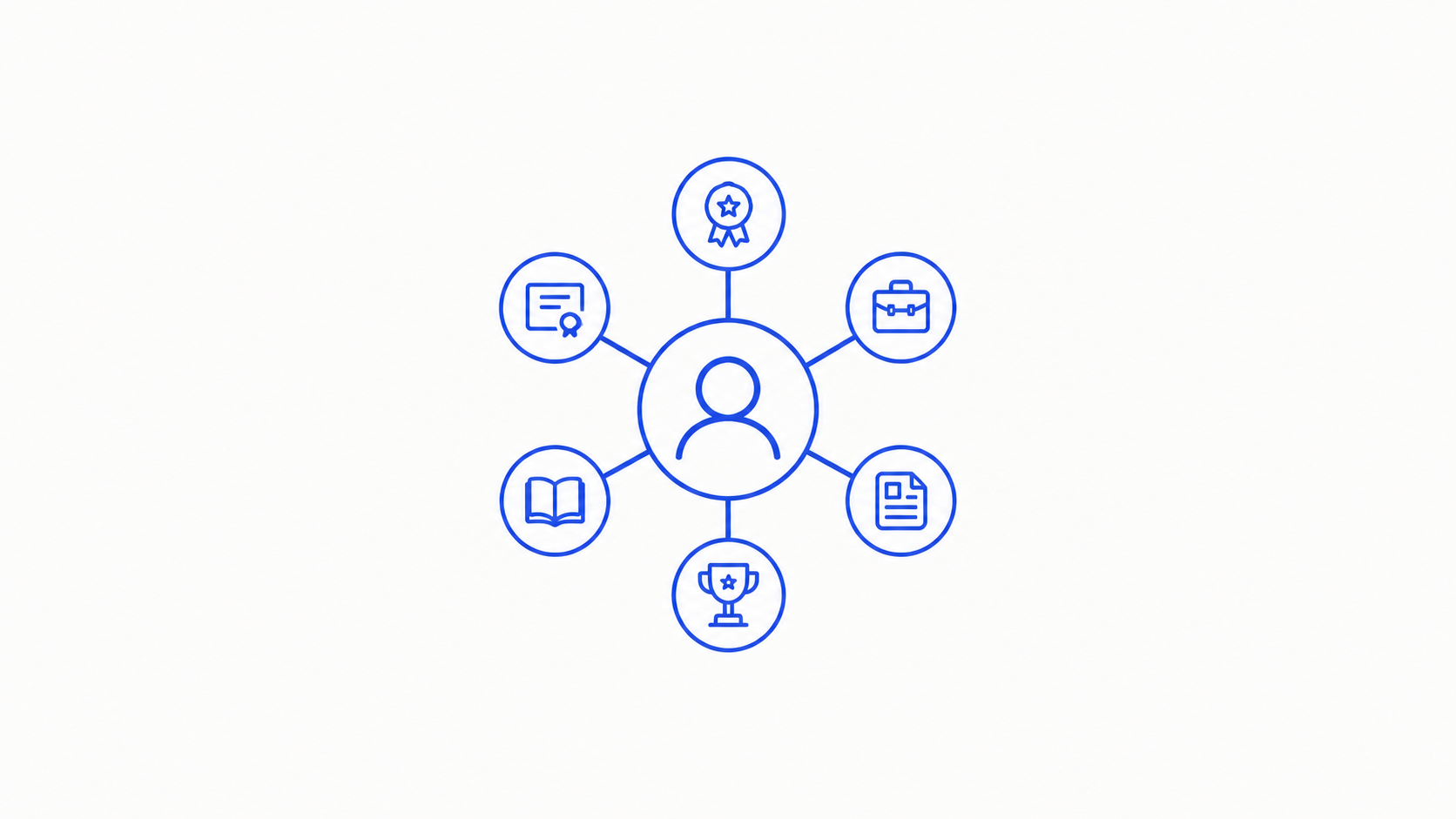
Google’s guidance on AI-generated content (per Google Search Central documentation) doesn’t ban AI. It insists that authorship reflect real human expertise and real accountability. Your author credentials policy needs to cover several dimensions:
Transparency Disclosure
Decide how, and whether, you’ll disclose AI involvement. Some organizations add a note along the lines of “This article was researched and fact-checked by [Human Expert], with AI-assisted writing.” Others put the human expert front and center and leave AI unmentioned. What matters is that the byline points to a real person with verifiable expertise who owns the accuracy and completeness. That’s what holds trust in place while you still get AI’s efficiency.
Research from Pew Research Center suggests transparency about AI use holds reader trust when it’s paired with clear authorship and expertise signals. Your credibility doesn’t take a hit because you used AI. It takes a hit when readers find out you used it and hid that fact. Getting ahead of it beats cleaning up after it.
Author Qualification Requirements
Set minimum credentials for your authors. YMYL content (health, finance, law) might demand professional licenses or advanced degrees. Technical content might call for demonstrated experience in the field. General topics could mean published prior work or time inside the organization. Put these thresholds in a policy template that says clearly which content types need which credential levels.
Think about what a credential signals to your actual readers. A financial planning article bylined to someone with 20+ years in the industry carries weight that the same piece under a junior writer’s name simply won’t. Your credentialing policy should account for that gap.
Author Profile and Bio
Build detailed author profiles with credentials, professional background, and links to relevant work. Then link every article back to that profile. Author authority accrues this way as readers and search engines gather evidence over time. Five published articles on a topic and an author starts looking knowledgeable. Twenty, and they read as a recognized voice.
Multi-Author and Organization Authority
When several people create content, build brand authority by tying all of it back to company expertise, mission, and track record. Different bylines are fine, as long as organizational authority still shows through: about pages, certifications, client testimonials, and a consistent thread of company experience. You end up with layered authority, individual expertise and organizational credibility both feeding E-E-A-T.
Plenty of organizations treat author credibility and organizational credibility as two separate things. They’re one system. Every article your experts publish reinforces your organization’s standing in that domain, and it compounds. Publish 50 articles on data analytics from your data team, and the organization itself becomes known as authoritative on data analytics.
How Do You Create a Fact-Checking and Revision Workflow for AI Content?
Fact-checking is the point where E-E-A-T either holds or collapses. AI content tends to carry subtle inaccuracies, stale statistics, and claims that sound reasonable while being wrong. A structured fact-checking workflow catches those before they publish and keeps your credibility intact. Skip it and you’re shipping unverified content at scale, which is exactly how domains get penalized.
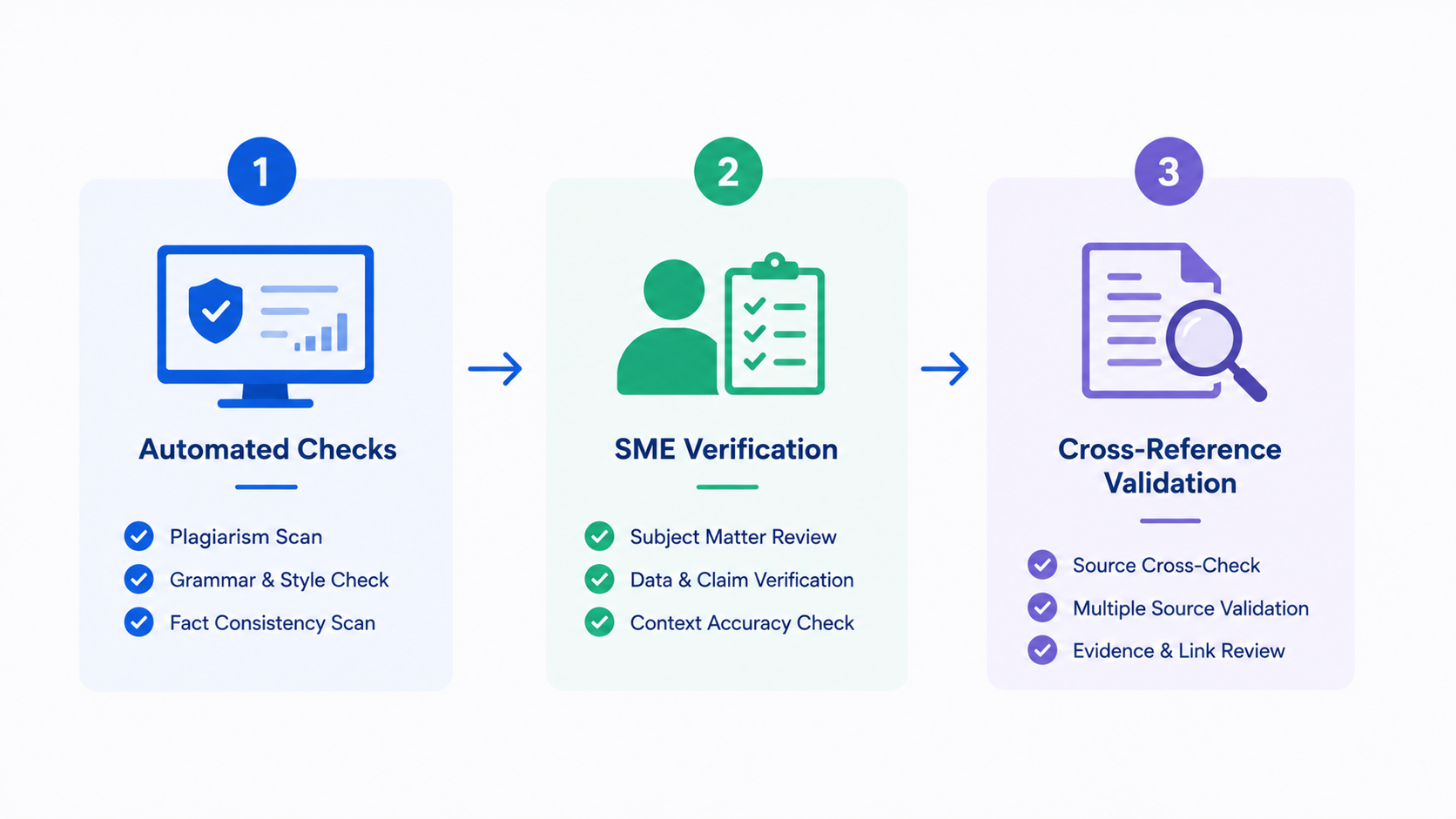
Run a three-tier process, because different tiers catch different failures:
Tier 1: Automated Checks
Point automated tools at the obvious stuff: broken links (a link checker), stale date references (flag anything citing statistics more than 2 years old), and plagiarism (Copyscape or similar). It’s fast, and it clears mechanical errors before a human reviewer ever sees the draft. Treat this tier as the baseline gate that runs on every single article.
Tier 2: SME Review
A subject matter expert reads the draft for factual accuracy, sound methodology, and completeness, checking key claims against their own knowledge and authoritative sources. On content in your wheelhouse, this is usually the most valuable review you run. Give the SME a fact-checking template that walks them through verifying 5-10 key claims per article. It should capture four things: the claim as written, the source the article cites, what the SME actually knows about that claim from their expertise or references, and whether it passes.
Tier 3: Cross-Reference Verification
For high-stakes claims, and YMYL content especially, a second reviewer independently checks key facts against the original sources. This catches what the SME missed and adds rigor. It’s expensive on time, so hold it for your most important content: strategic posts, cornerstone pieces, anything set to drive real traffic.
Categorizing and Handling Issues
When fact-checking surfaces problems, sort them. Technical inaccuracies cover incorrect data, methodology errors, and misquoted sources. Incompleteness means missing context or counterpoints. Currency is information that’s simply out of date. Technical inaccuracies go back to the SME to fix. Incompleteness goes back to the editor for more research and expansion. For currency, you decide whether the article gets an update or an archive.
Revision Workflow Example
Here’s a concrete workflow that keeps weak content from publishing:
- Editor sends AI draft to SME with fact-checking template
- SME completes fact-check, noting any inaccuracies (max 3 business days)
- If inaccuracies found, piece returns to editor for revision research
- Editor revises content based on SME feedback and corrected information
- Revised piece returns to SME for spot-check verification (1 business day)
- If approved, piece moves to final QA. If issues remain, cycle repeats
- Final QA reviewer conducts last-look verification and approves for publishing
This kills the “quick publish” temptation and pins down accuracy before launch. Give it room. Plan on 7-10 days from first draft to publication for a typical article. Rush it and you compromise E-E-A-T, which throws away the effort already sunk into the piece.
Handling Corrections
Have a policy ready for post-publication corrections. Find an inaccuracy after something’s live, update the article right away and add a note: “Updated [date]: This article was corrected to reflect [change].” Owning corrections in public strengthens trust. Readers respect the organization that fixes errors out in the open far more than the one quietly editing articles and hoping nobody noticed.
How Can You Structure SEO Workflows to Protect E-E-A-T While Scaling Content?
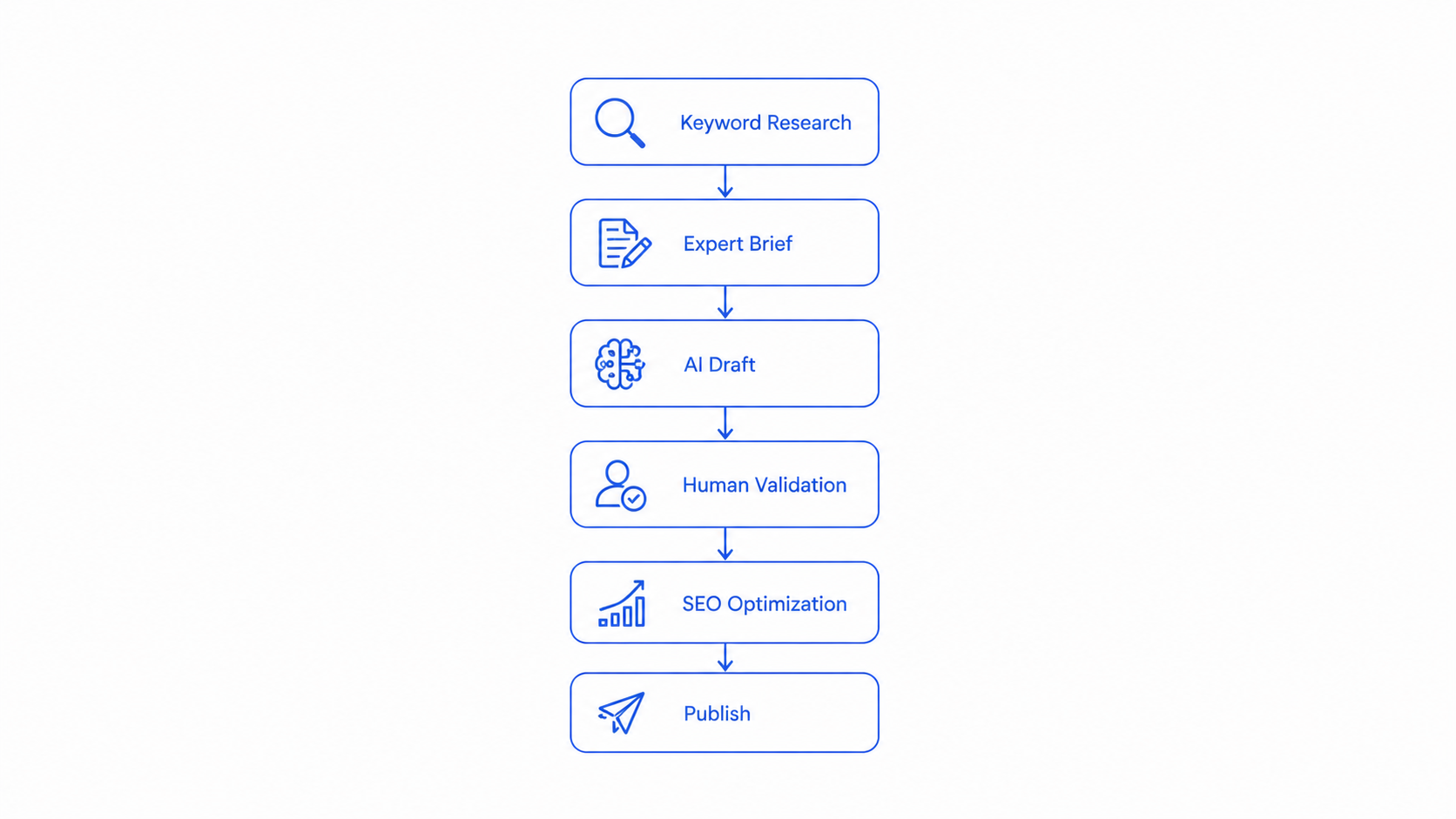
SEO and E-E-A-T can look like they’re pulling in opposite directions. SEO wants high-volume keywords and a fast publishing cadence. E-E-A-T wants depth, accuracy, and real expertise signals. The tension is real, but it isn’t permanent. Design your SEO workflow with E-E-A-T as a hard constraint and the conflict dissolves, because the content ranks for the simple reason that it’s good.
Build the SEO workflow in three phases, with E-E-A-T threaded through all of them:
Phase 1: Keyword Research and Content Planning
Find your target keywords and search intent, then filter them through an E-E-A-T lens. Ask it directly: “Do we have genuine expertise in this topic? Can we demonstrate experience, provide original insights, or cite authoritative sources?” Kill the keywords where you can’t. A software company chasing healthcare keywords it has no standing in violates E-E-A-T, plain and simple. Aim instead at the topics where your organization or team already holds recognized authority.
While planning, tag each article with its expertise requirements. “This article requires SME review from [department].” “This article requires original research/data.” “This requires interviews with customers.” Now the brief reflects E-E-A-T needs from the outset, not just keyword targets. Bake those requirements in at the start and the whole workflow points toward compliance instead of bolting it on at the end.
Phase 2: AI-Assisted Draft with Expert Input
Hand the AI tool a detailed brief: keyword target, search intent, required sources or expertise, author credential level, and explicit E-E-A-T requirements (“This article must include at least 3 case studies” or “This article must cite original research”). The tighter the brief, the stronger the draft, and the less revision you’ll owe it later. “Write an article about X” gets you nothing. “Write an article about X for C-level executives, including at least 2 case studies demonstrating ROI, authored by [expert], fact-checked against [sources]” gets you a draft worth editing.
Get expert input before generation, not after. Initial research, an outline, or a few key points anchor the content to real expertise instead of generic AI synthesis. A five-minute session with the expert to supply direction and sources lifts the AI output more than any prompt trick.
Phase 3: Review, Verification, and Compliance Check
Run the editorial QA checklist, the fact-checking workflow, and brand voice verification from the earlier sections. Only content that clears every E-E-A-T criterion publishes. Not a negotiation. Fail the review and the piece waits until it’s revised.
Balancing Scale and Quality
Teams worry this structure will slow their publishing velocity. It usually does the opposite. Better briefs produce better AI drafts, which need less revision. Solid fact-checking heads off the costly corrections and ranking penalties that hit later. And consistent E-E-A-T compliance means your content ranks higher and holds those rankings longer, which lifts your ROI per article.
If scale is the real goal, scale by hiring, more SMEs and editors, not by pulling out your quality controls. One well-reviewed article that ranks and pulls sustained traffic beats ten unreviewed ones that never rank or get penalized down the line. Spend the time on quality.

How Do You Train Teams to Execute E-E-A-T Workflows Consistently?
The best workflow on paper still fails if the team doesn’t grasp the reasoning behind it or how to run it. Consistent E-E-A-T compliance means everyone, SMEs, editors, QA reviewers alike, knows why these steps matter and how to execute them. Training isn’t a nice-to-have. It’s the line between a workflow that exists in a doc and one that actually runs.
E-E-A-T Principles Training
Open with a one-hour session on what E-E-A-T is, why Google prioritizes it, and how it moves rankings. Pull examples of high E-E-A-T content next to low E-E-A-T content from your industry. Then show your own content, good and bad, and say why each landed where it did. That builds the shared understanding that E-E-A-T isn’t bureaucracy. It’s SEO fundamentals. Once the team connects E-E-A-T to ranking performance, compliance stops feeling optional.
Role-Specific Training
Train each role for what it actually does:
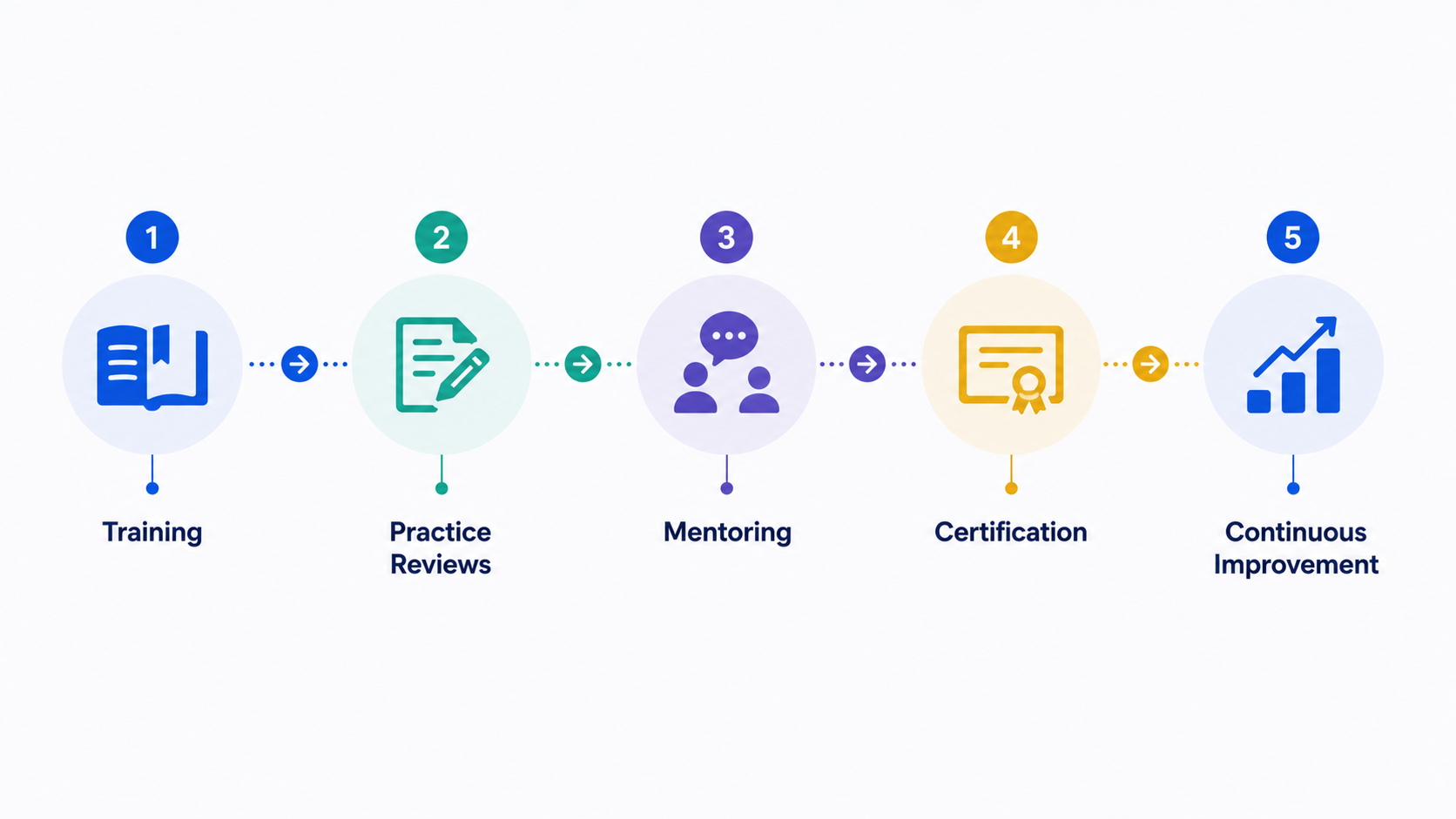
- For SMEs: Train on fact-checking standards and how to spot AI inaccuracies. Walk through common types of AI errors (hallucinated citations, slightly wrong statistics, oversimplified explanations) and teach them to recognize these patterns.
- For editors: Train on brand voice compliance and the editorial QA checklist. Have them practice identifying off-brand phrasing in sample articles.
- For QA reviewers: Train on using the checklist and determining what requires revision versus what’s ready to publish. Show them examples of articles that should have failed review but didn’t.
- For strategy leads: Train on brief-writing and expertise assessment. Teach them how to identify keywords where your organization genuinely has expertise.
Tool and Process Training
Walk the team through the workflow tools, forms, and templates directly. Show them how to fill out the editorial QA form, where to find the source approval list, and how to review and approve work inside your system. People don’t reliably figure tools out on their own. Hands-on training prevents mistakes and builds confidence faster than a written guide ever will.
Case Study Review
Pull up published articles that passed E-E-A-T review and ask the team a single question: “What makes this article high E-E-A-T?” Then bring up ones that failed and talk through what got caught and why it mattered. Concrete beats abstract here every time. Real examples from your own content library land harder than any generic training deck.
Ongoing Communication
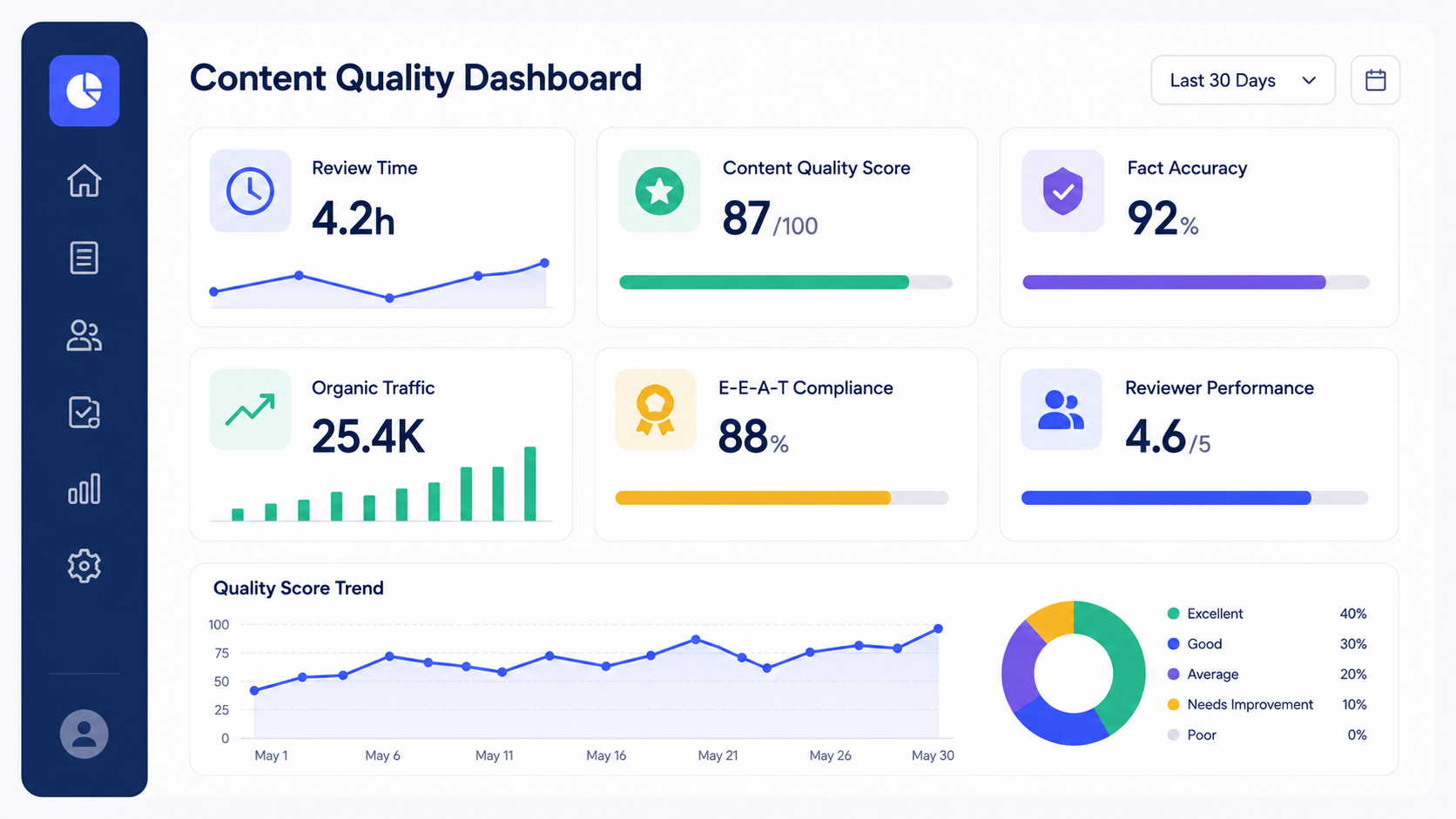
Run monthly 15-minute team syncs on quality metrics, recent issues, and workflow tweaks. Share the numbers from your quality dashboard. Call out the articles that nail E-E-A-T. This keeps it present instead of letting it fade into a forgotten checklist. Make E-E-A-T a regular conversation and it turns into culture rather than a rule people resent.
Documentation and Resource Library
Stand up an internal hub (a wiki, a knowledge base, or a shared drive) where every template, guideline, and training material lives. Include the Brand Voice Guide, source approval list, E-E-A-T QA checklist, brief template, fact-checking template, and training recordings. Keep it accessible so people can find answers without pinging someone. A good hub becomes the first place the team looks when a process question comes up.
Document your decisions too. When the team debates whether a piece needs SME review or how to handle a specific accuracy issue, write down the call and the reasoning. That gives future decisions a reference point and trims inconsistency. Institutional knowledge builds this way, and over time the decisions get both more consistent and faster to make.
